The La Plata Observatory turns 127 years old. On Saturday I was there to tour the century-old facilities.
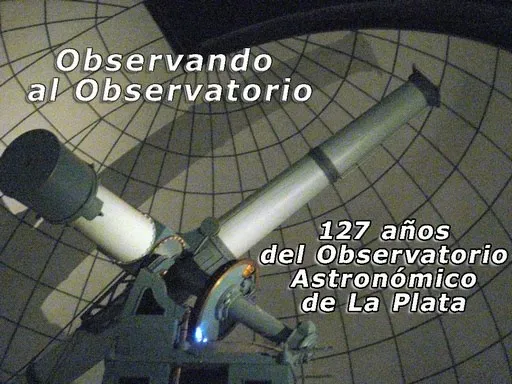
That I visited the Astronomical Observatory of the University of La Plata (UNLP) on Saturday, November 20 (National Sovereignty Day) was a coincidence. The visit was planned as part of the course Discover, Observe and Enjoy the Sky held at the Buenos Aires Planetarium, led by Diego Hernández.
A bit of history
Four decades after Rosas resisted the Anglo-French forces at La Vuelta de Obligado, the French sailor François Beuf ordered instruments from the Gautier house in France.
Dr. Dardo Rocha spearheaded the creation of the city of La Plata (the city's 128th anniversary was celebrated on November 19) and one year later, on November 22, 1883, Beuf was appointed director of the building construction.
There are other important prior dates: on May 7, 1881, the decree that included the creation of the observatory was issued, and on October 18, 1882, Law 1579 was enacted, authorizing the necessary investment for its construction.
A few days ago, regarding the death of Allan Sandage, I wrote that a page of world astronomy history had passed. But an even richer history is still standing in the city of diagonals.
The visit
We met at the Planetarium at 16:30 and an hour later we left by bus heading to the provincial capital. The Observatory tour was scheduled for 20:00 and since we arrived at 18:40 we had to kill time.
The Museum of Natural Sciences was closed, but that wasn't going to stop me from wanting to photograph the saber-toothed cats. Afterwards, I went to the lake and the wonderful square with its nooks and waterfall.
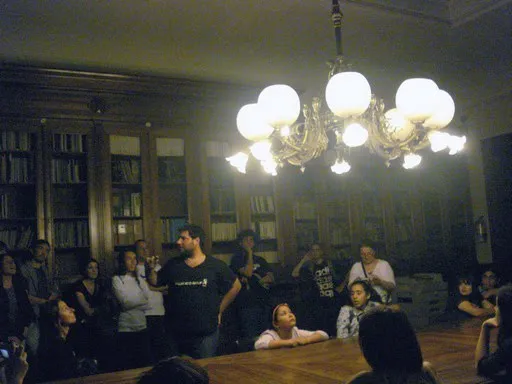
Finally, a few minutes after 20:00, Nicolás Salerno arrived, an astronomy student and guide for the visit. He led us to the beautiful library with the huge table in the middle and the central chandelier, originally gas-powered.
The large table in the middle of the library was used for cartography. Dardo Rocha had requested establishing the coordinates of 50 locations in the province with a view to creating a geographic map. This was later repeated by Governor D'Amico. In 1886, another decree assigned the observatory the task of establishing the provincial meteorological service.
Then, on the way to the Gautier, he pointed out the Virpi Niemela Telescope (used to study Eta Carina) and the Zeiss comet seeker.
Next, we entered the Great Equatorial building, preceded by a museum-room displaying heritage instruments.
A virtual visit to these facilities is possible through the Museum of Astronomy and Geophysics.
The Great Equatorial
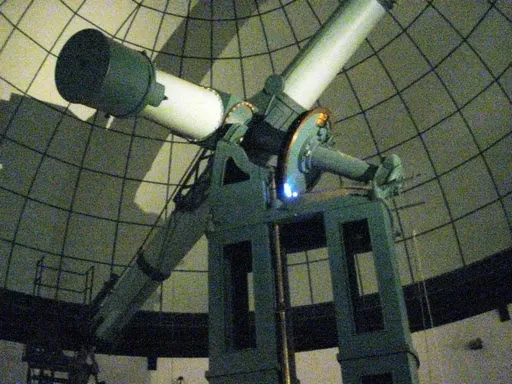
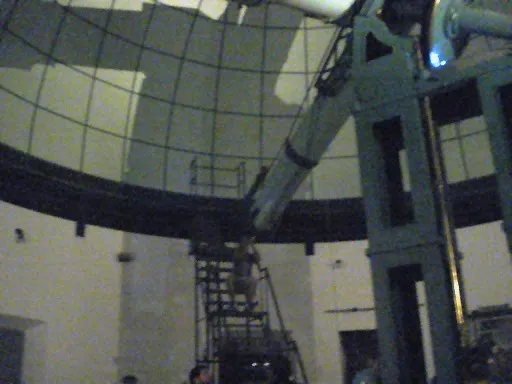
After climbing the spiral staircase, we were able to observe the great instrument.
Its diameter, one inch more than initially specified, is 433 millimeters, and its focal length is 9.6 meters.
What differences there are between the instruments amateurs commonly use, with their GoTo mounts, and this beautiful installation with its clockwork mechanism!
The entire system is placed in an iron and bronze tube assembled in parts and supported by a counterweight system on a mount that weighs about 3,000 kg in total.
I believe I recall it being said during the visit that the parts were brought by ship to Buenos Aires and from there by cart to La Plata.
The tube consists of a central cast iron piece attached to the head of the declination axis; four sections of rolled steel, two of which go below and two above the midpoint of the central piece; the piece where the lens mount and the sliding tube go.
Equatorial Mount: The base is formed by large cast pieces strongly fastened by means of screws. On one of them that forms the base, two hollow rectangular columns are placed, joined at their top by a heavy cast piece that connects the columns and holds the bearings of the polar axis.
The support point of the tube is in its middle, holding all the weight there by the base and the counterweight, so moving the tube is as simple as a seesaw.
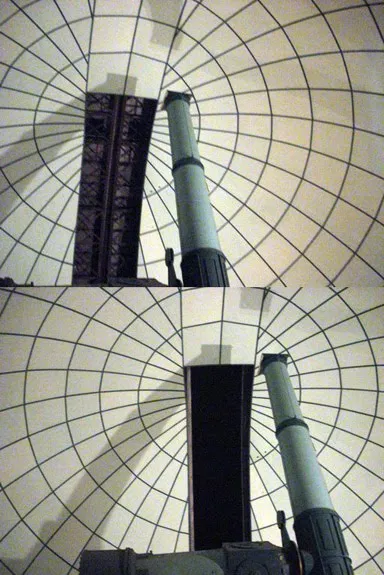
The instrument is protected by an iron dome 15 meters in diameter and almost 23 meters high. It has a 360º rotation mechanism with an electric motor.
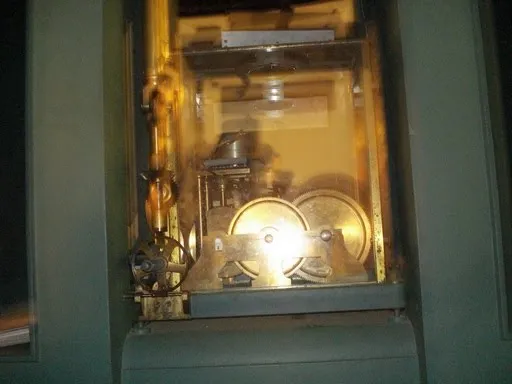
The clockwork apparatus is installed in the central part of the pillar, in a glass case that protects it from dust.
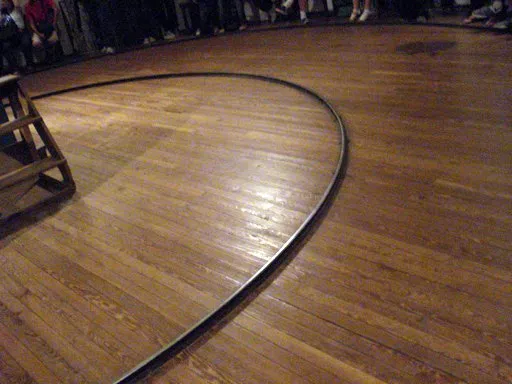
Ladder chair: The eyepiece of the instrument can be at a great height relative to the floor, even when the telescope is pointed towards the zenith. That is why there is a ladder-chair, made of reinforced iron, mounted on flanged wheels that allow it to be moved on the circular tracks around the telescope.
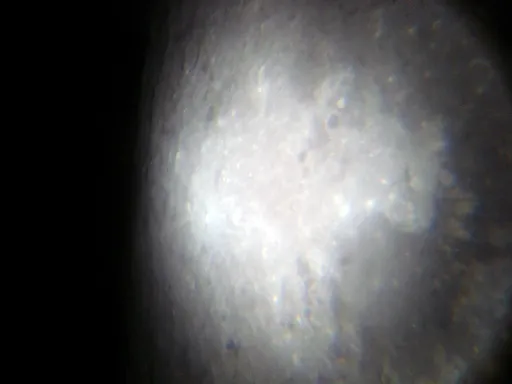
After admiring this century-old mechanical beauty, Nicolás warmly invited us to observe Jupiter and its Galilean moons, the almost full Moon (a sector since the magnification did not allow a full view) and, finally, M42, the Orion Nebula. He also kindly took photographs of the Moon through the eyepiece with the digital cameras several of us had brought.
The obligatory return
Later than planned, but happier, we left near the change of day heading back to the Planetarium.
Already at home, I couldn't stop thinking that the creation of the Observatory and the installation of its instruments were possible thanks to a vision of the country linked to development and research.
This Great Equatorial, like the instruments in Córdoba and San Juan, have seen stars, planets, and other cosmic objects. But they have also witnessed the ups and downs of scientific policies over the years.
On Saturday, however, the observed was the observatory. Just as looking at the cosmos is, in a way, looking at the past (due to the constant speed of light), so was touring these historic facilities that have borne so much fruit.
Looking at the past with this admiration is also observing the future with expectations of recovering that vision of the country, in search of our astronomical sovereignty.
Sources and related links
- History of the FCAyG UNLP
- Museum of Astronomy and Geophysics
- Telescopio Gran Ecuatorial Gautier, by Luis Martorelli
- Historia de la astronomía argentina, AAABS No. 2, edited by Gustavo E. Romero, Sergio A. Cellone and Sofía A. Cora, AAA.
About the images
- Images captured by me during the visit. More on Flickr.