A selection of multimedia files where art and science intersect.
Today: Ultraviolet Galaxies by Hubble; The Pink Panther and the astronomer; and music for looking at the sky, by Jaime Heras.
A decade ago
To study distant galaxies, they turn to the closest ones, observing them in ultraviolet wavelengths. This is because the light from distant galaxies travels so many light-years that the light "stretches," arriving as longer, infrared waves, which instruments capture with less sensitivity. But the regions where there are hot and young stars are visible because although they emit in ultraviolet, when that light reaches Earth it is seen in optical wavelengths.
That's why astronomers studied 37 nearby galaxies in ultraviolet to compare their shapes with those much more distant.
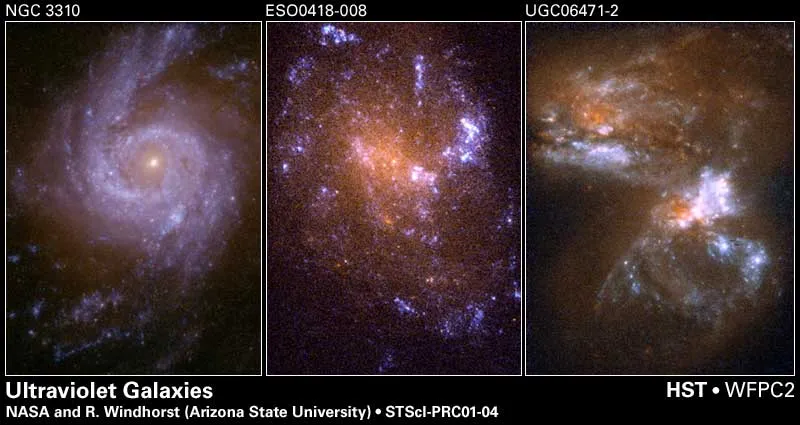
The three images above, taken by the Hubble Space Telescope, are a sample of that survey.
The results of that study were presented at the 197th meeting of the AAS. This was a decade ago, since the triple photograph was published on January 11, 2001. This year, as usual, American astronomers gathered again at the 217th meeting.
The image on the left is the central region of NGC 3310 at 46 million light-years away.
The image in the center is a young dwarf spiral, ESO 418-008 at 56 million light-years.
The collision of UGC 06471 and UGC 06472 is shown in the image on the right, at 145 million light-years.
Credits: NASA, Rogier Windhorst (Arizona State University, Tempe, AZ), and the Hubble mid-UV team
Video: The Pink Panther - Twinkle Pink Little Star
http://www.youtube.com/watch?v=uLt2KLy0pdQ
Music for looking at the sky
Celestia is an album by Jaime Heras, whom I will link to often in this section because it is an excellent example of the intersection of art and science, especially astronomy.
This and the other albums can be downloaded complete and for free from Jamendo. It is also possible to make a donation to the author.
To learn more about Jaime we can access the blog of Jaime Heras.