Interview with Dr. in history Eduardo Saguier about a complaint of his investigated by the Fiscalía de Investigaciones Administrativas regarding alleged conflicts of interest in Argentine science.
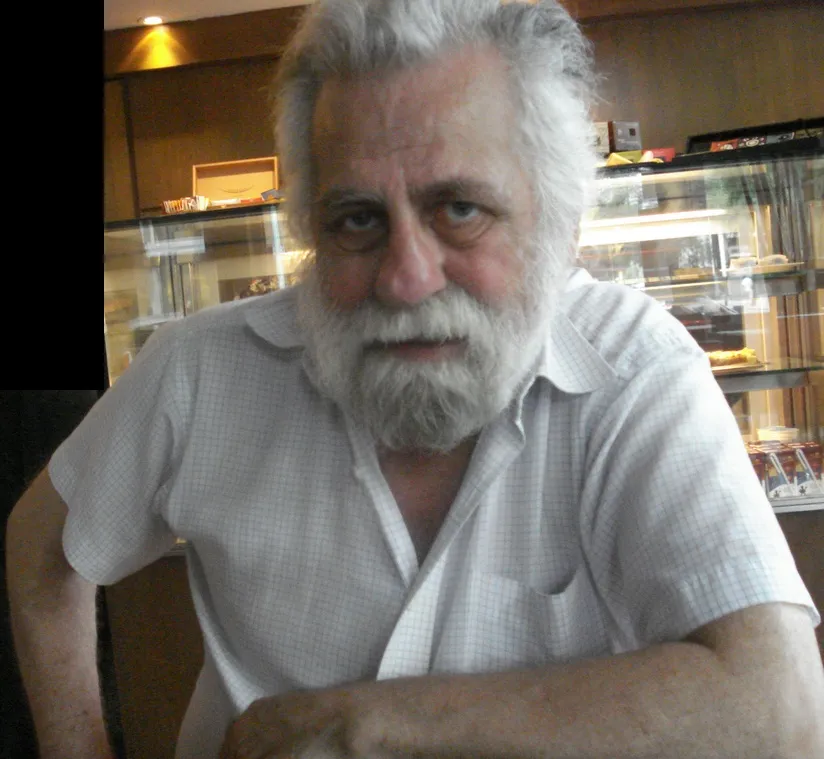
On Friday, January 14, at 11:00, in a bar in Capital Federal, I met with Eduardo Saguier, Dr. in history, CONICET researcher, who for years has been denouncing alleged corruption in the science organizations in Argentina.
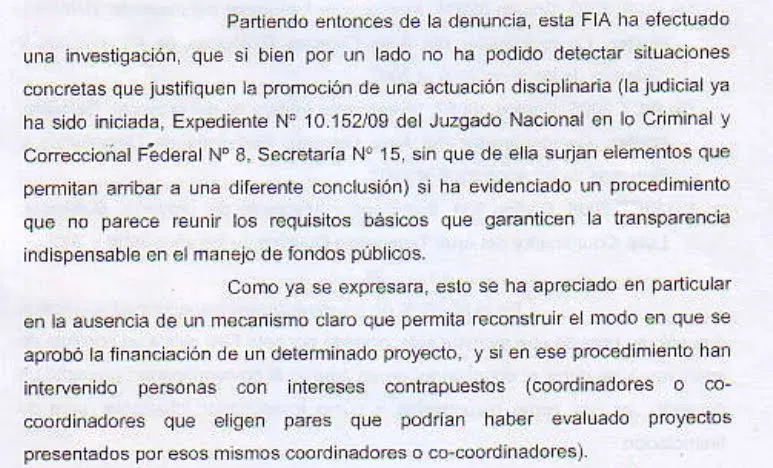
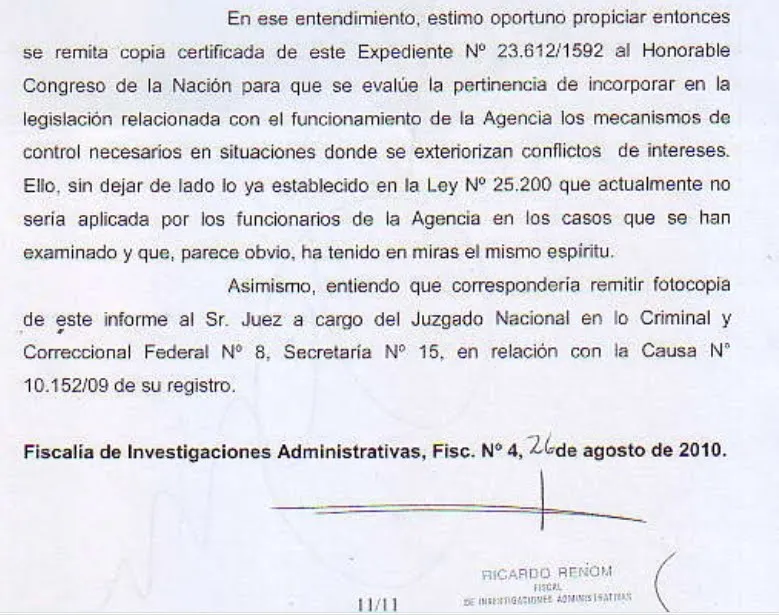
Beyond the various writings in his own hand circulating on the internet that we could discuss or consider debatable, I think it is newsworthy that a complaint was made that was investigated by the Fiscalía de Investigaciones Administrativas (FIA). That oversight body, after five years during which it gathered documentary and testimonial information, issued a ruling at the end of last year.
To understand the situation:
CONICET, the organization that brings together and trains Argentine researchers from different scientific disciplines, depends on the Ministry of Science. On the other hand, the Agencia de Promoción, in charge of executing funds from international financing, also depends on the Ministry. The idea is to distribute those funds through grants to researchers who meet some formal requirements and pass an evaluation. For this, the Agency divides the scientific disciplines into broad areas, each of which has a coordinator and three co-coordinators. These coordinators will be in charge of forming a "peer bank", supposed experts in each area who will be the ones to evaluate the applications that researchers submit to the coordinators.
What Dr. Saguier denounces is that in this process there is a "conflict of interest", since grants have been awarded to the coordinators themselves (since they are researchers) or to relatives-spouses, etc.
In addition to being a professional ethical conflict, there is an ethics law that would be being violated.
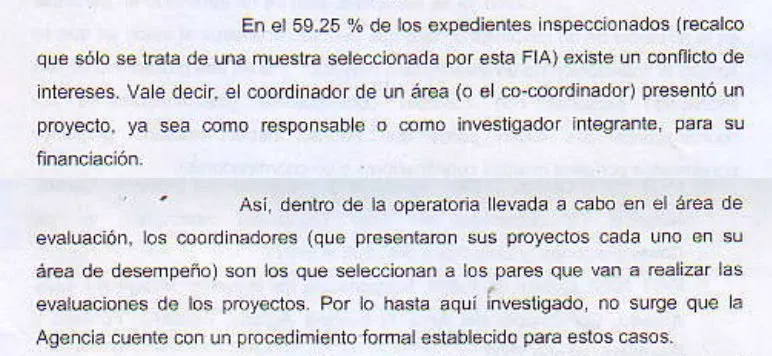
The FIA investigation concludes that this indeed "could happen", in relation to how grants are currently awarded and points out that cases were found that demonstrate this. 59% of the cases studied (a few cases were studied) had some "conflict of interest".
Saguier has had discussions with the current Minister of Science, Lino Barañao (when he was president of ANCYPT) on the matter. Barañao has pointed out to him that coordinators cannot be excluded from receiving grants, because that would not be fair. At some point it had been thought that the coordinators would have a previously agreed-upon grant, to avoid these instances, but it did not seem the best and the current situation was reached. Put that way, it seems the thing is not only confirmed, but inevitable.
On the other hand, Barañao used the concept of the famous "Occam's Razor" to point out that some of those researchers also received grants from prestigious foreign organizations. And that they must be deserved, otherwise it would be thinking of a worldwide conspiracy.
Furthermore, the peers chosen by the coordinators are anonymous. It is supposed that this is so because transparency is guaranteed, when it could be interpreted exactly the opposite way.
On the other hand, thinking that this system is created this way deliberately with the sole purpose of benefiting the "friends of power", implies a conspiratorial hypothesis, to call it something. An idea reinforced by Dr. Saguier's other writings on his site and on other web pages that speak of a "mafia network" of Argentine science.
The interview with Saguier goes through these topics. I asked him why he thinks he is the only one pointing out these things and if these episodes are a consequence of his reports being rejected or if those rejections are a consequence of his complaints.
Saguier speaks of "correligionarios", that is, he points to a partisan affinity (towards the Unión Cívica Radical), the opposition party in recent years. I asked him if this had to do with that partisan stance.
Dr. Saguier points out other issues and, in some cases, mentions alleged irregularities in people by name.
I think it is good for the public to know that not everything is rosy in Argentine science, but from there to assuming that everything is black there is a distance.
Saguier's message, ultimately, points to the latter: everything is a plot, no one is saved, everything is wrong and the only alternative is to leave the country to be able to do science.
So, who is right?
On one hand, it does not seem right that conflicts of interest of this type exist. In some cases, the researchers benefited with grants, aside from some kinship with someone, may have been correctly evaluated. But in this framework, it is logical that suspicion arises if the procedure is not transparent. The FIA ruling stipulates nothing more than presenting the proceedings to the legislators so that they review the process since there seem to be concrete cases in which Law 25.200 on public ethics is not complied with.
Conclusion
Saguier's statements on multiple web pages and other interviews he gave may seem implausible to us, since it would imply the silence of his colleagues, out of complicity, or out of fear. And they are not few: by 2010 the number climbed to 6000, according to CONICET. But I consider it logical to differentiate Saguier's statements (which are broad) from the FIA investigation (which is particular) whose ruling seems to reaffirm that something of what the historian denounced can occur. Knowing this is important, analyzing it in context as well. We will each form our opinion, evaluating these and other data.
The flip side is that science is being done, and first-rate science. And that there is a planning that is vital to maintaining long-term policies. On those topics I will advance in the future. Perhaps next month I will arrange a new interview to address those topics, surely with a somewhat more positive vision. How is a scientific policy designed and planned, what variables to consider?
I also think that this solitary voice of Saguier must not be lost in the thicket of data and conspiracy theories. The transparency and democracy of institutions is fundamental. Just as citizens must demand that leaders support science and researchers, we also have to demand clear processes, free from non sanctas interference.
The interview lasts 48 minutes and can be listened to here or can be consulted online or downloaded from Archive.org.
http://www.archive.org/details/EntrevistaAEduardoSaguier
FIA Ruling (PDF)
Sources and related links
- Eduardo Saguier's Site
- National Agency for Scientific and Technological Promotion
- Office of Administrative Investigations (FIA)
- FIA Opinion