Since the 2010 Census was conducted last year, some provisional results have already been coming out. A map of the Argentine population, in numbers.
The results are being published on the 2010 Census page. A look at the already known data allows us to see how the population has grown and distributed across the territory.
The data corresponding to the surface area of each province were taken from the National Geographic Institute page.
On the 2010 Census page we can access some data in table form, others in map form, and a presentation along with a more extensive document in pdf.
The presentation is as follows:
Provisional Results 2010 Census
View more presentations from Gerardo Blanco.
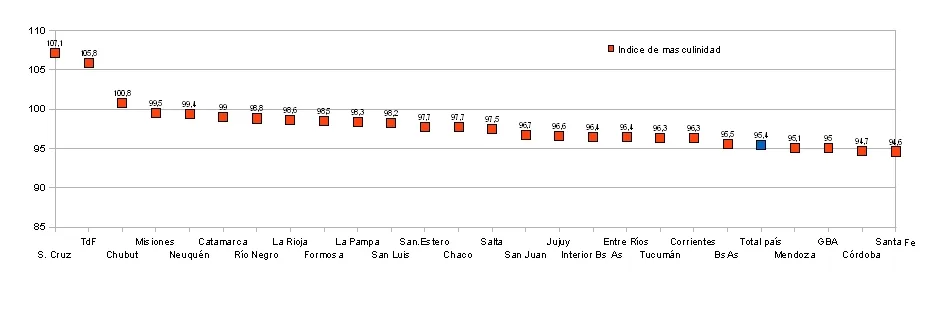
With the data from the Census page we can graphically see two interesting variables: population growth rate and the masculinity index.
This index indicates how many men there are, in a region, per 100 women. If the index is 100 it implies there are equal numbers of people of both genders. If the index is lower it is because there are, in that place, more women. Note that the first three provinces coincide in both tables. Coincidence?
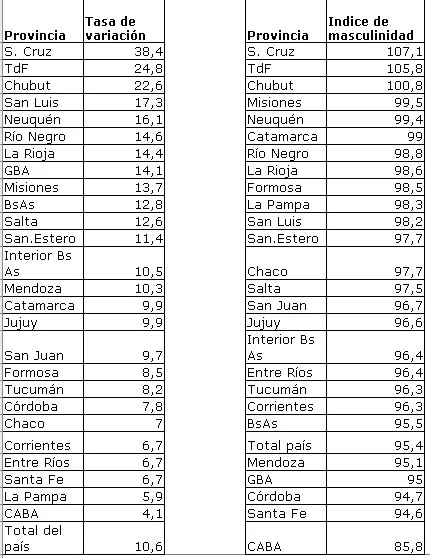
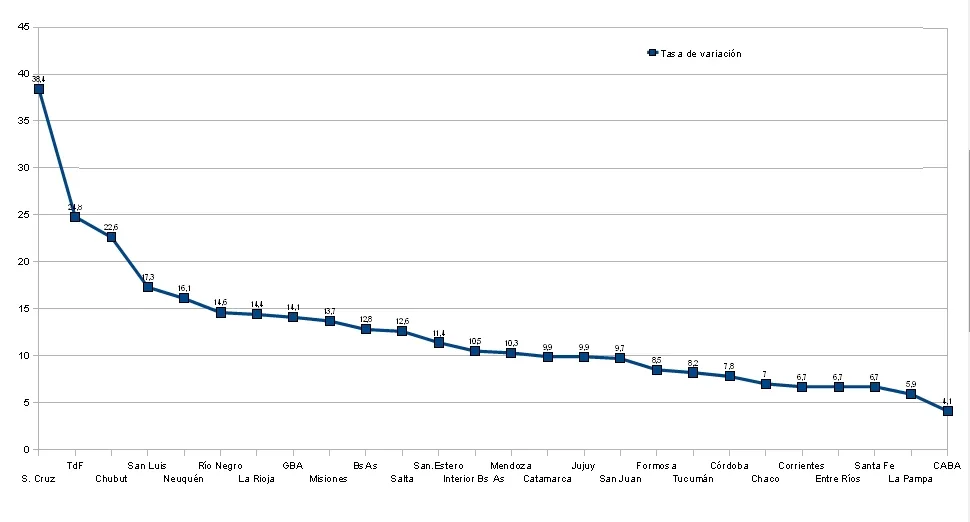
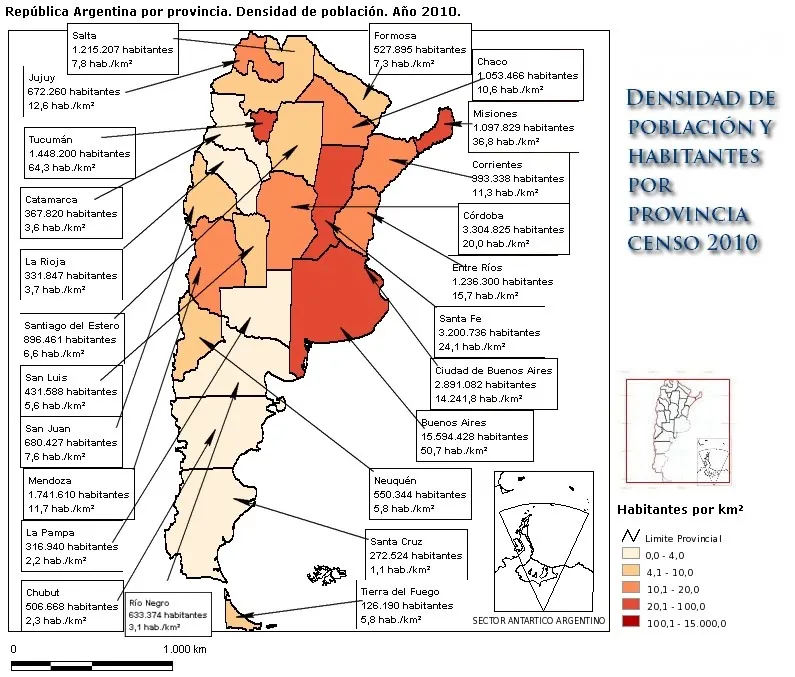
It would be interesting, along with the variation rate, which indicates the percentage of population increase in each province, to know the population density. We will see that in a way the table is inverted. While the variation in the Autonomous City of Buenos Aires (CABA) is the lowest, its density will be the highest. And, while Santa Cruz has a 38.4% population increase, it is, however, the one with the lowest density.
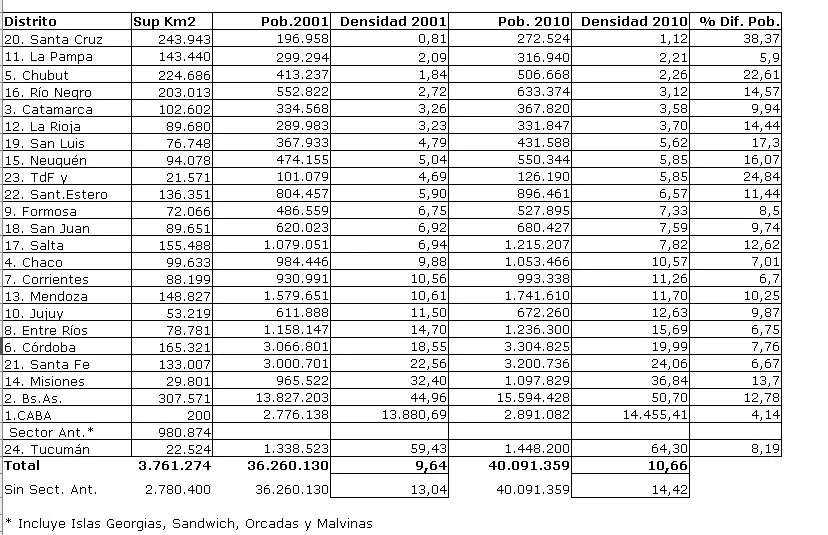
On the 2010 Census page it is possible to access the density data, but in map form. The image shown here is static, but on the census page, by positioning the mouse over a province, you can know the number of inhabitants and its density (not the surface area), data that matches the table above:
Just for comparison:
According to Wikipedia, Spain has a surface area of 504,645 Km2, while Argentina, not counting the Antarctic sector, has 2,780,400, five times more.
However, on the peninsula live just over 47 million people, while in our country we scrape 40 million.
The GDP (nominal) in the Old World country is USD 1,438,356 million. Here, in contrast, it climbs to USD 351,015 million, four times less. Per capita implies USD 35,100 vs 8,700.
Do these numbers say something about the productivity and efficiency of Argentines? Do they tell us of a waste of the land and the climatic variety present in the territory?
I know from good sources that there is good growth in wind energy and some interesting projects. The population growths of provinces with low density don't seem like bad data. And, despite knowing it beforehand, the differences between CABA and the rest of the country, in terms of population density, are still shocking.
What the numbers surely tell us in this sense is that Argentina has space to grow. It will depend a little on all of us to know how to take advantage of the opportunities that nature and the spilled blood have given us. We will have to do what is necessary so that brains don't flee and those who stay start thinking and producing, instead of watching Gran Hermano, in which neither of the two things is done, right?
Sources and related links
- Census 2010
About the images
- The images belong to INDEC/Census 2010.