October 12 and the calendar in red, even though some took yesterday's holiday, because of those tourism things. But the famous discovery of America also has another side that is indeed worth rescuing: exploration. However, I think we must make a discrimination, precisely on this day.
In several Latin American countries, the Day of the Race is "celebrated" today. Race? According to Wikipedia, the term fell out of use in botany since the beginning of the last century. We speak of ethnicities, of populations, not of races. "Races" do not exist. But there are ethnic, cultural differences. Let's say I use the term ethnicity as groups of people (not necessarily minorities) who share a common genealogy or ancestry or historical, cultural, linguistic ties.
In Argentina there is a project, which I hope becomes a reality, for this day to indeed celebrate American Cultural Diversity in Argentina.
Meanwhile, coincidentally, three new members arrived at the Space Station on Sunday. They departed on Soyuz TMA-01M on Thursday as part of Expedition 25, as astronaut Ron Garan relates on his blog.
An expedition is a journey of exploration and discovery. Geographic exploration, which has existed since time immemorial, has not been limited to the geoid we inhabit.
We have explored the skies, the oceans, the poles and the highest peaks, but humanity has also been able to begin sailing the vast cosmos to explore space. This is usually celebrated on the first Friday of May each year on Space Day.
Since October 4, 1957 with the launch of Sputnik, we have been able to know other worlds, new worlds for real. For these new journeys, people are needed, although not necessarily human travelers, as demonstrated by the successful robotic missions.
I believe in exploration. I think it is something we cannot avoid, despite being rational beings who could control that intellectual and physical yearning for discovery. I value the knowledge and technological advances that space exploration, for example, usually implies, as well as a greater knowledge of ourselves and our place in the cosmos.
And of course, also the geographic exploration of this pale blue dot that we still do not know as much as we would like.
But on a day like today, I cannot help but also see the dark side, not of exploration per se, but of humanity. We have lived centuries confusing (or not) exploration with conquest, discovery with massacre, progress with genocide.
If we must learn anything, it is the complex relationship that binds us to living beings, despite the biological differences between species and cultural differences among humans. We should build a broader concept, beyond border limits and systems of government, but rescuing what differentiates us, because it enriches us.
There are no human advances, no progress or evolution without respecting the values of others. The end does not justify the means. Science and technology, without morality, can be something dreadful. Well, with the "wrong" morality too. But it's that morality has to do with people.

For this reason, I believe today is a day to discriminate. To differentiate between ends and means, between valuable methods and abominable procedures, between respectful practices and dreadful mechanisms.
Another discrimination must also be made, of significant scale.
It is often said that, astronomically speaking, we are nothing. We are insignificant. As I said above, just a pale dot of light in a cold, dark, and immense cosmos.
But within this globe of sea and land, the scale is different. Here our actions, our values, are indeed significant. The atrocities committed in the name of progress, discovery, and exploration were carried out by people like us, of flesh and blood. And it also depends, to some extent, on people like us (you, me) that they are not continued to be committed.
Just as in this Year of Biodiversity the aim is to raise awareness of the variety of life on Earth, it would also be good if we increasingly value cultural diversity.
That is why I believe today is indeed a day to discriminate, that is, to select the best of human beings, excluding (condemning) the horrific practices of inferior treatment for whatever reason.
Sources and related links
- Day of the race, or: Day of bureaucracy
Marcelo Pisarro - The Planetary Society (English): Why do we explore?
About the images
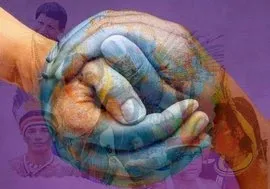
- Google Doodle by Natalia Isabel Cuevas Niño
Age: 9, School: I.E Bicentenario De La Republica Colombiana