A collection of links to music, images and videos that relate art and science. Today: Images of gamma-ray bursts, a supernova and the Sun in the East. Music for traveling to Mars and a video about information design.

Images of the decade
GRB 010222
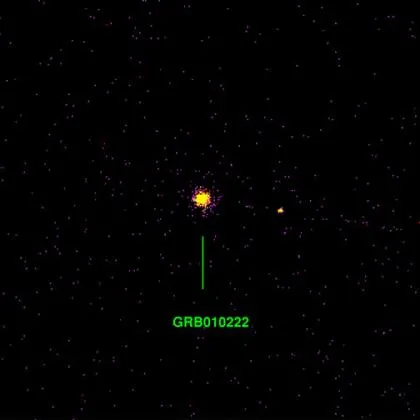
A Chandra image of the afterglow of a gamma-ray burst, GRB01022, provides evidence that these massive explosions take place when stars are born. Several theories exist about what causes these GRBs, such as the merger of neutron stars or black holes or the explosion of massive stars or hypernovae. Luigi Piro, an Italian researcher, with images from Chandra and the BeppoSAX satellite, found evidence supporting the hypernova model.
Piro's data and his team suggest that the blast waves collide with a wall of dense gas, perhaps a star-forming region. The hypothesis suggests that the massive star required for a gamma-ray burst explosion evolves very rapidly in dense star-forming regions. Thus, the hypernova explosion could occur in the same environment that originally produced it and perhaps trigger further star formation.
The image was released on April 4, 2001 by the Chandra X-ray Observatory.
Credit: NASA/CNR/L.Piro et al.
The most distant supernova
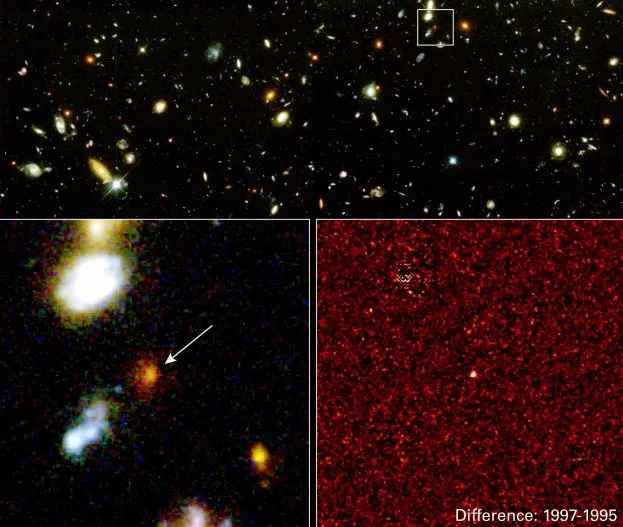
On April 2, 2001, the Hubble Space Telescope announced to the public the detection of the most distant supernova known (at that date), 10 billion light-years from Earth.
The images produced were taken two days later by the Astronomy Picture of the Day and, in Spanish, by Observatorio.
Credit: Adam Riess (STScI) et al., NASA
Equinox

On March 30, 2001, the Astronomy Picture of the Day (APOD) published a photo by Joe Orman taken at the March equinox of that year. Well, almost, because the photo was taken one day later.
Can you imagine why? Hint: below the Sun, what hides its lower part, are not clouds, but mountains.
Find out the answer at Observatorio.
Space Music
Today: Joost Egelie is a Belgian musician author of three albums of space-related music.
Boundaries Of Infinity, from 2008, contains 6 tracks inspired by the search for a Theory of Everything.
The following year he released Music for Mars to accompany our dreams of traveling to the Red planet.
In 2010, a sequel to the previous album was released, From Mars to Earth, because if we went to Mars, then we must return home.
Joost Egelie's music is free and we can download it from his page on Jamendo, from where we can also donate a sum of money to him, if we like his music and feel like it.
Science in motion
David McCandless turns complex data series, such as global military spending, media coverage, Facebook profile updates, among others, into the most beautiful and simple diagrams. He proposes information design as a tool to navigate through the current information superabundance, looking for unique patterns and connections that can manage to change the way we see the world.
