A collection of links to music, images and videos that relate art and science. Today: Hydra Galaxy Cluster and a universe with more dimensions; ChromoTone: sounds from multi-band images; and The Milky Way over El Teide.

Images of the decade
The Hydra Galaxy Cluster
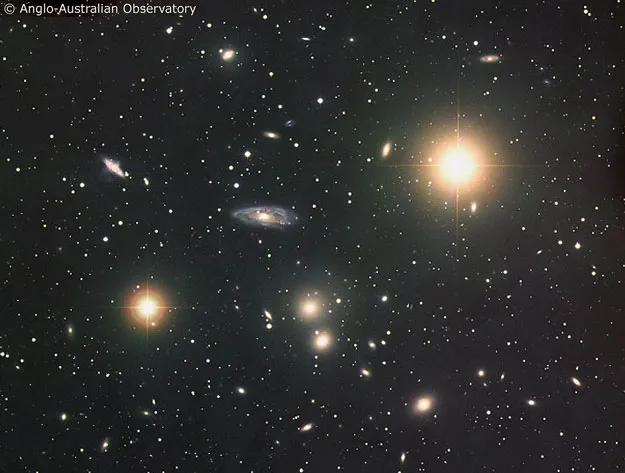
The Hydra galaxy cluster contains more than 100 bright galaxies – but perhaps fewer galaxies than might be expected from its mass.
Astronomy Picture of the Day (APOD) published on April 16, 2001.
Also in Observatorio.
Credit: David Malin (AAO), AATB
A universe with more dimensions?
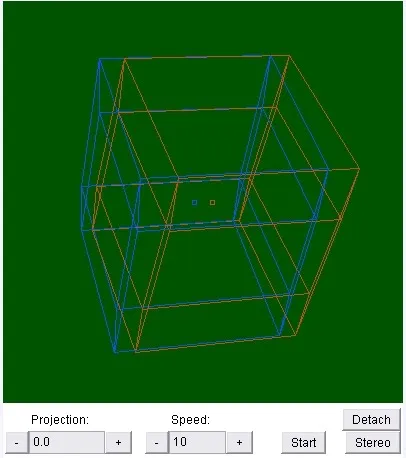
Does our universe have more and unusual spatial dimensions? This idea has gained popularity to explain why vastly separated regions of our universe appear so homogeneous and why the geometry of the universe does not seem to result naturally from the amount of matter it apparently contains. In a new incarnation of the old idea of extra spatial dimensions, some astrophysicists hypothesize that we live in a universe called Ekpyrotic, where our four dimensions (three spatial and one of time) resulted from the collision of two four-dimensional spaces (branes) in a five-dimensional universe.
This Big Bang hypothesis competes with another hypothesis that our universe underwent superluminal inflation in the distant past and makes different predictions. In the Astronomy Picture of the Day for April 18, 2001, instead of a photograph, a three-dimensional Java application (two dimensions of space and one of time) of a four-dimensional representation of a hypercube or tesseract is shown. With red-blue, stereoscopic, also called anaglyph glasses we will have the best multi-dimensional perspective.
Credit: Mark Newbold
Space Music
Today: Chromotone
This is a web application that allows you to view some images in different wavelengths. But instead of applying colors to the different wavelengths, ChromoTone uses different notes, converting color into musical sounds.
The application was created during the Hack Day of .Astronomy this year. The group that created it is composed of astrophysicists and musicians: Jon Yardley, Haley Gomez, Ed Gomez and Rob Hollow, as they tell on Orbiting Frog.
Video: ChromoTone
http://www.youtube.com/watch?v=httseMaxiFA
On the ChromoTone page we will see that Java needs to be installed, since the application was created with Processing.
There are three possible images to use: by default the full sky, but we can also choose an image of M1 or M31.
How is it used?
Just drag the mouse to create sounds. We can switch between the different wavelengths of the same image with the keyboard (by pressing numbers 1 to 7).
What does it do?
According to its author, it creates a soundscape using a multi-band image. Each image is assigned a frequency that changes in amplitude in relation to the strength of the signal.
Thus, in the case of the full-sky image, pressing 1 shows a gamma image, with an E-flat fifth sound; with 2 X-rays in C fifth; with 3 DSS blue in E fourth; with 4 H-alpha in B-flat; with 5 IRAS image in G third; with 6 Planck image in C third; and with 7 a radio image in E second.
http://jyardley.co.uk/chromotone/index.php
Science in motion
Today: The mountain
This was filmed between April 4 and 11, 2011. Its author, Terje Sorgjerd, notes on Vimeo that he had the pleasure of visiting El Teide. "Spain's highest mountain (3715m) is one of the best places in the world to photograph the stars and is also home to the Teide Observatories, considered among the best in the world. The goal was to capture the beautiful Milky Way along with one of the most incredible mountains I know," says Terje.
The Mountain from Terje Sorgjerd on Vimeo.
To access previous editions of this section, consult the Multimedia Selection Series.