Today the shadow of the Earth will be visible on the Moon. Twenty-five years ago, another shadow eclipsed Borges. But Selene, like Georgie, is always there.
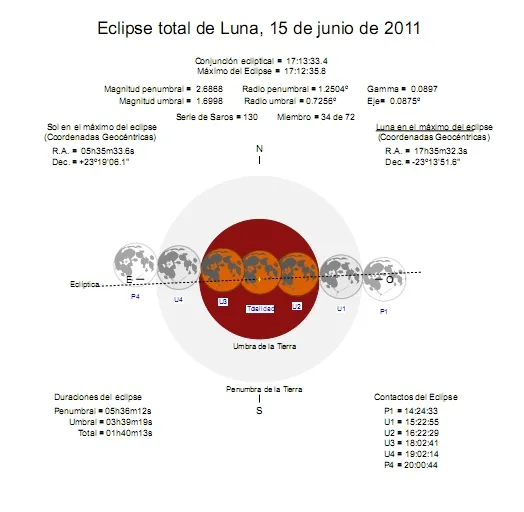
The first lunar eclipse of 2011 will be observed today in much of the world, except for central and northern America and the northernmost part of Asia.
In Argentina it will be seen partially, when the Moon rises already eclipsed (at 17:45) and somewhat orange.
From 18 h the Planetario de Buenos Aires will offer the possibility to observe the phenomenon with the naked eye and with instruments. Also the robotic telescopes of Slohh.com, for free, will allow following the event online.
Lunar eclipses occur because the Sun, the Earth and the Moon are aligned in such a way that the light from the star illuminates one face of the Earth (on that face it is day, on the other it is night) and the shadow that the Earth casts covers the Moon.
Another shadow eclipsed the great Jorge Luis Borges a quarter of a century ago.
We could dig (almost reaching China) the multiple allusions to the Moon in World Literature. That's what Borges did in the poem La Luna, from El Hacedor (1):
And, while I was sounding that mine
Of the moons of mythology,
There it was, around the corner,
The celestial moon of every day
Coincidentally, the title of that work refers in some way to Olaf Stapledon's work Star Maker, which Borges wrote the prologue for.
But I think Borges cared little about the astronomical phenomenon. There is another somber occultation that deserved his reflection (2):
I have committed the worst of sins a man can commit. I have not been happy. May the glaciers of oblivion drag me away and lose me, merciless.
My parents engendered me for the risky and beautiful game of life, for the earth, the water, the air, the fire.
I failed them. I was not happy. Fulfilledwas not their young will. My mind applied itself to the symmetrical stubbornness of art, which weaves trifles.
They bequeathed me courage. I was not brave.
It does not leave me. It is always by my side
The shadow of having been an unhappy man.
One must take advantage of life, every instant. And if we want to observe the eclipse, let's do it. Because if not (3):
The silent friendship of the moon
(I misquote Virgil) accompanies you from that lost now in time night or evening when your vague eyes deciphered it forever in a garden or a courtyard that are dust.
Forever? I know that someone, one day, will be able to truly tell you:
You will not see the clear moon again,
You have already exhausted the unalterable sum of times that fate gives you.
Useless to open all the windows of the world. It is late. You will not find it.
We live discovering and forgetting that sweet custom of the night.
We must look at it well. It may be the last.
As the eclipse ends, night will begin. The young night (4):
Already the lustral waters of the night absolve me of the many colors and the many forms.
Already in the garden the birds and the stars exalt the longed-for return of the ancient norms of sleep and shadow. Already the shadow has sealed the mirrors that copy the fiction of things.
Goethe said it better: The near moves away.
Those four words encapsulate all of twilight.
In the garden the roses cease to be the roses and wish to be the Rose.
The near moves away. Perhaps because everything is movement, Borges boasts of his stillness (5):
Scriptures of light assail the shadow, more prodigious than meteors.
The high unknowable city intensifies over the countryside.
Sure of my life and of my death, I look at the ambitious and would like to understand them.
Their day is avid like the lasso in the air.
Their night is a truce of anger in the iron, ready to attack.
They speak of humanity.
My humanity lies in feeling that we are voices of the same penury.
They speak of homeland.
My homeland is a throb of a guitar, some portraits and an old sword, the evident prayer of the willow grove in the evenings. Time is living me.
More silent than my shadow, I cross the throng of their raised greed.
They are indispensable, unique, deserving of tomorrow.
My name is someone and anyone.
I pass slowly, like one who comes from so far away he does not expect to arrive.
To look at the moon is to connect with those ancestors who also observed it. It is the same, the same white face that looks at us. It is like a mirror and a bond. (6)
I have performed an irreparable act, I have established a bond.
In this everyday world, which so resembles the book of the Thousand and One Nights, there is not a single act that does not run the risk of being an operation of magic, not a single fact that cannot be the first of an infinite series.
I wonder what shadows these idle lines will not cast.
I wonder that too...
Sources and related links
- Planetario: Lunar eclipse
- NASA Eclipse
- Poems by Borges cited from Obra poética, Biblioteca Borges, Alianza Editorial, Buenos Aires, 1989.:
(1) La Luna, from El hacedor (1960)
(2) El remordimiento, from La moneda de hierro (1976)
(3) La cifra, from La Cifra (1981)
(4) La joven noche, from Los Conjurados (1985)
(5) Jactancia de quietud, from Luna de enfrente (1925)
(6) El tercer hombre, from La Cifra (1981)
About the images
- Fig. 1: Diagram from: Boletín 310 (Noticias del Observatorio de La Plata)
- Initial image: combination of a photo from Efemérides Culturales Argentinas and a photo from UCM.