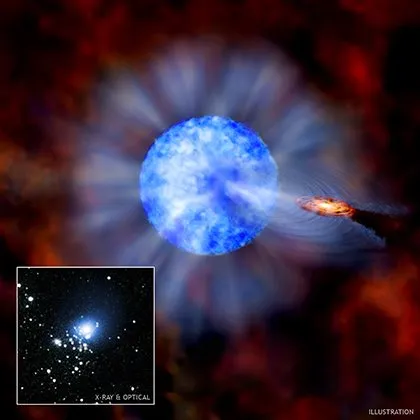
With the deepest X-ray images to date, astronomers have found the first direct evidence that massive black holes were common in the early universe. The discovery made with the Chandra Observatory shows that very young black holes grew more aggressively than previously thought, in tandem with the growth of the galaxies that hosted them.
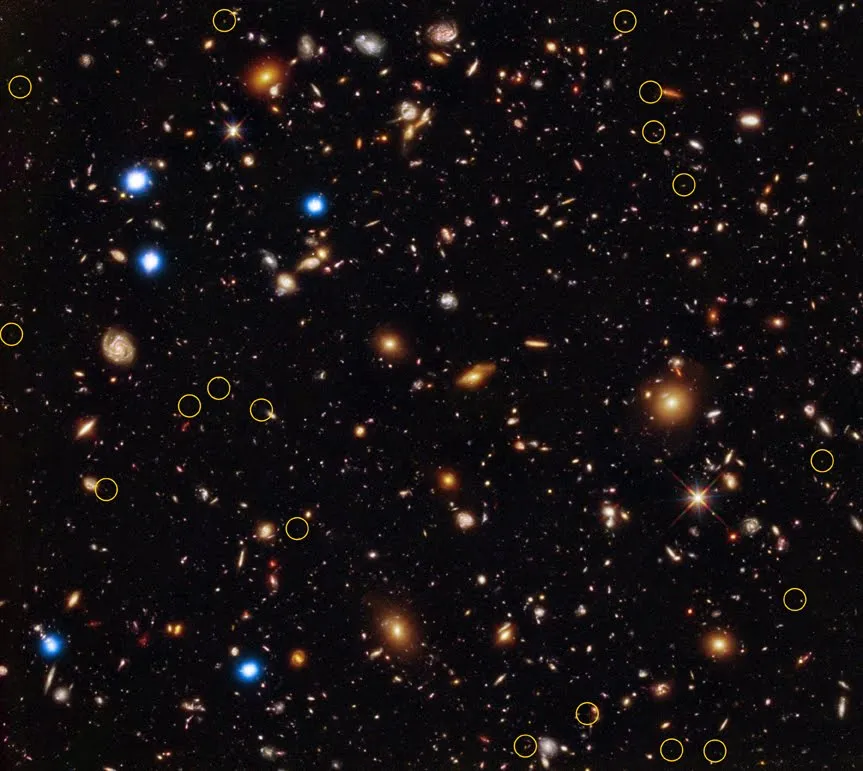
By pointing Chandra at a region of the sky for more than six weeks, astronomers obtained what is known as the Chandra Deep Field South (CDFS). Those images began to be obtained in a survey started in 1999. By combining that data with optical and infrared images from Hubble, astronomers were able to search for black holes in 200 distant galaxies from when the universe was between 800 million to 950 million years old (a cosmological redshift, z, between 6 and 7).
"Until now we had no idea what the black holes in these early galaxies were doing or if they existed," said Ezequiel Treister of the University of Hawaii, lead author of the study that will appear tomorrow in Nature (it is already online, see below). "Now we know they are there and that they are growing a lot."
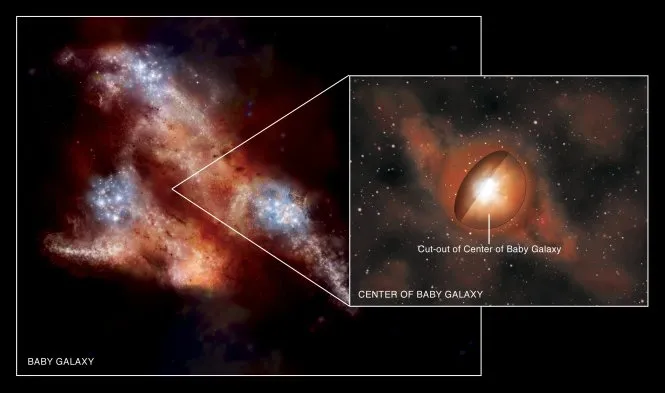
The super growth implies that the black holes in the CDFS are less extreme versions of quasars—very luminous objects generated by material falling into supermassive black holes. However, the sources in the CDFS are about a hundred times fainter and the black holes are a thousand times less massive than those in quasars.
The observations found that more than 30% of the distant galaxies contain growing supermassive black holes. If these results are extrapolated to the entire sky, there would be at least 30 million supermassive black holes in the early universe. This is a factor 10,000 times greater than the estimated number of quasars in those primitive times of the cosmos.
"It seems we have found a whole new population of baby black holes," commented co-author Kevin Schawinsky of Yale University. "We think these babies will grow by a factor of between 100 and 1000, eventually becoming the giant black holes we see today almost 13 billion years later."
A population of young black holes in the early universe had been predicted, but not observed. Detailed calculations show that the amount of black hole growth observed by this team is about 100 times greater than previous estimates.
The mAGNificent Universe
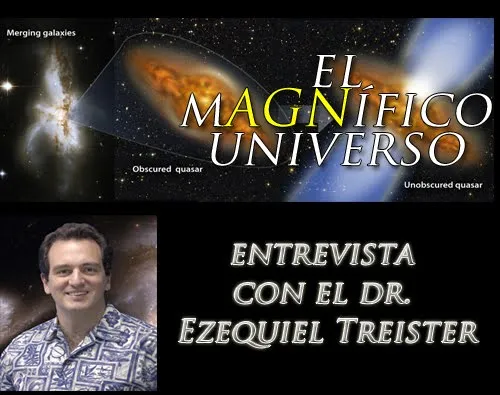
We announced that the conference where these data were presented would take place in an interview with the lead author of the study, Dr. Ezequiel Treister. In that talk, data were provided that allow a better understanding of this information, by discussing the relationships between AGNs, black holes, quasars and galaxies. I invite you to read the interview in The mAGNificent Universe
Since black holes are enveloped by thick clouds of gas and dust, optical telescopes often cannot detect them. However, the high energies of X-ray light can penetrate those walls.
Physicists who study black holes want to know more about the first supermassive black holes that formed and how they grew. Although evidence of parallel growth between black holes and galaxies in the nearby universe had already been found, the new Chandra results show that this connection began earlier than thought.
"Most astronomers think that in the current universe, black holes and galaxies grow symbiotically," explained Priya Natarajan, co-author of the work. "We have shown that this relationship existed from much earlier."
It has been suggested that early black holes would have played an important role in clearing the cosmic "fog" of neutral hydrogen that bathed the early universe when temperatures cooled after the Big Bang. However, the Chandra study shows that the "walls" of dust and gas stopped the ultraviolet radiation generated by black holes, so they must not have been responsible for the so-called "reionization". Therefore, stars and not black holes are probably those that contributed to emerging from that "dark age" of the cosmic dawn.
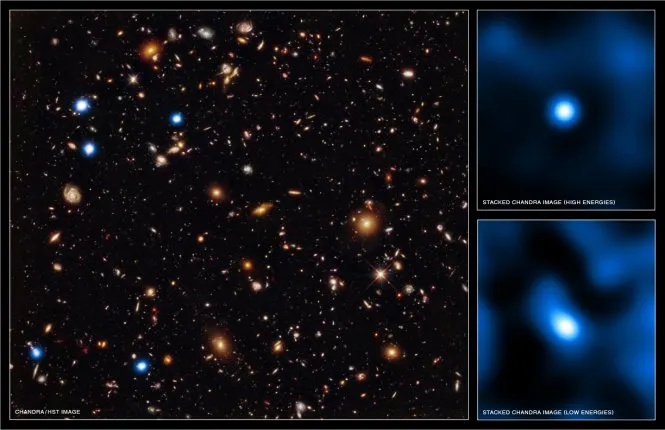
With Hubble the astronomers detected 200 galaxies and their positions (in the video they appear as yellow circles). None of them was detected individually by Chandra, so the team used a technique that relies on the instrument's ability to determine with great precision the direction from which the X-rays come. In that way they were able to add the X-rays coming from positions close to those galaxies observed by Hubble. The two "stacked" images resulted in the two insets seen in this image (high energy and low energy, top and bottom respectively).
http://www.youtube.com/watch?v=odframNYNd8
The following video, shown today at the NASA conference where the work was presented, shows a region, in the constellation Fornax of the CDFS. You can see the locations of some of the studied galaxies, as yellow circles, and then the X-ray observations of those positions.
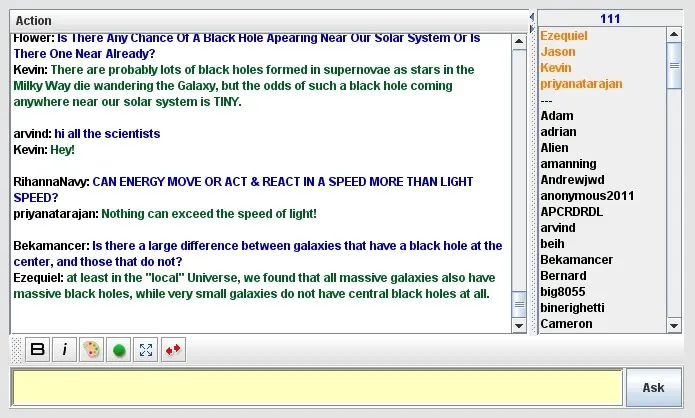
After the press conference, the panelists joined a chat on a NASA page where over a hundred people asked questions to the scientists. The vast majority of the questions were about what black holes are, about the speed of light, wormholes, white holes, and other topics. The goal of the chat was to connect with the general public and not with journalists, as that was the purpose of the press conference, which is why questions about the research itself were not answered in the chat.
There were a couple of participants who asked their questions in Spanish and Ezequiel Treister answered them in that language.
Sources and related links
- Black hole growth in the early Universe is self-regulated and largely hidden from view
Ezequiel Treister, Kevin Schawinski, Marta Volonteri, Priyamvada Natarajan & Eric Gawiser
Nature 474, 356–358 (16 June 2011)
DOI:10.1038/nature10103 - Chandra Deep Field South: NASA's Chandra Finds Massive Black Holes Common in Early Universe
About the images
- Fig. 1: Credit: X-ray: NASA/CXC/U.Hawaii/E.Treister et al; Infrared: NASA/STScI/UC Santa Cruz/G.Illingworth et al; Optical: NASA/STScI/S.Beckwith et al
- Fig. 2: NASA/CXC/M.Weiss