Winter holidays are beginning for students in Argentina and there are some valuable options for kids to learn while having fun.
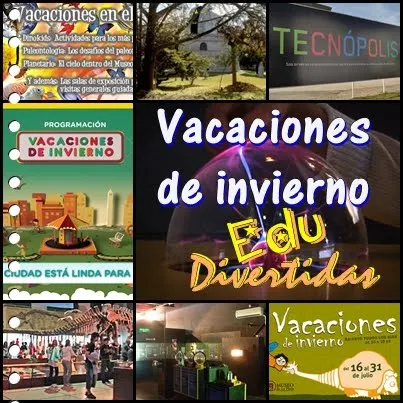
Among the various options for the kids' winter holidays, beyond the classic ones like taking them to the movies, the circus, or the zoo, in the City of Buenos Aires (and surroundings) there are options that combine fun and learning.
Options
This is NOT a complete list, but only an incomplete selection, for the Federal Capital and Surroundings.
To get more information about each activity listed here, check the page of each place, duly indicated.
Participatory Science Museum
Do Not Touch is Forbidden
The Participatory Science Museum is an institution dedicated to the popularization of science in a playful and participatory way.
It has a significant number of interactive exhibits, which stimulate the visitor's curiosity, offering them the freedom to play and the desire to learn more.
It is an active proposal for the public of all ages.
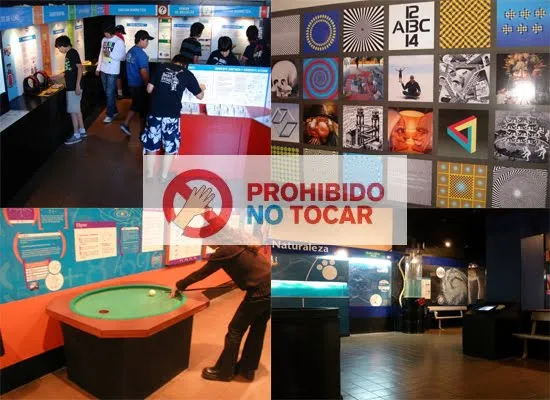
The museum is located at:
Recoleta Cultural Center
Junin 1930
Ciudad de Buenos Aires - Argentina
Tel/Fax: 4807-3260 / 4806-3456
Web: http://www.mpc.org.ar/index.html email: [email protected]
Winter holiday hours:
Monday to Friday from 12:30 to 19:30 h.
Saturdays and Sundays from 15:30 to 19:30 h.
Tecnópolis
Tecnópolis is your place to learn about the legacy of the Bicentennial generation. Science, art and technology in an exhibition to continue recovering what we were and advance in what we are capable of doing together. To tour the republic that is built with Argentine talent, creativity and knowledge. More than 50 hectares to enjoy the latest innovations being developed in a country we are transforming with your ideas. Because Argentina's third century of life begins at Tecnópolis. Come in to be part of the present that looks to the future.
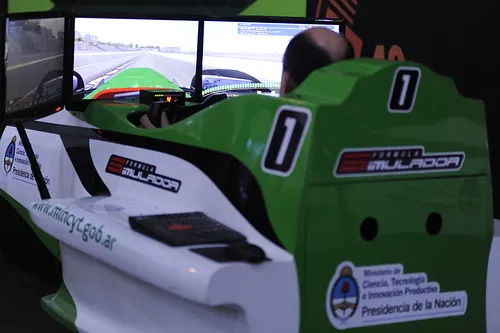
The science and technology fair in Villa Martelli (General Paz between Balbín and Constituyentes) proposes a tour of several topics. For example:
Pierre Auger Observatory. The universe at your fingertips
Inside the dome of the Pierre Auger Observatory you will be able to learn the elementary principles of astronomy and physics and experience contact with the universe at your fingertips.
With the help of specialized guides you will be able to learn how physicists and astronomers detect cosmic rays, particles smaller than an atom that come from space and fall on us like rain even though we don't see them. Using a scintillator, a muon detector and a fluorescence detector you will discover how many particles travel in the air without us realizing it.
Furthermore, in our Planetarium, with all five senses you will learn more about the constellations of Orion, Scorpius and the Southern Cross. In an installation with facilities for the blind, visually impaired and hearing impaired, you will be able to experience the sky of a May night with its sounds and smells.
And Suddenly It Went Bang. An approach to the origin of the universe.
How did the universe originate? Relive the exact moment when the Big Bang occurred.
Get into the Large Hadron Collider and feel in your body the collision of particles with which the world was created.
To live this experience firsthand, a 3D stereoscopic video on a 180º screen will explain the technical details of the sophisticated machinery and the scope of the research involving scientists from 35 countries, including Argentina.
Video: Welcome to Tecnópolis!
http://www.youtube.com/watch?v=K5gpRPR6CE4
Web: http://tecnopolis.mincyt.gob.ar/
http://www.tecnopolis.ar/full/
Buenos Aires World Book Capital 2011
The capital offers a wide schedule of activities for the school holidays.
Theatrical shows, literary workshops, storytelling, narrations are just some of the activities that kids will be able to enjoy during these holidays.
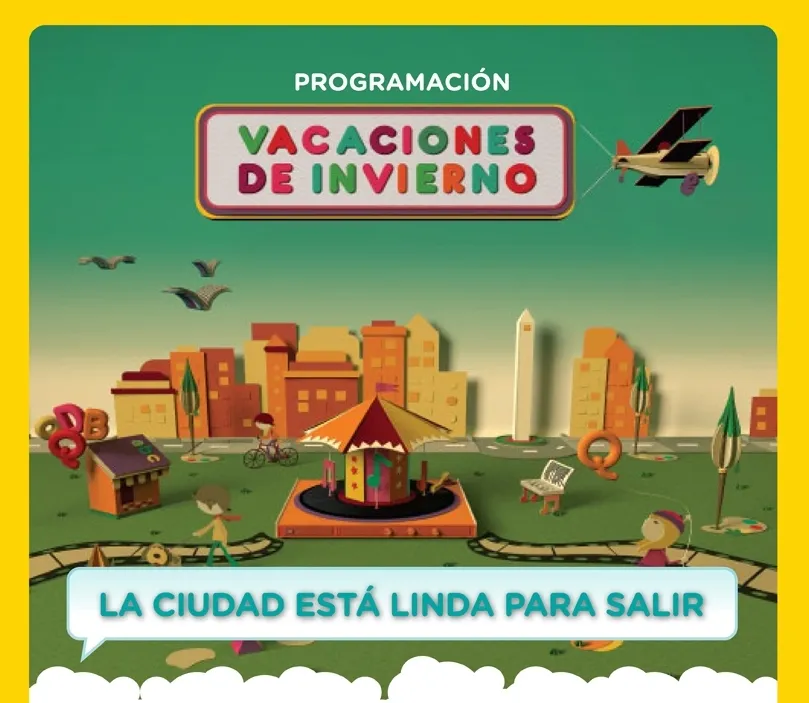
Among the most notable are the musical show Borges for children, which introduces children to the work of the famous Argentine writer, Doña disparate y Bambuco, offers a tour of the characters and songs of María Elena Walsh, the 21st Children's and Young Adult Book Fair and different free proposals offered by the city's public libraries.
To see the schedule click here.
Web: http://www.capitaldellibro2011.gob.ar/
A holiday at the museum
Two large and beautiful science museums propose playful and educational activities.
Argentine Museum of Natural Sciences "Bernardino Rivadavia"
During the upcoming winter holidays between Saturday the 16th and Sunday the 31st of July, the Museum will remain open every day from 10 to 19 h.
For kids up to 11 years old, playful, participatory and group activity "The Paleontologist's Challenges" from Monday to Sunday from 14 to 18 h. Through play, kids will develop their ability to discover, inquire and investigate as if they were real paleontologists, and will receive a "paleo-explorer" diploma.
All these activities are free and are included in the cost of admission, which is $5 for those over 6 years old, while those under that age enter for free.
The public will also be able to enjoy the shows offered by the Museum's Planetarium, at different times after 12 h, at a cost of $5.
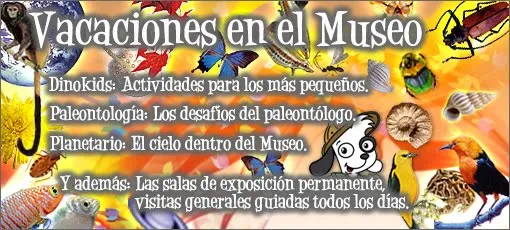
These Winter holidays, Discovery Kids will be present in the Museum's halls so that children can discover the secrets of nature and the curiosities of its animals.
In the Audiovisual Room, programs from that channel will be shown.
Furthermore, from Friday to Sunday from 14 to 19 h. kids will be able to dance, play and take photos with Doki and his friends.
All activities that Discovery Kids will carry out are free with the museum's general admission. Don't miss it.
Av. Angel Gallardo 470 - C1405DJR - Buenos Aires - Argentina
Web: http://www.macn.secyt.gov.ar/
Museo de La Plata
The Museo de La Plata is a Natural Sciences museum and unlike other museums of this type, it includes Human Sciences such as Archaeology, Anthropology, Ethnography, etc.
In addition to the activities, the museum is housed in one of the most beautiful buildings in the country and it is a pleasure to tour it for adults and children alike.
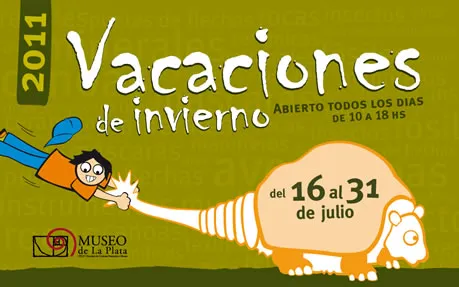
From July 16 to 31, EVERY DAY, from 10 to 18 hours.
Tickets are sold until 17:30 h. Open on holiday Mondays.
Closed on January 1st, May 1st and December 24, 25 and 31
Web: http://www.fcnym.unlp.edu.ar/museo/
In the southern area of the conurbano we have the Abremate center, dependent on the National University of Lanús.
Faculty of Astronomical and Geophysical Sciences.
Astronomical Observatory of the UNLP
All Workshops are free. Limited spots. Registration open.
Winter Break 2011
Thematic Workshops on Geophysics and Astronomy for Children between 6 and 12 years old
Registration starting Tuesday, July 12 from 9:00 to 12:00 h.
Call (0221) 423-6593 ext.112 or in person at the Faculty of Astronomical and Geophysical Sciences.
Workshops for children 6 to 8 years old
* Galileo
* Let's Meet Mr. Volcano
* The Faces of the Moon
* Making a Comet
Workshops for children 9 to 12 years old
* Discovering Volcanoes
* The Earth Moves
* Treasure Hunt with GPS (cancelled in case of rain)
* Space Travelers
Each workshop lasts 1 hour.
No need to bring any materials.
Paseo del Bosque s/n
Web: http://bit.ly/o56wtj
Amigos de la Astronomía
And, of course, it's a good opportunity to take guided tours of the Argentine Association Amigos de la Astronomía.
Sources and related links
About the images
- The images correspond to each cited institution and were used only for illustrative purposes.