A collection of links to music, images and videos that relate art and science. Today: NGC 4631, the Whale Galaxy; Stephan's Quintet and the film It's a Wonderful Life!; A rare footprint and a not-so-welcoming cosmic embrace; Music: Emitremmus: Starcraft II-Welcome to Nova; Video: What is it like to live and work in the driest Desert?

Images of the decade
Chandra detects a halo of hot gas around a galaxy similar to ours
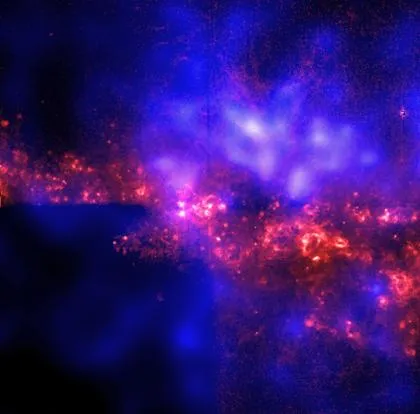
A team of astronomers led by Professor Daniel Wang, from the University of Massachusetts, observed NGC 4631 (the Whale Galaxy), a spiral galaxy about 25 million light-years from Earth, with Chandra and Hubble.
X-ray satellites had previously detected emissions from that and other galaxies, but Chandra's resolution allowed the researchers to separate the X-ray sources from the diffuse halo. With this instrument, they found a halo of X-ray gas at nearly 3 million degrees and extending about 25,000 light-years from the galactic plane.
"Scientists debated for forty years whether the Milky Way has a 'corona' or halo of hot gas," Wang noted and added, "Since we are inside the galaxy we cannot go out and take a picture. However, by studying similar galaxies, like NGC 4631, we can get an idea of what is happening in our own galaxy."
The image was made public on July 19, 2001.
Video of NGC 4631
http://www.youtube.com/watch?v=j7GUk4qob-s
Credits: X-ray: NASA/CXC/UMass/D.Wang et al., Optical: NASA/HST/D.Wang et al.
Clusters of stars born in cosmic collisions
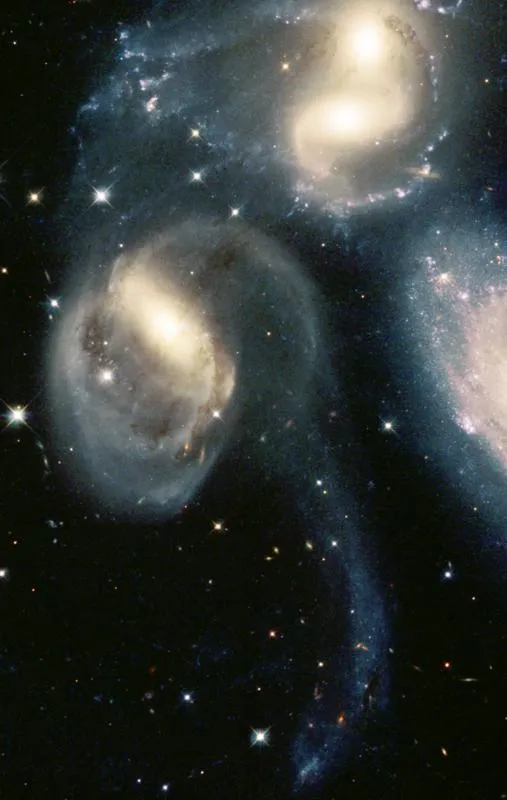
At the beginning of the 1946 film It's a Wonderful Life (¡Que bello es vivir!), angelic figures take the form of the famous compact group of galaxies known as Stephan's Quintet. In reality, those galaxies are not so celestial. Hubble images show that the quintet has been behaving devilishly. At least two of the galaxies have been involved in interactions that stripped stars and gas from the surrounding galaxies, but also generated new stellar life.
From this "cosmic destruction" emerged more than 100 star clusters and several dwarf galaxies. The young clusters, each with millions of stars, are clearly shown, for the first time, in images taken by Hubble's WFPC2.
This image is a close-up view of Stephan's Quintet and reveals star clusters born from violent interactions among some members of the group. The photo shows three star-forming regions: the long tail and spiral arms of NGC 7319 (near the center), the gaseous debris of two galaxies, NGC 7318B and NGC 7318A (top-right), and the northern area of these galaxies (to the left).
The bluish color of the clusters indicates they are relatively young. Their ages range from 2 million to one billion years.
Here we can see an annotated image of the Quintet:
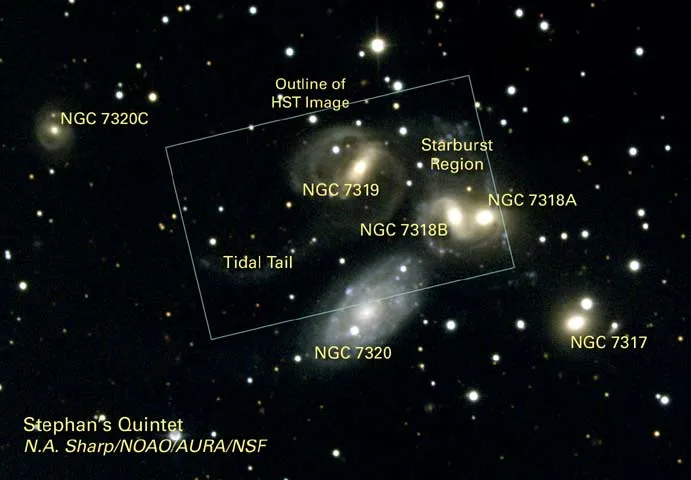
The images were published on July 19, 2001 on HubbleSite.
Credits: NASA, Jayanne English (University of Manitoba), Sally Hunsberger (Pennsylvania State University), Zolt Levay (Space Telescope Science Institute), Sarah Gallagher (Pennsylvania State University), and Jane Charlton (Pennsylvania State University)
Science Credits: Sarah Gallagher (Pennsylvania State University), Jane Charlton (Pennsylvania State University), Sally Hunsberger (Pennsylvania State University), Dennis Zaritsky (University of Arizona), and Bradley Whitmore (Space Telescope Science Institute)
The release included this video:
Video: Hubble-A Real Battle in Stephan's Quintet
http://www.youtube.com/watch?v=Ivs0HlsyQX4
Here we can see in video the first scene of It's a Wonderful Life!. Although in the scene these galaxies seem to be spiritual entities worried about a certain George Bailey, calm and angelic, in reality, they are galaxies with violent interactions, although those collisions also generate star formation.
Video: It's a Wonderful Life First Scene
http://www.youtube.com/watch?v=uk8qY4FX-bE
Images of the week
A rare cosmic footprint
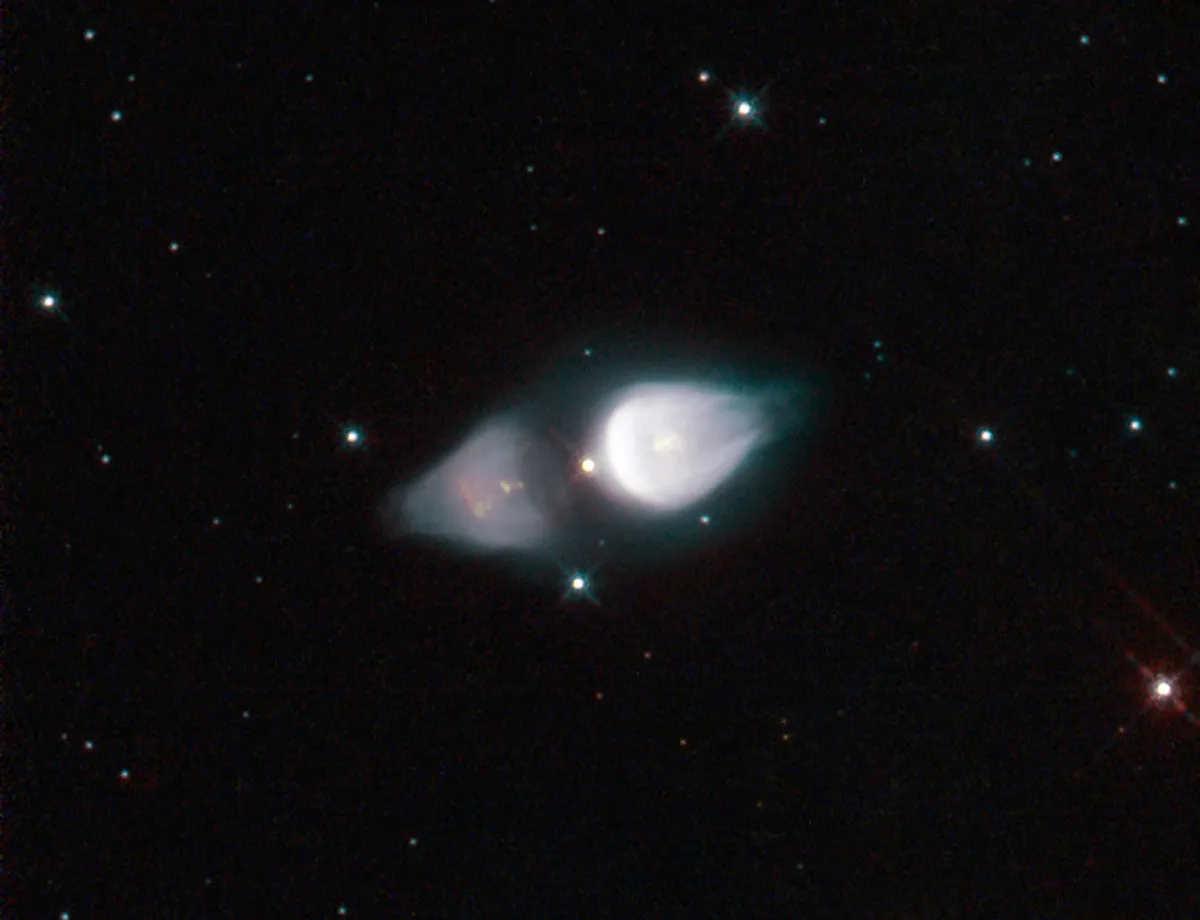
Hubble captured that image of a rare phenomenon called a protoplanetary nebula. This particular example, Minkowski's Footprint or Minkowski 92, includes two onion-shaped structures.
Protoplanetary nebulae like this one have short lives, as they are preliminary stages of the more common planetary nebula phase. In the middle of the image there is a star, which will soon be a white dwarf. The powerful stellar wind is sculpting the gas into the very interesting shapes that Hubble shows us.
The rare object is located 8,000 light-years away in the constellation of Cygnus.
It was the Hubble Space Telescope's Picture of the Week.
Credit: NASA/ESA Hubble.
A galactic embrace
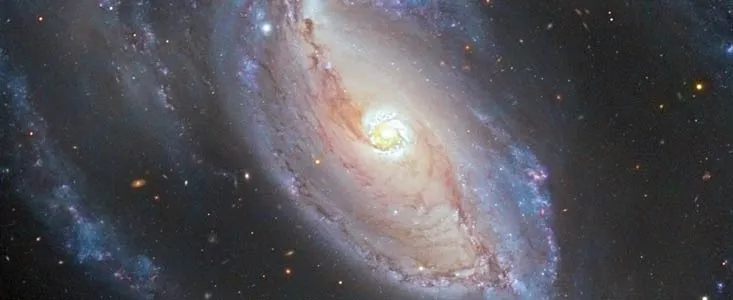
Two galaxies, about 50 million light-years away, are locked in a galactic embrace. The Seyfert galaxy NGC 1097, in Fornax, is seen in the image taken with ESO's VLT. A comparatively small elliptical companion, NGC 1097A, is also seen at the top left. There is evidence that both have interacted in the recent past.
The larger galaxy possesses four particle jets or jets, too extensive and diffuse to be seen in the image, that emerge from the center forming an X-shaped pattern and which are the longest jets in visible length known in any galaxy. These jets could be remnants of a dwarf galaxy that was cannibalized by NGC 1097 billions of years ago.
But this galaxy, as mentioned, is of the Seyfert type, which implies it possesses a supermassive black hole at its center, but being relatively weak it is thought that it is not swallowing large amounts of gas. In the center, however, there is a ring of bright knots surrounding the nucleus. They are thought to be large hydrogen bubbles between 750 and 2500 light-years in diameter, ionized by the intense ultraviolet radiation from young stars.
The image was taken in 2004, while the then president of Chile, Ricardo Lagos, was visiting the facilities, but it was chosen as the image of the week.
Credit: ESO
Space Music
Emitremmus
Like the Red Hot Chili Peppers song, Emitremmus (palindrome of summer time), an artist, perhaps of Italian origin, who is interested in digital drawing and photography, as well as music, exhibits his work on Takusama.com and on Jamendo.
Among his works is Welcome To Nova (Single), also known as "Starcraft II - Welcome To Nova". It is a tribute song to the epic game developed by Blizzard Entertainment.
The track has a video, in which the author notes that he has been composing since he was 17. In 2005 he released his first album "Step By Step".
Another of his works is Nuclearization.
It is a promise to take the listener on a "dark journey" made of radiations, storms of electronics and torments of the unconscious.
"Nuclearization" has been designed to evoke the deepest fears of a world devastated by atomic explosions and of an inevitable deterioration as a sign of human psychological devastation.
In Quarantined, new strange creatures populate the streets of desolate and destroyed cities. They are angry and want your blood. One must prepare for a biological threat.
In Lies (Clouds Of Fukushima) he returns to the topic of the nuclear disaster, one week after Fukushima.
In these works, there are dark sounds and elements of science fiction. While it is possible to interpret the tracks on these albums as an anti-nuclear message, the artist points out that this is not his goal, that is, he does not try to make his audience think in one way or another. But, without a doubt, it expresses a personal interest of the artist in those topics and is a form of expression.
Both on the albums on Jamendo and on Takusama.com it is possible to access "interviews", perhaps conducted by the musician himself, in which he points out his influences, his way of composing.
It is also possible to follow Emitremmus on Facebook.
Science in motion
ESOcast 29: Running a Desert Town
The Atacama Desert in Chile, one of the driest and most hostile environments in the world. Under a scorching sun, only a few species of animals and plants survive. However, it is the place where ESO operates the VLT.
See more from ESO on its Videos page and on dotSub, with subtitles.
To access previous editions of this section, consult the Multimedia Selection Series.