A collection of links to music, images, and videos that relate art and science. Today: Images of M17: NGC 1232. Music: Stellarium, by Protostar. Video: Let's Dance with the Perseids.

Images of the Decade
Cosmic Champagne
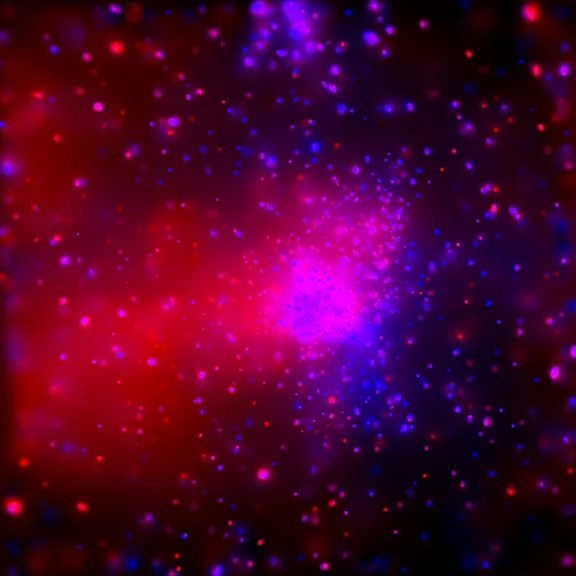
This image taken with the Chandra Observatory reveals hot gas flowing from a massive, young star at the center of the object cataloged as M17. It is a nebula known as the Horseshoe and also Omega due to the apparent similarity of those symbols to the structure of the object, which lies about 6,000 light-years away. A group of massive young stars is responsible for the activity in the nebula and is located in the bright pink region near the center of the image.
The stars in the Horseshoe are only a million years old, so this hot gas is unlikely to come from a supernova explosion, as that is a final stage of a star and normally takes more time. Instead, collisions between the winds of particles flowing from the massive stars could have heated the gas, which in the image appears to flow like champagne from a bottle when it is uncorked.
The image was part of research led by L. Townsley and others and was published on the Chandra site on August 14, 2003.
Credits: NASA/CXC/PSU/L.Townsley et al.
Images of the Week
NGC 1232
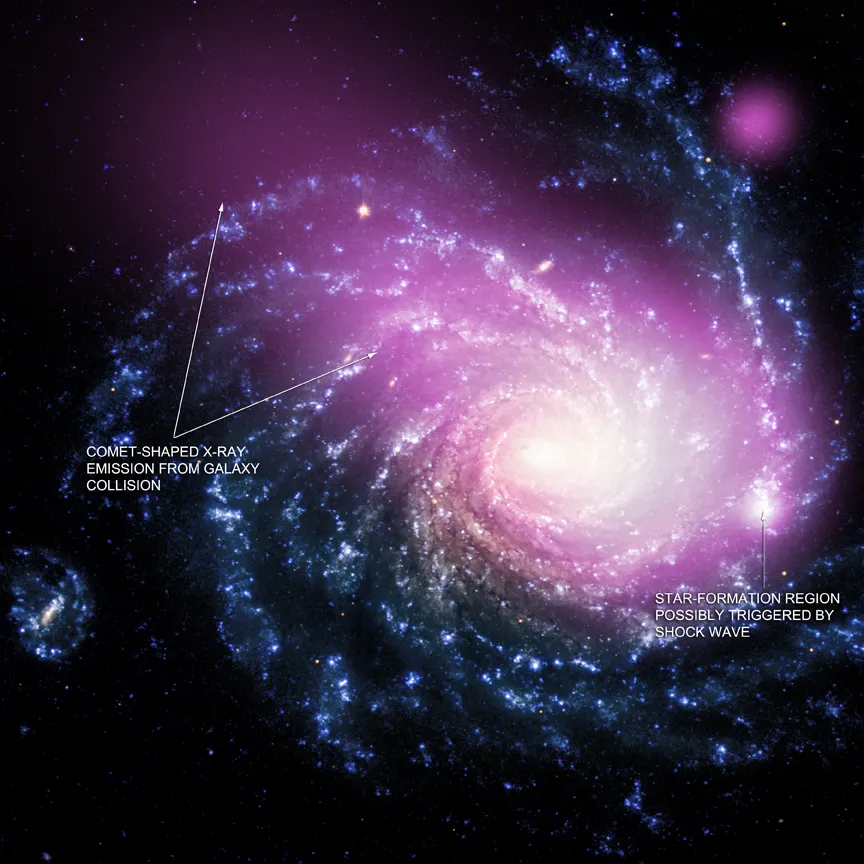
Observations with Chandra, NASA's X-ray observatory, revealed a massive cloud of very hot gas in a galaxy 60 million light-years from Earth. The gas was likely caused by the collision between a dwarf galaxy and a much larger galaxy cataloged as NGC 1232, in a not-so-romantic cosmic dance.
The X-ray and optical data allow us to understand that the collision between the galaxies caused a shock wave that generated very hot gas. The Chandra data, in purple, show the hot gas with a comet-like shape.
Two features are indicated in the image: on the left, the "comet" shape in X-ray data, and on the right, a region of star formation possibly triggered by the shock wave.
The data that made it possible to create these images were part of research led by Gordon Garmire.
The images were published on the Chandra site on August 14, 2013.
Credits: X-ray: NASA/CXC/Huntingdon Inst. for X-ray Astronomy/G.Garmire, Optical: ESO/VLT
To access previous editions of this section, consult the Multimedia Selection Series. The series attempts to show that the immensity of the universe can be perceived in different ways. I choose some images from a decade ago—so they don't fall into oblivion—and from the current week that is ending, as well as sounds/music and videos that are artistic forms of expression with content related to astronomy and related sciences. I am also collecting these materials on the Pinterest account