A collection of links to music, images and videos relating art and science. Today: Images of Cassiopeia A; An optical illusion. Music: Cassiopeia - Starry Sky, by Andrey Klimkovsky. Video: A short trip through the universe.

Images of the decade
Recycling Cassiopeia A
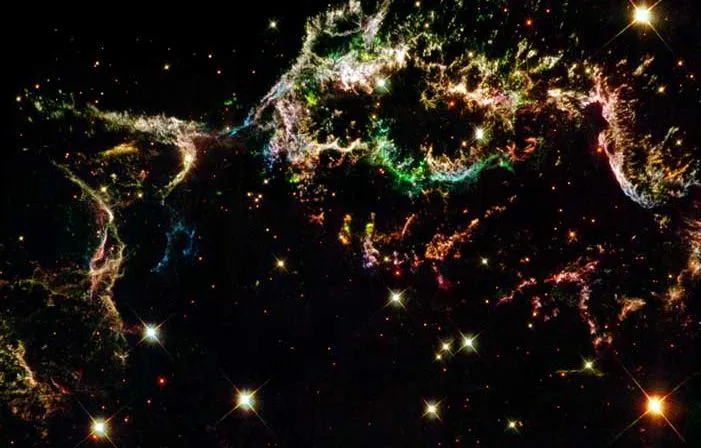
For billions of years, massive stars in our Milky Way have had spectacular "lives."
The collapse of large clouds of gas and dust causes their core to ignite, thus creating heavy elements.
After several million years the enriched material is thrown into interstellar space after the star's explosion and the formation of new stars begins. The universe recycles.
The expanding cloud of debris known as Cassiopeia A (Cassiopeia A, in Spanish or Cas A, for short) is an example of this final phase of the stellar life cycle, also called a Supernova Remnant (SNR).
The light from the explosion that created the remains of this supernova was probably first seen in the sky of planet Earth just 300 years ago, although the light took more than 10,000 years to reach us.
In this superb image -obtained with the Hubble Space Telescope- of cooling filaments and knots in the Cas A remnant, light from specific elements has been color-coded to help astronomers understand the recycling of stellar material in our galaxy.
For example, red regions are dominated by emission from sulfur atoms while blue ones correspond to oxygen.
The area shown is approximately 10 light-years across.
The image was published on HubbleSite on 07/03/2002, but was chosen as the Astronomy Picture of the Day (APOD) for August 30, 2003. In Spanish at Observatorio.
Credits: Hubble Heritage Team(STScI /AURA),R. Fesen(Dartmouth)and J. Morse(CASA, U. Colorado),NASA
Images of the week
Space optical illusion
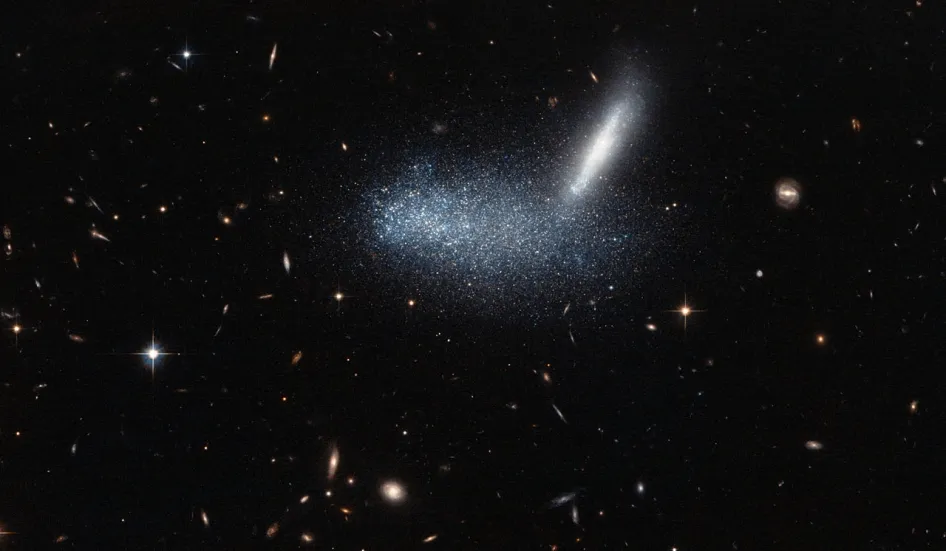
At first glance, this Hubble image appears to capture two space giants engaged in a fierce celestial battle, with two galaxies merging. But that is not the case, showing us how easy it is to misinterpret such images.
By coincidence, due to a matter of perspective, the two galaxies appear aligned from our point of view, but they are not. In the foreground, the irregular dwarf PGC 16389 -seen here as a cloud of stars- covers its neighbor APMBGC 252+125-117, which appears edge-on.
(Since in astronomy distance is not measured directly, but calculated, one might wonder how far away these objects lie. Considering data in Simbad about the first irregular galaxy, and using the z value in a calculator that uses Hubble's Law, it would give about 32 million light-years away.)
The image was published on the NASA website on August 28, 2003.
Credits: ESA/Hubble & NASA, Acknowledgement: Luca Limatola.
Space Music
Cassiopeia - Starry Sky, by Andrey Klimkovsky
Andrey Klimkovsky is a Russian composer who takes the mythical story of the Queen of Ethiopia and joins it with modern scientific knowledge to create a relationship.
And he says: "Human life is like a moment, a spark, a shooting star... For us, residents of the industrial age, the comparison with photographic exposure is useful, where a photosensitive material perceives the universe for hundredths of a second and during that brief interval the world does not change. It happens almost all the time. But there are exceptions or blurry pictures due to the speed of events and optical illusions. (...) Cassiopeia was as bright and fleeting as the fall of her empire."
It should be said that this line, as well as the following ones on this album's page on BandCamp, allude to SN 1572, the supernova in Cassiopeia seen by Tycho Brahe.
Animated Science
A Short Trip
A YouTube and Vimeo user (badatti2d) took photos made with Hubble and added music from the group Secret Garden who make neo-classical music. In this case, the track "Duo" from their album Once in a Red Moon. A way of "recycling" music and images to create something new. It's not to be missed.
To access previous editions of this section, consult the Multimedia Selection Series. The series attempts to show that the immensity of the universe can be perceived in different ways. I choose some images from a decade ago -so they don't fall into oblivion- and from the current week ending, as well as sounds/music and videos that are artistic forms of expression with content related to astronomy and related sciences. I am also collecting these materials on the Pinterest account