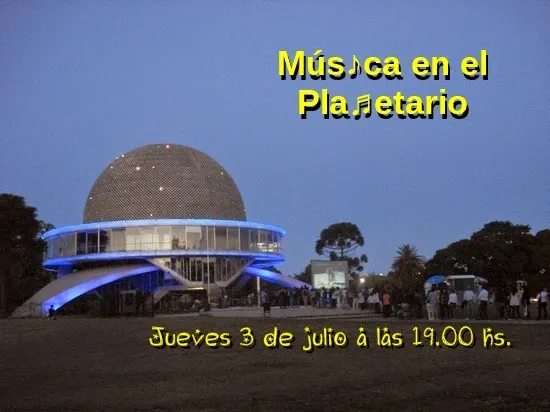
Lecture by Dr. Juan Carlos Forte (CONICET-Planetario Galileo Galilei)
Friday, July 11 at 19 h. Free activity in the Sala de Espectáculos
From the creation of the first sky maps to the construction of the models that dominate current Cosmology, Astronomy has traveled a path that confronts it with questions that, although we answer them daily in our lives (where?, when?, how?, what for?, who or Who?), become enormously complex when humankind asks them of the Universe.
In particular, the "where?" is linked to the problem of distances to celestial objects. Practically no intrinsic characteristic of those objects can be known if reliable methods to estimate those distances are not found first.
The GAIA satellite, which gives its name to the entire mission, is already located at the so-called "Earth-Sun Lagrange point L2" (one and a half million km from our planet) and aims to provide unprecedented data, in terms of volume and quality, on about one to two billion celestial objects in a range covering from the scale of the Solar System to the calibration of cosmological distances.
The talk will describe the ingenious technological solutions that will enable such an undertaking and the context in which that data can make crucial contributions to the Astronomy of the future.
Coordination: Lic. Lucía Sendón de Valery – Director of the Planetario de la Ciudad de Buenos Aires “Galileo Galilei”
(Free activity/Admission in order of arrival, no prior reservation)
Friday, July 11 at 19 h.
Dr. Juan Carlos Forte is a Senior Researcher at CONICET. Full Member of the Academia Nacional de Ciencias de Buenos Aires and Corresponding Member of the Academia Nacional de Ciencias en Córdoba. Former Dean of the Facultad de Ciencias Astronómicas y Geofísicas of the Universidad Nacional de La Plata.
Guide to our Galaxy - ESA, Youtube- http://youtu.be/G5AdrupH788
Sources and related links
- Planetario Galileo Galilei