In February, a faint star a few thousand light-years away suddenly exploded, shining so intensely that for a few days it was visible to the naked eye.
Sent by: Liberto Brun Compte to Astroseti
Article on Astroseti
Original article on Space.com
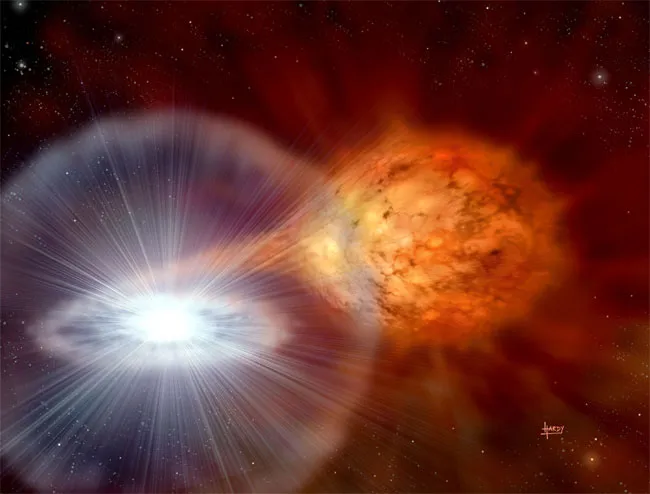
The star is a stellar corpse the size of our Earth, recognized as a white dwarf and paired in a binary system with a red giant star, a dying star that at some time must have resembled our Sun. The red giant has been dumping gas onto the surface of the white dwarf and after a few years, enough matter accumulates to generate a giant thermonuclear explosion.
It was one of these explosions, called a "nova," that astronomers and star observers detected early this year.
The double star system, called RS Ophiuchi, is known as a recurrent nova because five similar eruptions have already been detected. The first observation took place in 1898; the last one before this occurred in 1985.
The new observations, made using advanced radio and X-ray telescopes, which were not available during the last eruption, revealed that the explosion is much more complex than previously assumed.
Standard computational models had predicted a spherical explosion ejecting matter equally in all directions. However, instead of that, the latest observations showed that the explosion evolved into two lobes, confirming suspicions that nova explosions form twin jets of stellar material that are thrown from the white dwarf in opposite directions.
"The radio images represent the first time we have ever seen the birth of a jet in a white dwarf system." We literally see the emission "turn on," said Michael Rupen, an astronomer at the National Radio Astronomy Observatory who studied RS Ophiuchi using the Very Long Baseline Array (VLBA).
As impressive as novae are, they may simply be the precursors of an even more violent explosion that could occur in the future, scientists say.
Like the Sun, only more powerful
The thermonuclear detonations on white dwarfs are similar to those that occur on the surface of the Sun, but can be 100 thousand times more powerful. During each detonation, an amount of gas equal to the mass of the Earth is launched into space. Part of this ejected material strikes the extended atmosphere of the inflated red giant, creating shock waves that accelerate electrons to nearly the speed of light. As the electrons travel through the stars' magnetic fields, they emit radio waves that can be detected by telescopes on Earth.
The shock waves move at over 6.4 million kilometers per hour (about 4 million miles per hour). For a few weeks in each eruption, the white dwarf becomes a red giant.
"After the thermonuclear explosion, the white dwarf will swell to become a red giant for a few weeks while the hydrogen that has been ejected into space fuses into helium," explains Richard Barry of NASA's Goddard Space Flight Center in Maryland.
All eyes on Ophiuchus
Japanese astronomers first detected signs of the latest nova from RS Ophiuchi on the night of February 12. Subsequent observations made by radio telescopes revealed an expanding blast wave whose diameter was already the size of Saturn's orbit around the Sun.
In the following weeks, several X-ray telescopes and radio telescopes around the world followed RS Ophiuchi more closely, including the MERLIN facility in the United Kingdom, the European EVN, the VLBA (Very Long Baseline Array) and the VLA (Very Large Array) in the United States, and NASA's Swift and Rossi X-ray Timing Explorer satellites.
The findings from the Rossi X-ray Timing Explorer and the VLBA/EVN observations are detailed in two separate studies published in the July 20 issue of the journal Nature.
The two stars, the red giant and the white dwarf, that form RS Ophiuchi, are separated by 1.5 astronomical units, or one and a half times the distance from Earth to the Sun. The binary system is located in the constellation Ophiuchus about 5,000 light-years away – relatively close by astronomical standards.
"We have a front-row seat for this very important event," Barry told Space.com. Barry is a co-author on another study of RS Ophiuchi that will appear in a future issue of the Astrophysical Journal.
Precursor to a supernova?
When the explosion ends, gas will accumulate again on the white dwarf and the explosions will restart, perhaps within about 20 years. It is unknown whether the white dwarf emits all its accumulated material during each eruption, or if some of the material is saved and slowly increases the mass of the dead star.
"If the white dwarf is increasing its mass, then eventually it will go off in a titanic supernova explosion and the cycle of explosions will come to an end," said Tim O'Brien of the University of Manchester, a co-author on one of the Nature studies.
White dwarfs must reach 1.4 critical solar masses before they can explode in what scientists call a type 1a supernova. The white dwarf in RS Ophiuchi is near the critical limit now, but probably requires hundreds of thousands of years to accumulate the final amount of mass, scientists say.
Because all type 1a supernovae emit the same amount of light at their peak, they serve as "standard candles" that astronomers use to calculate cosmic distances.
"Our understanding of these objects is extremely important because any miscalculation or inaccuracy in the total light emitted from a supernova can have dramatic effects on our calculations of the scale and size of the entire universe," said Barry.