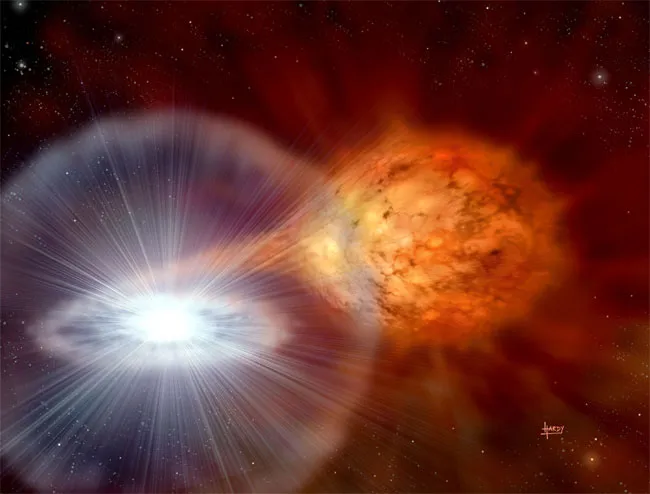
In the journal Nature, a group of astronomers led by Jennifer Sokoloski of the Harvard-Smithsonian Center for Astrophysics explains that the powerful explosion of the recurrent nova RS Ophiuchi, which occurred on February 12, 2006, is giving scientists the chance to have a clearer picture of the early stages of this type of repetitive outbursts, but also, of bigger explosions, as it seems to be heading towards becoming a supernova.
Via Cielo Sur and El Mundo
RS Ophiuchi is a stellar system composed of a white dwarf star and a red giant. But furthermore, it is providing new clues about the occurrence of much more powerful explosions, known as supernovae. The white dwarf is orbiting so close to the red giant that it is practically inside its atmosphere. Thus, the dwarf is absorbing so much material from the red giant that its future could be that of a supernova explosion.
During the night of February 12 of this year, a group of Japanese astronomers reported that a star called RS Ophiuchi had suddenly begun to increase its brightness and become increasingly visible in the night sky.
Although that was the last in a series of explosions that had occurred in the last hundred years, it was the first since 1985 and offered the opportunity to capture it with more powerful telescopes and understand the causes and consequences of those eruptions.
Their first observations, made just two weeks after the explosion, showed a shock wave comparable in size to the orbit of Saturn around the Sun.
The shock wave was the result of a nuclear explosion that occurred on the surface of Ophiuchi, neighbor to a red giant star.
Ophiuchi is a white dwarf, a supermassive dead star the size of Earth that was once the core of a star like the Sun.
The white dwarf was capturing gas emitted by the red giant and finally absorbed enough to trigger the explosion, similar to those that occur on the Sun.
In less than a day, its energy increased more than 100,000 times that of the Sun, and the gas, of the same mass as Earth, spread into the atmosphere at a speed of several thousand kilometers per second.
More information at:
http://www.cfa.harvard.edu/