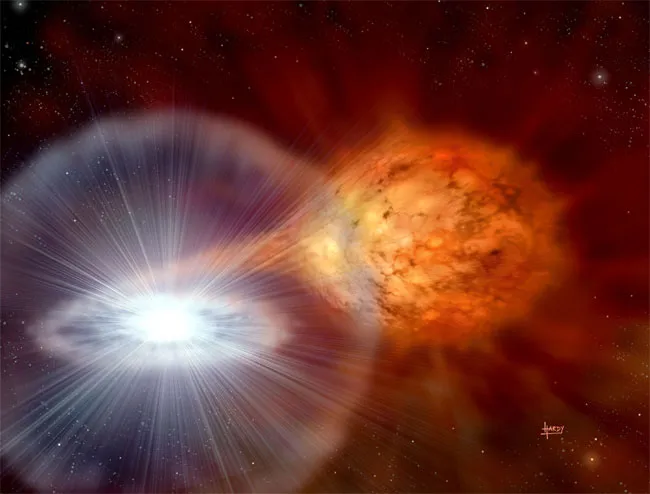
A group of scientists led by Andrea de Luca from the Institute of Astrophysics and Cosmic Physics in Milan, Italy, report that they have taken a very precise image of an object discovered 25 years ago, being the first of its kind to be seen in our galaxy. They state that thanks to the study of this object carried out with the X-ray telescope XMM-Newton, from the European Space Agency ESA, this very special object was located, at the center of the supernova remnant RCW103, the gaseous remains of a star that exploded approximately 2000 years ago.
Via CieloSur
At first glance, RCW103 and its central source would be an example of the remnants left after a supernova explosion: a bubble of ejected material and a neutron star.
But, by performing a continuous observation of this object, for 24.5 hours, it was shown that the emission of this central object varied with a cycle that repeated every 6.7 hours, this is an astonishingly long period, hundreds of thousands of times longer than what is expected in a young neutron star. The object is called 1E161348-5055, but scientists have nicknamed it 1E (the E for the Einstein Observatory which was its discoverer), and it is located 10,000 light-years from Earth, towards the constellation Norma.
Patrizia Caraveo, a scientist on the team, states that "the properties in a compact object 2000 years old tell us of two possible scenarios: on the one hand that this source comes from an accretion disk or is originated by a magnetic field". It could be that 1E is a "magnetar" of which currently only about a dozen are known, or else 1E would be an X-ray binary system, in its early stages. The team states that "RCW 103 is an enigma" which forces us to study more the evolution of supernovas, neutron stars.
More information at:
ESA