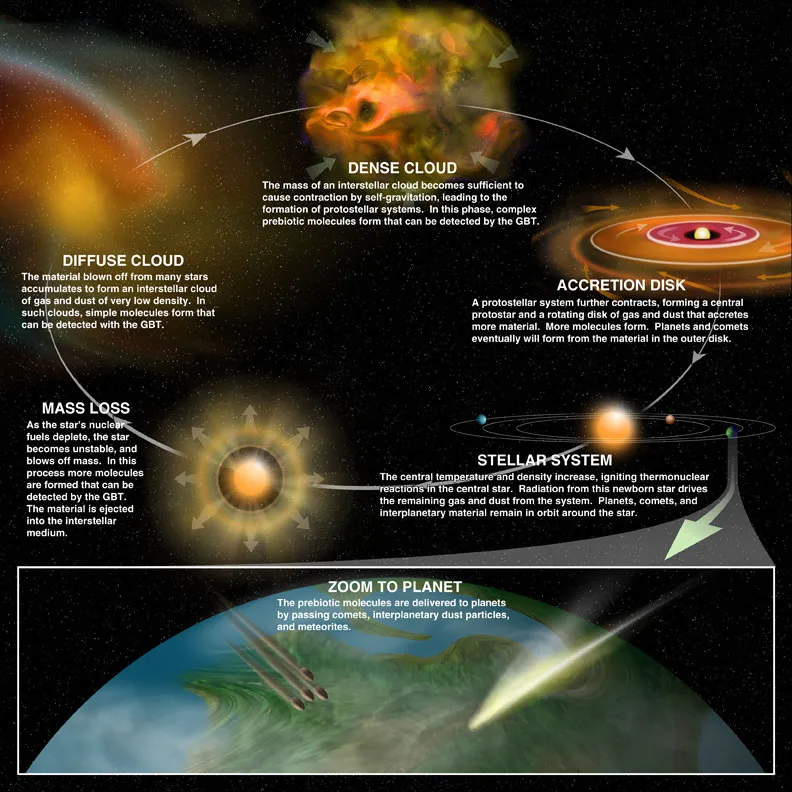
Scientists led by Jan M. Hollis of NASA's Goddard Space Flight Center conducted a two-year study on the formation of chemical precursors of life. For this, they used the Robert C. Byrd telescope of the National Radio Astronomy Observatory (NRAO), located in Green Bank, Virginia, United States. Thanks to the study, eight new complex biological molecules were discovered in interstellar space.
Via CieloSur
This work is unprecedented in the last 35 years of the history of the search for complex molecules in space and reveals that the prebiotic chemistry of the universe is at work.
This new discovery will help scientists understand how the molecular precursors of life can form in gigantic clouds of gas and dust in which stars and planets are born.
Phill Jewell, another scientist involved in the study, says that "the first chemical processes that gave rise to life on Earth were probably present even before the formation of our planet".
These new 8 discovered molecules add to a total of 141 molecular species found in interstellar space. 90% of these molecules contain Carbon, an element necessary for a molecule to be classified as organic.
The newly discovered molecules are composed of 6 to 11 atoms each. Let us remember that the mass of an interstellar cloud is composed of 99% gas and 1% dust.
The discoveries were made in two interstellar clouds; Sagittarius B2 and Taurus TMC1, the molecules are Acetamide, Cyclopropenone, Propenal, Propanal, Ketenimine, methyl-cyano-diacetylene, methyl-triacetylene and cyanoallene.
More information at:
http://www.nrao.edu/