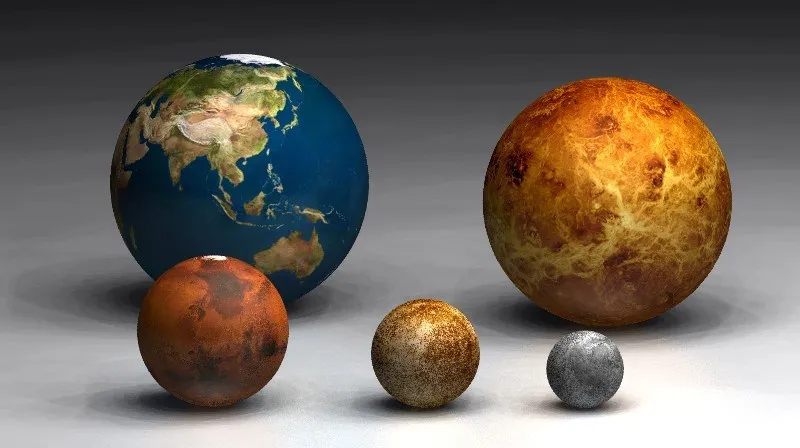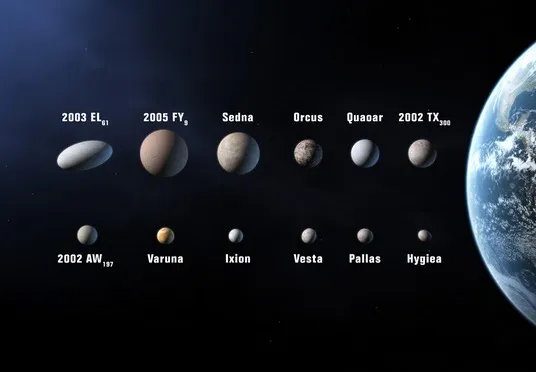
The Solar System will have 12 planets instead of the current nine, and could have more in the future if the definition of a planet presented by the International Astronomical Union (IAU) to its members is approved; they will vote next week.
Via El País
This is the first time an attempt has been made to define what a planet is, and the proposal has been met with divided opinions in Prague, where the triennial assembly of the IAU is being held. With this scientific definition, Pluto, until now the ninth planet of the Solar System and the one most at risk of losing its status, is the one that gains the most.
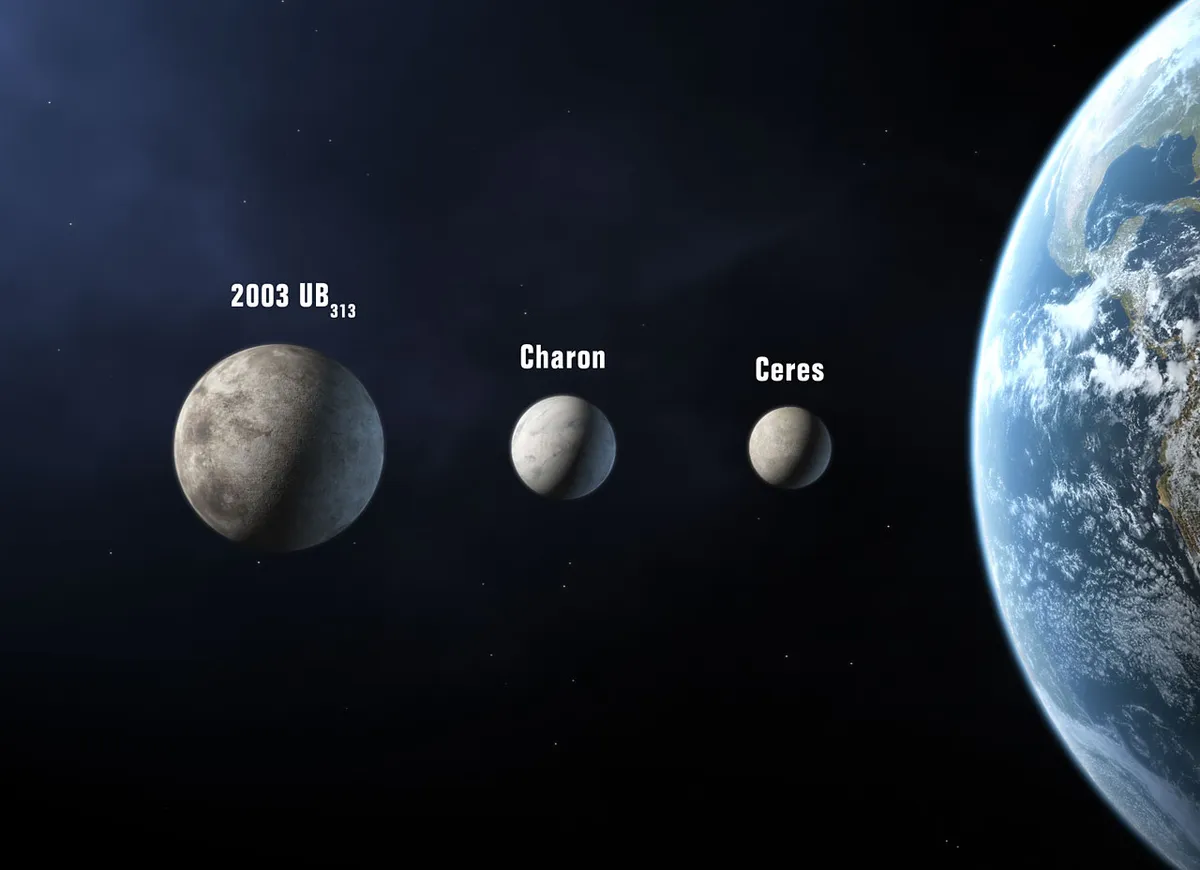
Pluto would not only remain a planet but would become a double planet with its former moon Charon and would also give its name to a new category of planets, the "plutons," among which the recently discovered Xena (the official name is 2003 UB313) would be included. But Pluto would no longer be the ninth, but the tenth planet of the Solar System, because it would move up one place (according to the order of distance from the Sun) as the small Ceres, discovered in 1801, is inserted between Mars and Jupiter.
"Recent discoveries of objects in the outer regions of the Solar System that are comparable in size to Pluto have raised the question of whether or not they should be considered planets," explained Ron Ekers, president of the IAU. And it turns out that the most important thing for something to be considered a planet is that it be spherical and orbit a star. Mass is the main factor, since, according to the definition that would go into textbooks, a planet is: a celestial body that has sufficient mass for the result of the interaction of its gravity with other forces "results in a (nearly round) shape of hydrostatic equilibrium," that "is in orbit around a star" and that "is not a star nor a satellite of a planet."
In practice, this means it is a celestial body with a mass greater than 500 quintillion kilograms and a diameter greater than 800 kilometers. Any candidate body for planethood near this boundary, such as the asteroids Pallas and Vesta, would be evaluated individually.
Continuing with the definition, the proposal indicates that a distinction is made between the eight "classical" planets discovered before 1900, which move in nearly circular orbits close to the plane of the ecliptic, and other planetary objects in orbit around the Sun that are smaller than Mercury (the smallest classical planet). "We recognize that Ceres is a planet by the previous scientific definition," the proposal says. Although it is permitted to call Ceres a dwarf planet, this would not be an official category.
Regarding Pluto, it states: "We recognize that it is a planet (...) the same as one or more of the objects located beyond Neptune recently discovered. Unlike the classical planets, these objects typically have highly inclined orbits of great eccentricity and orbital periods greater than 200 years". This category of planetary objects, of which Pluto is the prototype, is considered a new class, that of the "plutons". The IAU clarifies that they would be called "plutons", not "plutinos", an informal category suggested by some astronomers for celestial bodies with the same orbital period as Pluto.
Furthermore, according to the definition, all non-planetary objects orbiting the Sun, such as asteroids, would be called "small Solar System bodies". The upper limit, between planet and star, a controversial topic, is left out of the definition. In the case of Charon, Pluto's giant moon, it is considered a planet because it orbits the Sun and because it revolves around a point (the center of gravity of the system) that lies outside Pluto. Earth's moon, on the other hand, is a satellite because that point is inside Earth.
The three "new planets" would then be:
----------
Sources:
The International Astronomical Union (IAU)
Also in La crónica de hoy
On Astroseti: Nuevos planetas llaman a la órbita de Plutón