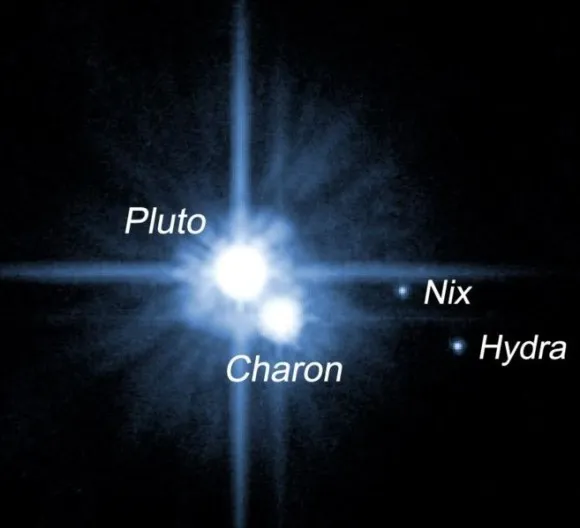
The names have been approved by the International Astronomical Union (IAU) for the two small satellites of Pluto discovered in May 2005.
Nix and Hydra are about 5,000 times fainter than Pluto and are at about two to three times the distance between Pluto and its largest moon Charon, which was discovered in 1978. The nine-member team that made the discovery selected the name Nyx for S/2005 P 2, which is the small satellite closest to Pluto, and Hydra for S/2005 P 1, the small satellite farthest away. Because asteroid 3908 had already been given the Greek name Nyx, the IAU changed the name to its Egyptian equivalent, Nix.
In mythology, Nix is the goddess of darkness and night, being the satellite that orbits distant Pluto, the god of the earthly underworld. Nix is also the mother of Charon, testimony to the giant impact that is believed to have created Pluto's three satellites, indicating that Charon was born from the material of which Nix is formed. Hydra is the terrifying monster with the body of a snake and nine heads, being the outer moon of Pluto, the ninth planet in the Solar System.
Additionally, the name Pluto begins with the letters "P" and "L" to honor Percival Lowell, who motivated the search that led to its discovery. Nix and Hydra, which begin with "N" and "H," honor the search for new satellites of the upcoming mission to Pluto called New Horizons, and the first letter of Hydra also honors the Hubble Space Telescope that was used to detect the satellites.
Sources: New Horizons mission site
Abierta.tv (in Spanish) and Science magazine