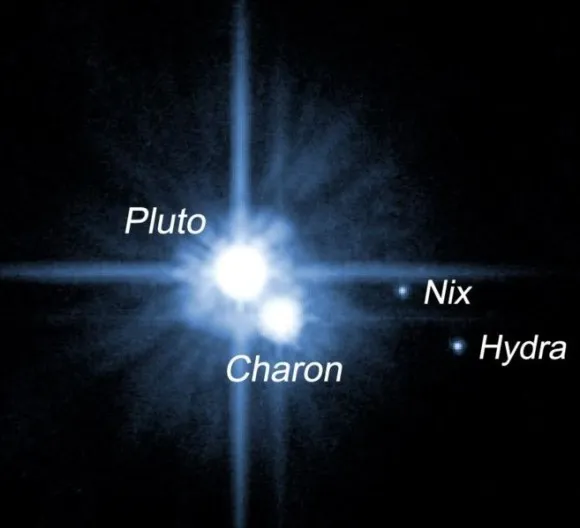
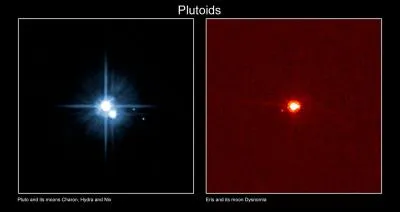
The results of the vote at the 2006 General Assembly of the International Astronomical Union have shaken the headlines of all the world's news agencies.
Via Astroseti
August 24, 2006 will be forever inscribed in the annals of the history of astronomy.
After long and heated discussions that were repeated in all forums of astronomy professionals and amateurs around the world, the 26th General Assembly of the International Astronomical Union (IAU) has reached its conclusion.
In the city of Prague, more than 2,500 astronomers participated in six symposia, seventeen joint discussions, seven special sessions, and four more special sessions. Scientific results were discussed, new international collaborations were initiated, plans for future facilities were presented, and much, much more. And as a finale, six resolutions were voted on at the closing ceremony of the assembly.
The IAU Resolutions
The six resolutions adopted at the 26th General Assembly of the International Astronomical Union were as follows:
- Resolution 1 of GA-XXVI: “Precession Theory and Definition of the Ecliptic”
- Resolution 2 of GA-XXVI: “Supplement to the IAU 2000 Resolutions on reference systems”
- Resolution 3 of GA-XXVI: “Re-definition of Barycentric Dynamical Time”
- Resolution 4 of GA-XXVI: “Endorsement of the Washington Charter for the Communication of Astronomy with the Public”
- Resolution 5A of GA-XXVI: “Definition of ‘planet’”
Resolution 6A of GA-XXVI: “Definition of Pluto-class objects”
What is a planet?
But the most interesting resolution, the most discussed, and the one that will surely be the most remembered, was the one defining the word “planet.”
Since the early days after the discovery of Pluto, discussions began about its planetary status. Many agreed with it, but many others opposed it.
However, the years went by, and Pluto remained a planet, a very special one, very separate from the rest, but generally accepted, or at least tolerated.
Astronomical instruments continued to improve, and scientists learned more about our solar system. And, of course, the moment arrived when a planetary body larger and more distant than Pluto was discovered, the one that still bears the provisional name 2003 UB313. Its discoverers (Mike Brown et al.) argued that it had the right to be considered the tenth planet, if only for “sociological reasons.” And the uproar erupted.
It became evident that there had to be a definition of a planet to replace the one of a “wandering” star that came to us from antiquity. It was a job for the International Astronomical Union (IAU). And it was decided that the matter should be resolved at the XXVI General Assembly to be held in August 2006 in the city of Prague.
For this purpose, a committee was appointed to make a proposal. This committee could not reach a conclusion, so another special committee, with fewer members, was appointed to give its opinion.
The definition from this committee, the official one, proposed a categorization so broad that it raised the number of planets in our solar system to 12, but with real possibilities that this number would reach 53 in a very short time, due to the existence of many “candidates” with chances of obtaining the title.
Almost no one was satisfied, and the reaction from the community of astronomers was not long in coming. A group of them, led by Uruguayan scientists Julio A. Fernández and Gonzalo Tancredi, and which included recognized specialists from around the world, presented a new proposal that would finally be proclaimed as the final resolution of the assembly.
The winning proposal
The members of the IAU gathered at the 2006 General Assembly agreed that a “planet” would be defined as a body that (A) is in orbit around the Sun, (b) has sufficient mass for its own gravity to overcome rigid body forces so that it assumes a hydrostatic equilibrium shape (approximately spherical), and (c) has cleared the neighborhood around its orbit.
This means that the solar system has eight “planets”: Mercury, Venus, Earth, Mars, Jupiter, Saturn, Uranus, and Neptune. It was also decided that a new, different class of objects exists, called “dwarf planets.”
It was agreed that “planets” and “dwarf planets” are two distinct classes of objects. The first members of the “dwarf planet” category are Ceres, Pluto, and 2003 UB313 (provisional name). It is expected that the IAU will announce the categorization of more “dwarf planets” in the coming months and years. Currently, more than a dozen of these objects are listed on a waiting list, which will continue to be modified as new objects are discovered and the physical characteristics of existing candidates become better known.
The “dwarf planet” Pluto is recognized as an important prototype of a new class of trans-Neptunian objects.
The resolutions that were voted on
We detail below the text of the approved resolutions.
RESOLUTIONS
Resolution 5A is the main definition for the IAU's use of the terms “planet” and related ones.
Resolution 6A creates for the IAU's use a new class of objects, for which Pluto is the prototype. The IAU will decide on a process for naming these objects.
IAU Resolution: definition of a planet in the solar system
Contemporary observations are changing our knowledge of planetary systems, and it is important that our nomenclature for objects reflects our current knowledge. This applies, in particular, to the designation “planet.” Originally, the word “planet” described “wanderers” that were known only as moving lights in the sky. Recent discoveries lead us to create a new definition, which we can craft using the scientific information currently available.
Resolution 5A
Therefore, the IAU resolves that “planets” and other bodies in our solar system be defined into three distinct categories, as follows:
(1) A “planet”1 is a celestial body that (a) is in orbit around the Sun, (b) has sufficient mass for its own gravity to overcome rigid body forces so that it assumes a hydrostatic equilibrium shape (approximately spherical), and (c) has cleared the neighborhood around its orbit.
(2) A “dwarf planet” is a celestial body that (a) is in orbit around the Sun, (b) has sufficient mass for its self-gravity to overcome rigid body forces so that it assumes a hydrostatic equilibrium (nearly round) shape 2, (c) has not cleared the neighborhood around its orbit, and (d) is not a satellite.
(3) All other objects3 orbiting the Sun, except satellites, shall be referred to collectively as “Small Solar System Bodies”.
Notes
1 The eight planets are: Mercury, Venus, Earth, Mars, Jupiter, Saturn, Uranus and Neptune.
2 An IAU process will be established to assign borderline objects into either dwarf planet and other categories.
3 These currently include most of the Solar System asteroids, most Trans-Neptunian Objects (TNOs), comets, and other small bodies.
IAU Resolution: Pluto
Resolution 6A
Furthermore, the IAU resolves:
According to the above definition, Pluto is a “dwarf planet”, and is recognized as the prototype of a new category of trans-Neptunian objects.
Written especially for Astroseti.org by
Heber Rizzo Baladán
More information at: UIA