This is work done by astronomers from the Chandra Telescope on the galaxy cluster 1E 0657-56.
Via Chandra
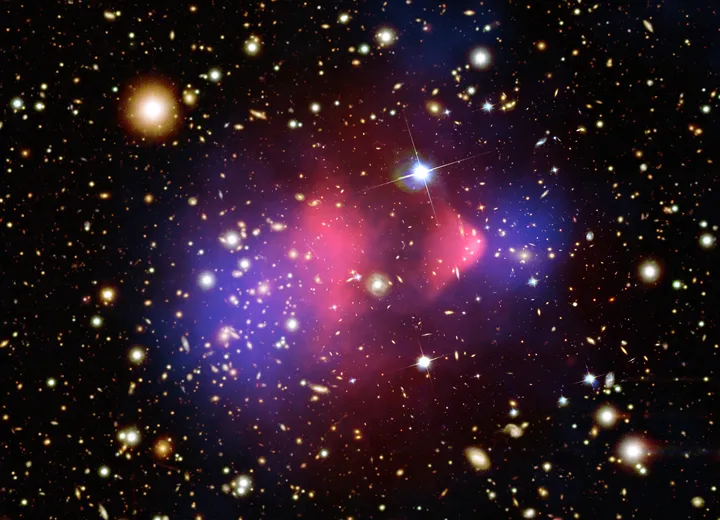
The hot gas detected by Chandra's x-rays is seen as two pink clumps in the image and contains the majority of "normal" or baryonic matter in the two clusters. The clump on the right is the hot gas from one cluster, which passed through the hot gas of the other larger cluster during the collision. An optical image from Magellan and the Hubble telescope shows the galaxies in orange and white. The blue areas in this image show where astronomers find most of the mass of these clusters. The concentration of mass is determined using the effect called gravitational lensing, where light from distant objects is distorted by intervening matter. Most of the matter in the clusters (blue) is clearly separated from the normal matter (pink), giving direct evidence that almost all the matter in the cluster is dark matter.
The hot gas in each cluster was slowed by a force similar to air resistance during the collision. In contrast, the dark matter was not slowed by the impact because it does not interact directly with the gas except through gravity.
During the collision the dark matter from the two clusters moved ahead of the gas, producing the separation of normal and dark matter, seen in this image. If the hot gas were the most massive component in the clusters, as proposed by alternative theories of gravity, an effect like this would not have been seen. Instead, this result shows that dark matter is required.
--------
NASA RELEASE 06-297
For Release: August 21, 2006
Erica Hupp/Dwayne Brown
Headquarters, Washington
(Phone: 202/358-1237/1726)
Steve Roy
Marshall Space Flight Center, Huntsville, Ala.
(Phone: 256/544-6535)
Megan Watzke
Chandra X-ray Center, Cambridge, Mass.
(Phone: 617/496-7998)
----------
Fast Facts for 1E 0657-56:
Credit X-ray: NASA/CXC/CfA/M.Markevitch et al.; Optical: NASA/STScI; Magellan/U.Arizona/D.Clowe et al.; Lensing Map: NASA/STScI; ESO WFI; Magellan/U.Arizona/D.Clowe et al.
Scale Image is 7.5 x 5.4 arcmin
Category Groups & Clusters of Galaxies
Coordinates (J2000) RA 06h 58m 19.85s | Dec -55' 56" 29.40º
Constellation Carina
Observation Dates 2004: Aug 10, 11, 14, 15, 17, 19, 24, 25
Observation Time 140 hours
Obs. IDs 5355-58, 5361, 4984-86
Color Code Energy (X-ray: Pink; Optical: White/Orange; Lensing Map: Blue)
Instrument ACIS
Also Known As The Bullet Cluster
Distance Estimate About 3.4 billion light years
Release Date August 21, 2006
-----
See on the Chandra site animations and graphics.