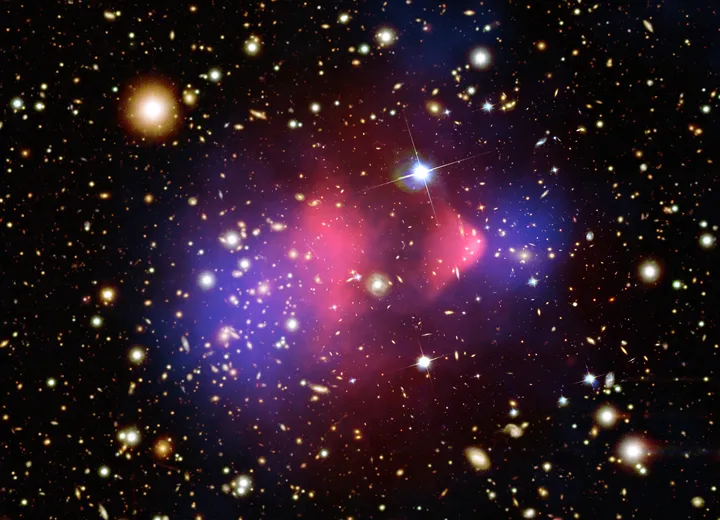
by Marcelo Dos Santos (www.mcds.com.ar)
More than once we have spoken, from this illustrious platform, about the fact (evident to us) that there is not enough matter in the universe to stop the expansion. On the contrary, it is accelerating, threatening to turn the universe into a huge empty space, where each galaxy is at an infinite distance from all the others.
Via Axxón
The reason for this is that nine-tenths of the universe is not composed of matter but of dark energy, an elusive entity that emits no type of radiation and produces no gravitational effects but, on the contrary, quite the opposite: a strange form of repulsive force that, according to the most accepted theories, is the cause of matter repelling itself and of space expanding faster and faster to make room for it.
Not long ago, a group of scientists (led by astrophysicists Nikhil Padmanabhan of Princeton University and David Schlegel of the Lawrence Berkeley National Laboratories) published the results of a singular study never attempted until now: a meticulous catalog of all the normal matter, dark matter and dark energy present within a radius of 5,600 million light-years. In other words, they have made a detailed inventory of everything that exists in a sphere 1,700 parsecs in diameter around us.
They achieved it by "illuminating" that monstrous territory with the light of very distant and very old galaxies (senile, we could say), which show enormous redshifts due to the Doppler effect. This map is the largest and most precise ever achieved, and it is also three-dimensional.
The senile galaxies contain only very red stars (reddened even more by the redshift imparted by the speed at which they are moving away), and, together, they have formed a set of 600,000 light sources, essential for illuminating the map. Once this map was drawn, we can say that Padmanabhan and Schlegel have shown us beyond any doubt everything that exists from here to 40% of the way to the edge of the universe. It's not a small thing.
Starting with 10,000 red galaxies located in a piece of the northern sky (10% of it), the astrophysicists later extrapolated the conclusions from this sample to the rest of the universe, because there is no reason to think that one part of the universe is different from another.
The transcendent news, once the data was carefully cross-checked, is that the new map confirms the theories about dark energy. More than 75% of the universe's density is due to it, and not to any type of matter. The temporal development of the small variations in the cosmic microwave background radiation, comparing them with the later evolution (5,600 million years later) demonstrates that three-quarters of the universe is made of shadows and not of light, matter or energy.
Long ago, there were those who said the universe would collapse in a "Big Crunch". Others said it would end, empty and frozen, in a "Big Chill". This theory is more likely, but could there be another possibility?
The new results may indicate yes.
If the "inverse gravity" of such a huge amount of dark energy keeps pushing matter (and consequently space itself) farther and farther away from all the rest, it may be that the entire universe disintegrates in a new "Great explosion" or tear that astrophysicists call the "Big Rip".
The critical factor would be whether dark energy is all there is or if it increases (and don't ask us the reasons, which until today are inscrutable. To make matters worse: if it grows, at what rate does it do so? If it does so more quickly, until reaching a certain value, galaxies, stars and eventually each and every atom of the universe will disintegrate and be broken into pieces by the resulting repulsion.
Big Crunch, Big Rip or Big Chill? We don't know. That is, we know there will never be a Big Crunch. What remains to be demonstrated is whether dark energy will be so much that in 20 thousand million years the universe culminates with a horrendous noise, or if, with other barely different values, it will continue expanding forever until ending in an eternal, cold and dark nothingness.
MORE DATA:
Largest Map of Universe Yet Bolsters Theories about Dark Energy
(Translated, adapted and expanded by Marcelo Dos Santos from SciAm and other Internet sites.)