Neil Calder
Dark matter –that elusive substance that makes up more than a quarter of the universe– has been observed for the first time in isolation.
Marusa Bradac of the Kavli Institute for Particle Astrophysics and Cosmology (KIPAC), located at the Stanford Linear Accelerator Center (SLAC) of the U.S. Department of Energy, and her colleagues made the landmark observations by studying a galaxy cluster 3,000 million light-years away.
Via La Epoca
"We had predicted the existence of dark matter for decades; now we have seen it in action," said Bradac, "This is revolutionary."
Dark matter is, in essence, different from ordinary matter. It is invisible even to modern telescopes, as it emits no light or heat, and it seems to interact only at gravitational levels (very subtle ones) with other matter. In contrast, luminous matter represents everything commonly associated with the universe: galaxies, stars, gas, and planets.
Previous observations had indicated that only a small percentage of the mass in the universe could be described through normal matter to explain the expansion of the universe. This research is the first to detect luminous matter and dark matter independently of each other, with luminous matter clustered in one region and dark matter clustered in another. These observations demonstrate that two types of matter exist: one visible and one invisible.
The results also support the theory that the universe contains five times more dark matter than luminous matter. "A universe that is dominated by dark matter seems illogical, therefore, we wanted to test if there were errors in our logic," said Doug Clowe of the University of Arizona, one of the lead collaborators of the study. "We believe these results prove that dark matter exists."
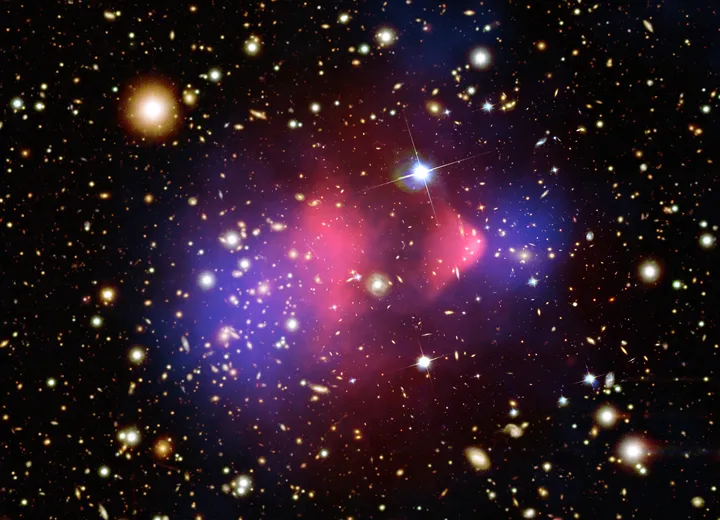
The research is based on observations of a remarkable cosmic structure called the bullet cluster. It is actually a structure of two galaxy clusters passing through each other. When the two clusters cross at a speed of ten million miles per hour, the luminous matter in each cluster interacts with the luminous matter in the other cluster, causing the speed to decrease. But the dark matter in each cluster does not interact, it passes by without any alteration. This difference in interaction causes the dark matter to sail ahead of the luminous matter, separating each cluster into two components: dark matter ahead and luminous matter behind.
To detect this separation between dark and luminous matter, the researchers compared X-ray images of luminous matter with measurements of the total mass of the clusters. To obtain the total mass they got measurements of a phenomenon called gravitational lensing, which occurs when the gravitational field of the cluster distorts the light from galaxies behind it. The greater the distortion, the more massive the cluster.
By measuring these distortions with the Hubble Space Telescope, the Magellan telescopes, and the Very Large Telescope, the team mapped the location of all the mass in the bullet cluster; then they compared these measurements with X-ray images of the luminous matter taken by the Chandra X-ray Observatory and discovered four distinct clumps of matter: two large ones of dark matter rapidly moving away from the collision and two smaller clumps of luminous matter behind. The spatial separation of the clumps demonstrates that two types of matter exist, and the extreme difference in their behavior is evidence of the distinct nature of dark matter.
"These measurements are fascinating and force us to take them into account," said the director of KIPAC, Roger Blandford. "The direct proof that dark matter possesses the properties presumed on the basis of indirect arguments shows that we are on the right track toward an understanding of the structure of the universe."
The team includes Douglas Clowe and Dennis Zaritsky of the Steward Observatory at the University of Arizona, Anthony Gonzalez of the University of Florida, Maxim Markevitch, Scott Randall, Christine Jones and William Forman of the Harvard-Smithsonian Center for Astrophysics, Tim Schrabback of the University of Bonn, and Phil Marshall of KIPAC. This work received support from the National Science Foundation and NASA. The project was also partially supported by the U.S. Department of Energy through the Stanford Linear Accelerator Center.
Neil Calder is a member of Stanford Linear Accelerator Center/Translated by Leonardo Humérez Bloch