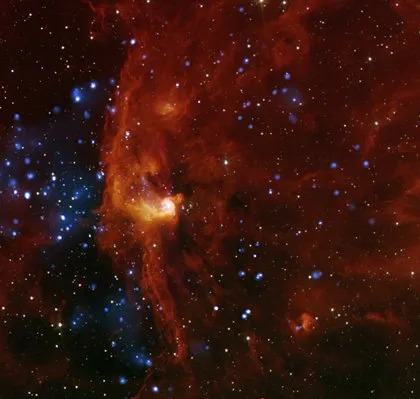
How do massive stars originate in the Universe? Are they the result of gravitational collapse processes and accretion of stellar gas and dust?
Via Universia
The discovery of a collapse near the massive and luminous star G24.78+0.08 A1, now published in the journal Nature by an international team, is a new boost to theoretical predictions about massive star formation through accretion via a disk or torus, as occurs in lower-mass stars.
The study is a new step to constrain theoretical models on massive star formation
It is signed by an international team led by the Juan de la Cierva program researcher, Maria Teresa Beltrán, from the Department of Astronomy and Meteorology of the UB. Also participating were Riccardo Cesaroni, Claudio Codella, Leonardo Testi and Luca Olmi, from the Osservatorio Astrofisico di Arcetri (Italy), and Ray Furuya, from the Subaru Telescope of the National Astronomical Observatory of Japan (Japan).
In the star formation process, collapse, expansion and rotation motions play an important role. This is, at least, the scenario for low-mass stars like the Sun, formed by an accretion process of gas and dust, in which observational evidence and theory point to the existence of circumstellar material descending towards the recently formed star.
If the mass is eight times greater than that of the Sun, the formation of a star by accretion of material must overcome significant obstacles
The powerful stellar wind and the great radiation pressure of the star can stop the accretion onto the central star and thus prevent the growth of its mass. This is a fundamental problem in the field of massive star formation, and leads us to a paradox: stars with more than eight solar masses should not exist.
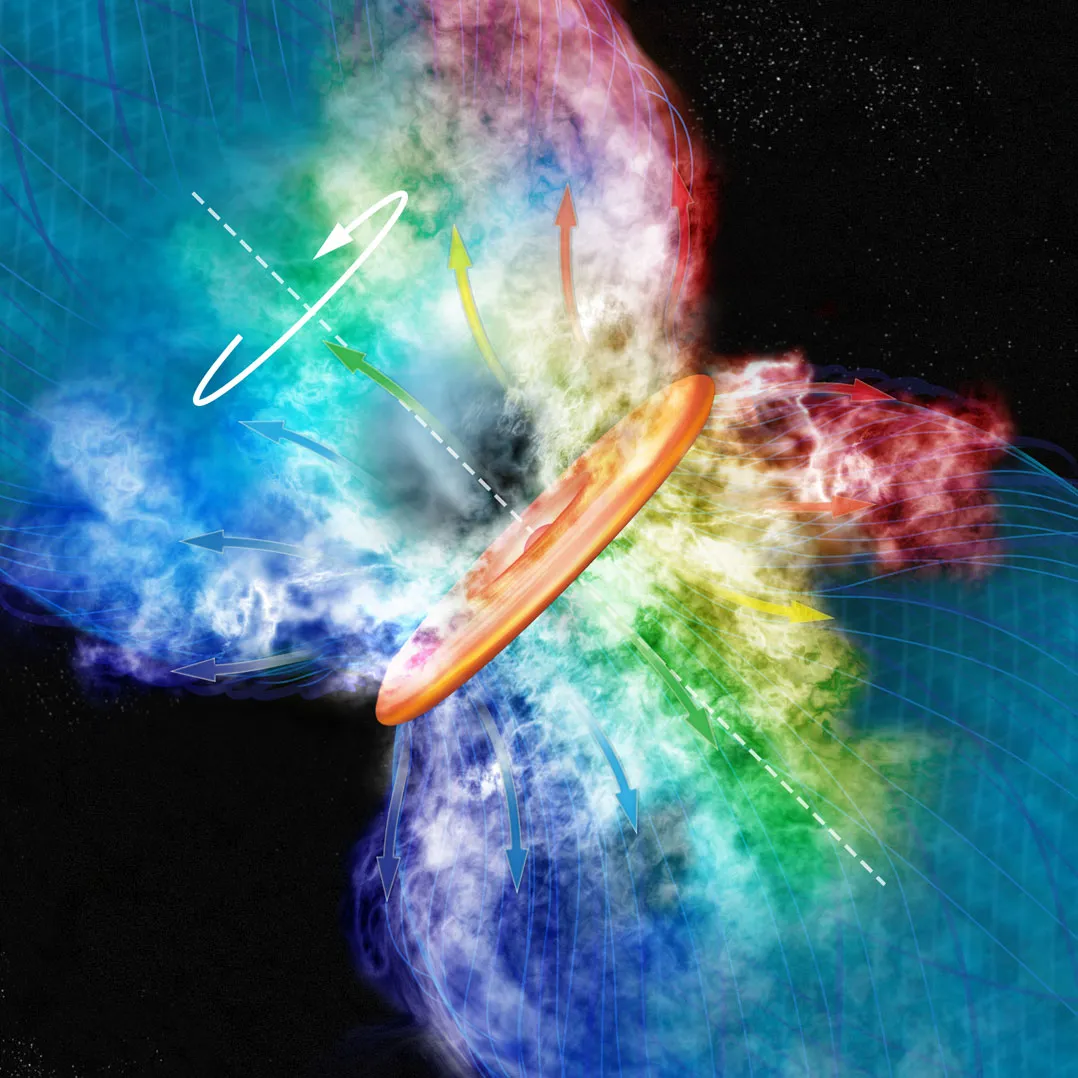
Recently, some theoretical works had proposed a possible scenario to solve the problem: the formation of massive stars through non-spherical accretion (that is, through a disk or torus). According to this model, some of the stellar photons could escape along the rotation axis, where the density has been considerably reduced.
In this article, the scientific team presents important evidence of collapse in a rotating circumstellar torus around the star G24.78+0.08 A1, which is twenty times more massive than the Sun.
The discovery, unique in the world of astronomy, is one of the few direct detections of collapse in a young high-mass star recorded to date, and reveals for the first time the simultaneous existence of a rotating and collapsing torus, a bipolar molecular flow driven by the star, and an ultracompact ionized region around the star.
The discovery was carried out through observations of the ammonia molecule at a wavelength of 1.3 cm, made with the network of twenty-seven antennas of the Very Large Array of the National Radio Astronomy Observatory (United States).
The investigated area, G24.78+0.08, is a massive star-forming region located at a distance of about 7.7 kiloparsecs
The research team has studied the region in detail from different observatories, as demonstrated by the high number of scientific articles published in specialized journals.
The region contains a cluster of young stellar objects, some of which are associated with rotating tori. One of these young objects, G24.78+0.08 A1, is driving a powerful high-velocity bipolar flow and also contains an ultracompact ionized region about 1500 astronomical units in diameter located at the center of the torus.
The continuum spectrum of this object would correspond to that of a zero-age main sequence star of spectral type O9.5 (that is, about twenty times the mass of the Sun), and with high luminosity (33,000 times that of the Sun).
Since the ionized region is very bright at centimeter wavelengths, and its temperature would exceed 2000º K, it is very easy to observe the molecular gas—colder, at 100º K—in absorption against the continuum spectrum emission.
If, in addition to rotating, the torus is also collapsing towards the central star, this absorption would be expected to be shifted towards positive velocities (due to a redshift Doppler effect) relative to the stellar velocity.
The ammonia observations of G24.78+0.08 A1 have precisely revealed that the emission of this molecule is observed in absorption towards the region ionized by the star, with the absorption maximum—observed right at the center of the rotating torus—shifted to the red by about 2 km/s relative to the stellar velocity.
The gas detected in absorption is approaching the ultracompact ionized region at a speed of about 2 km/s
In this way, the existence of collapse towards the O-type star located at the center of the torus is confirmed. According to the properties of ammonia, an accretion rate of material onto the central star sufficiently high to overcome the star's radiation pressure is derived, and therefore, for the star to continue gaining mass through the accretion of the material surrounding it.
You can see more information on the CIENCIA, INVESTIGACIÓN Y PDI portal