RCW 108 is a region where stars are actively forming in the Milky Way, 4,000 light-years from Earth. This is a complex region containing clusters of young stars, including one that is deeply embedded in a cloud of molecular hydrogen. Using data from different telescopes, astronomers determined that star birth in this region is being triggered by the effect of nearby young massive stars.
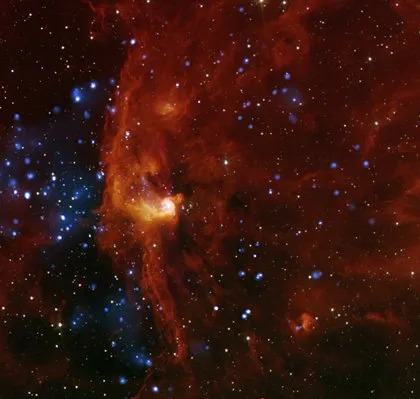
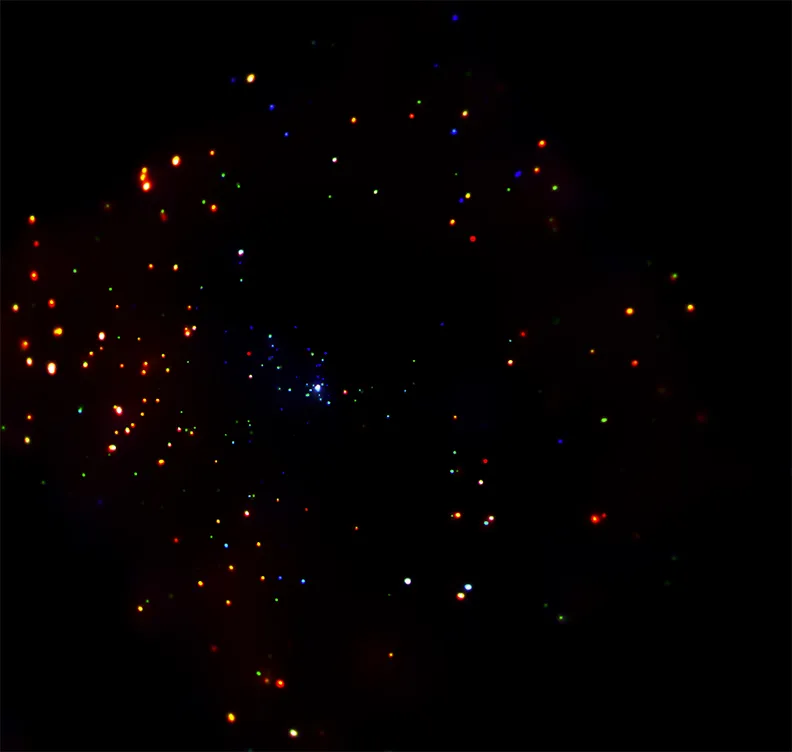
The image is a composite of data from the Chandra X-ray Observatory (in blue) and infrared emission detected by the Spitzer Space Telescope (in red and orange). More than 400 X-ray sources were identified in Chandra's observations of RCW 108. About 90% of these sources are thought to be part of the cluster and not stars lying in the field of view. Many stars in RCW 108 are experiencing the violence seen in other star-forming regions like the Orion Nebula. Gas and dust block many of the X-rays from the young stars located in the center of the image, explaining the relative absence of sources observed by Chandra in the image.
Spitzer data show the location of the embedded star cluster, which appears as a bright red and orange spot just to the left of the center of the image. Some stars from a larger cluster, known as NGC 6193, are also visible on the left side of the image. Astronomers think the dense clouds in RCW 108 are in the process of being shredded by the intense radiation emanating from the hot, massive stars in NGC 6193.
Chandra and Spitzer data indicate that there are more candidate massive stars than expected in several areas of the image. This suggests that regions of RCW 108 developed localized episodes of star formation. Scientists predict that this type of formation is triggered by the effects of radiation from the bright massive stars, like those in NGC 6193. This radiation could cause the interior of the gas clouds in RCW 108 to compress, which would generate gravitational collapse and the formation of new stars.
Sources and related links
- Chandra:RCW 108:Massive Young Stars Trigger Stellar Birth
- Spitzer:Massive Young Stars Trigger Stellar Birth
- X-Ray and IR Point Source Identification and Characteristics in the Embedded, Massive Star-Forming Region RCW 108
Scott J. Wolk et al 2008
The Astronomical Journal 135 693-721
DOI: 10.1088/0004-6256/135/2/693
arXiv:0712.3005v1
About the images
Credit:NASA/CXC/CfA/S.Wolk et al; IR: NASA/JPL-Caltech
Chandra:NASA/CXC/CfA/S.Wolk et al