Astronomers investigated a massive young protostar called "Source I" at radio wavelengths with the VLBA. The observation was performed at monthly intervals for two years and then the individual images were assembled into a video sequence.
Researchers from the Harvard-Smithsonian Center for Astrophysics observed a star forming in a cluster of massive suns in the Kleinmann-Low nebula, a hotbed of massive star formation, in Orion, using the Very Long Baseline Array (VLBA).
The VLBA detected hundreds of clouds of silicon monoxide gas called masers and the researchers think Source I ("Source I", I=capital letter i) is the richest source of masers in the galaxy.
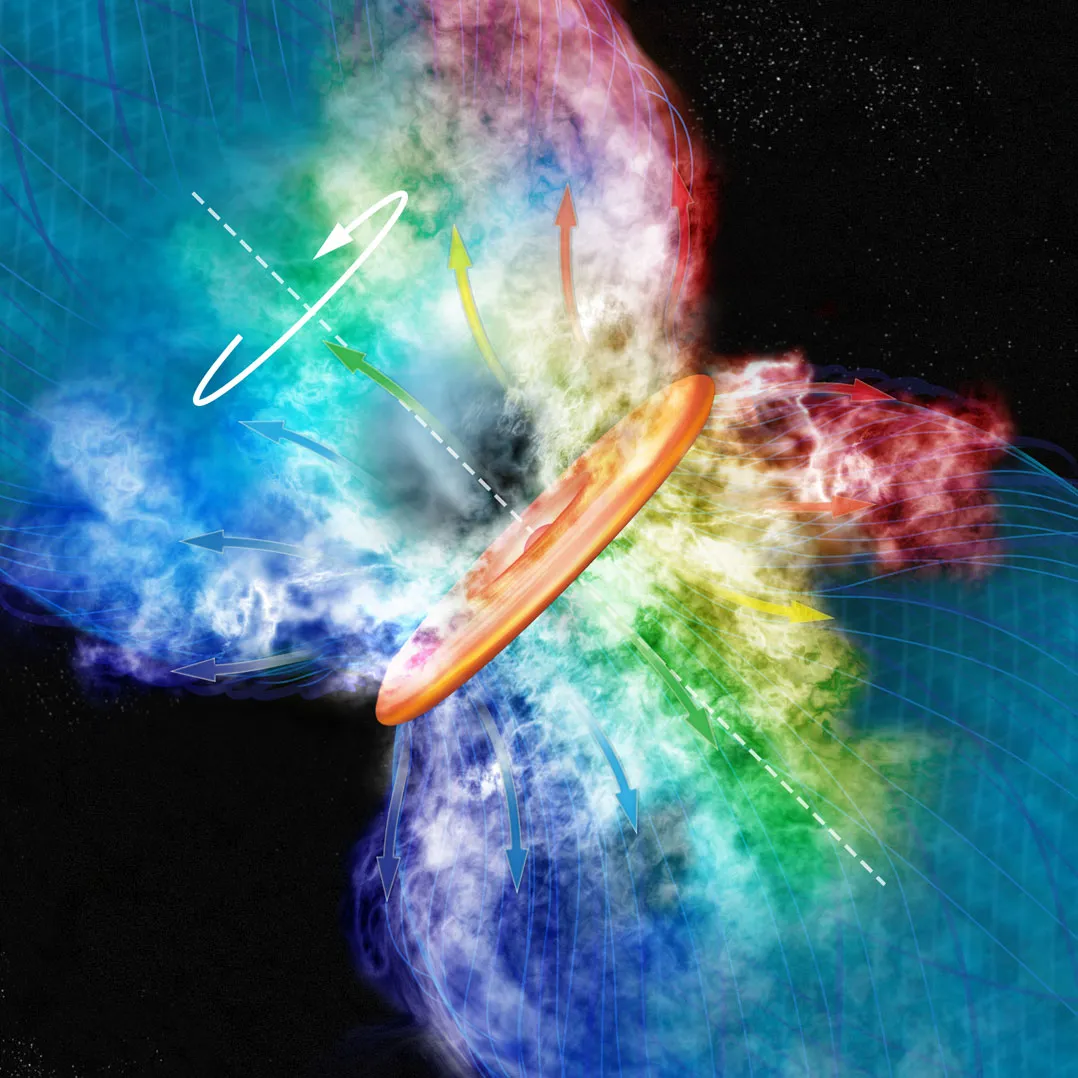
The resulting film, a time-lapse sequence, reveals signs of a rotating accretion disk, where gas swirls toward the center of the star and material flows perpendicular to the disk (in a "V" shape).
And this is just the beginning. "We know how these stars die, but not how they are born," noted Lincoln Greenhill, principal investigator of the study team. Future observations by the Expanded Very Large Array (E-VLA) and ALMA could distinguish between different hypotheses that explain, for example, the curvature of the path of these masers and their possible origin in magnetic fields. Those fields could arise in the star or in the accretion disk.
The film shows current data from the Very Long Baseline Array that observed clusters of gas flowing from a young protostar known as Source I over the course of two years. Gas moving toward us is colored green or blue, while gas moving away from us is colored yellow, orange, and red. The observations were made at radio wavelengths, so the protostar is not visible, but its location is marked by a red dot.
http://www.youtube.com/watch?v=o7tNZL4sszA
Sources and related links
- Close-Up Movie Shows Hidden Details in the Birth of Super-Suns
- A Feature Movie of SiO Emission 20-100 AU from the Massive Young Stellar Object Orion Source I
L. D. Matthews et al.
arXiv:0911.2473v1
Will appear in Astrophysical Journal in January 2010. A copy can be obtained at KALYPSO - The Orion Nebula and Orion’s Source I
About the images
- Illustration of the disk around the massive young star, Orion Source I. A disk of hot ionized gas surrounds the central star. A cold wind of gas is generated from the top and bottom surfaces of the disk (indicated by arrows) and the magnetic field lines (in blue) give it the shape of an hourglass.
Credit: Bill Saxton, NRAO/AUI/NSF