A group of scientists, part of the project called SAGE, led by Dr. Margaret Meixner of the Space Telescope Science Institute STScI in Baltimore, USA, has combined hundreds of thousands of images taken by NASA's Spitzer Space Telescope to make a map of the entire Large Magellanic Cloud, one of the Milky Way's satellite galaxies, visible to the naked eye in the southern skies. The resulting map allows us to perceive features of how new stars would have formed and to determine how dust from old stars is pushed into the galaxy itself.
Via CieloSur
"The Large Magellanic Cloud is like an open book," says Dr. Meixner. "We can see the complete life cycle of matter in a galaxy at a single glance."
For the first time the map allows us to see the percentage of stars that are forming throughout this entire Cloud. Karl Gordon of the University of Arizona in Tucson, co-author of the work, explains "we are using this incredible map to begin to understand how galaxies develop".
To make the map, around 600,000 images from the Spitzer instrument called the Multiband Imaging Photometer (MIPS) were processed.
The Large Magellanic Cloud is located 160,000 light-years from us and is an ideal astrophysical laboratory for studying the life cycle of galaxies. Its approximate size is one third that of the Milky Way.
Another instrument used on Spitzer is the Infrared Array Camera (IRAC) which takes images in infrared light waves. The final result is a composite photo of 300,000 images that shows everything from hot stars to cold dust between the stars or the interstellar medium.
Gordon adds that "this means our images really see the galaxy in depth, it's like seeing the life cycle in the interstellar medium, a dust life cycle, we manage to see young stars that consume dust and that form in molecular dust clouds and old stars that expel dust into the interstellar medium".
The study will be published soon in the Astronomical Journal.
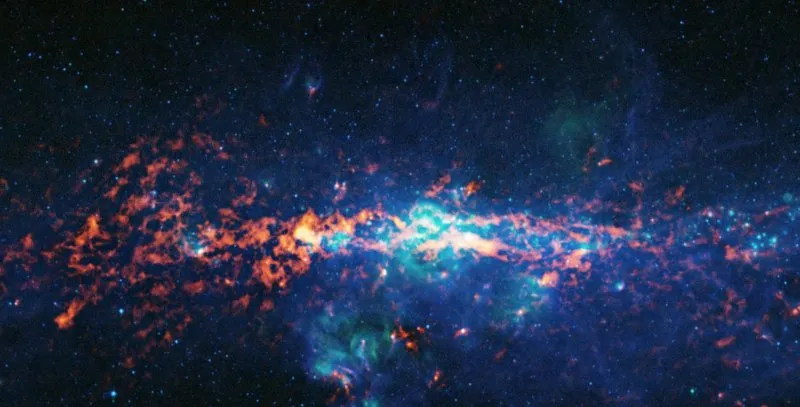
In the photo the blue color shows mainly -located in the center- the light from old stars; the chaotic bright regions farther out from the center are full of massive, hot stars wrapped in dust. The red color envelops the bright zones composed of dust heated by stars, and the red dots seen in the image are old, dusty stars and more distant galaxies. The green clouds contain cold interstellar gas and molecular-sized dust grains also illuminated by starlight.
The SAGE project (Surveying the Agents of a Galaxy's Evolution) is made up of an international team of more than 50 astronomers. The main data centers are located at the Space Telescope Science Institute STScI in Baltimore, led by Dr. Margaret Meixner; at the University of Arizona in Tucson, led by Dr. Karl Gordon; and at the University of Wisconsin in Madison, led by Dr. Barbara Whitney.
More information at:
http://www.spitzer.caltech.edu/