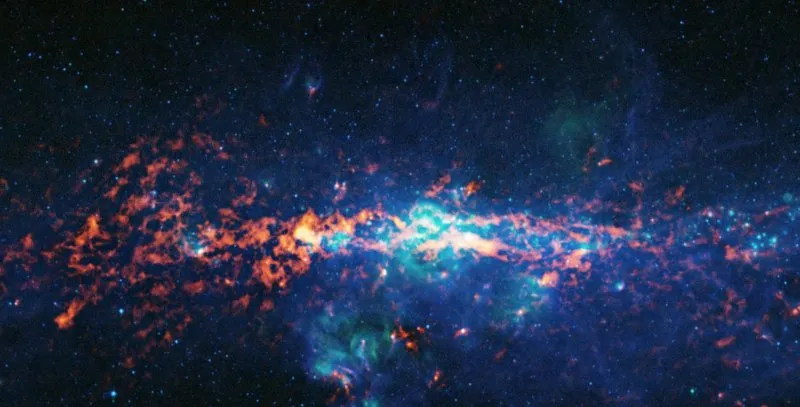
Astronomers have revealed a new atlas of the inner regions of the Milky Way, dotted with unknown knots of cold cosmic gas, potential birthplaces of new stars. It is the largest map of cold dust to date.
This new survey, called the APEX Telescope Large Area Survey of the Galaxy (ATLASGAL), shows the Milky Way at submillimeter wavelength (between infrared light and radio waves). Images of the universe at these wavelengths are vital for studying the birthplaces of new stars and the structure of the crowded galactic core.
"ATLASGAL gives us a new view of the Milky Way. Not only will it help us investigate how massive stars form, but it will also give us an overview of the structure of our galaxy," said Frederic Schuller, of the Max Planck Institute for Radio Astronomy, leader of the team.
The area of the submillimeter map is approximately 95 square degrees, covering a region of the galactic plane two degrees wide and over 40 long. The 16,000-pixel map was made with the LABOCA camera on the APEX Telescope of the European Organization ESO. The telescope is located at 5100 meters altitude on the Chajnantor plateau in the Chilean Andes, which has unparalleled sky quality and atmospheric conditions.
The interstellar medium, the material between the stars, is composed of gas and grains of cosmic dust. However, the gas is mainly hydrogen and relatively difficult to detect, so astronomers often search for these dense regions by observing the faint glow of heat from these grains.
Submillimeter light allows astronomers to see these dust clouds glow, even though they obscure our view of the universe at visible wavelengths. Consequently, the ATLASGAL map includes the densest central regions of our galaxy, in the direction of the constellation Sagittarius (home of the supermassive black hole), which would otherwise be hidden behind dense dust clouds.
The new map also reveals thousands of dust clusters, many previously unknown, that mark the birthplace of massive stars. These are clusters a couple of light-years in size, with masses between ten and a few hundred times the mass of our Sun. Furthermore, ATLASGAL captured images of beautiful filamentary structures and bubbles in the interstellar medium, expelled by supernovae and the winds of bright stars.
Some incredible highlights of the map include the center of the Milky Way, the dense, massive and nearby molecular gas cloud Sagittarius B2 and the expanding gas bubble RCW120, where the interstellar medium around the bubble is collapsing and forming new stars.
Sources and related links
- ESO: Astronomer's new guide to the galaxy: largest map of cold dust revealed
- ATLASGAL - The APEX telescope large area survey of the galaxy at 870 microns
F. Schuller et al.
A&A - To be published
DOI: 10.1051/0004-6361/200811568
arXiv:0903.1369v2 - ATLASGAL
About the images
Color composite of the Galactic Center and Sagittarius B2 by ATLASGAL. Sag B2 is the bright orange-red region in the middle-left part of the image.
ESO/APEX & MSX/IPAC/NASA
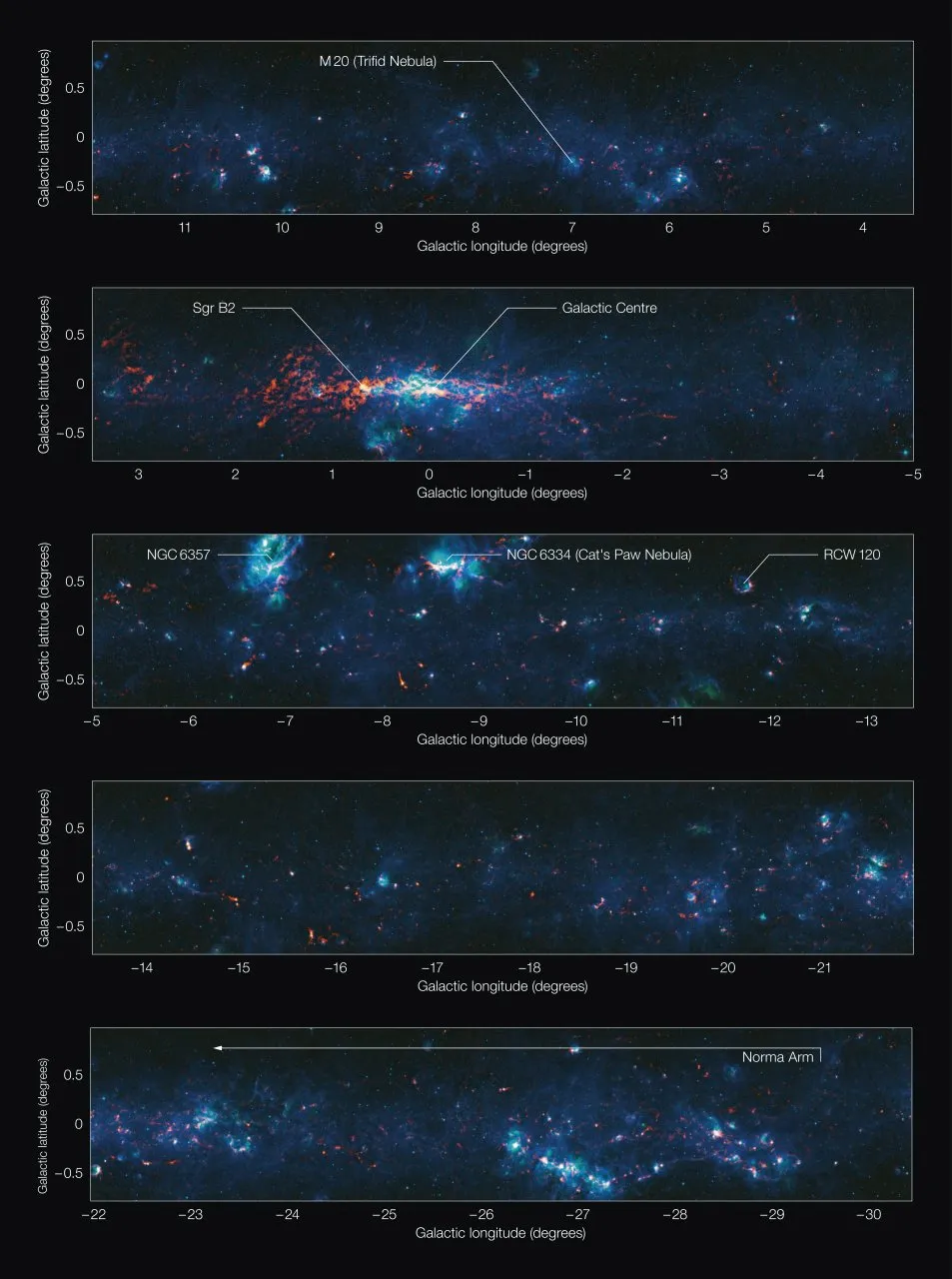
Annotated color composite of part of the Galactic Plane seen by ATLASGAL, divided into sections.
Some features to highlight in the image (from left to right; from top to bottom)
Messier 20 (The Trifid Nebula): Contains an open cluster of stars and a stellar nursery. The name comes from the way the dense dust appears to divide into three lobes, seen at visible wavelength.
Sagttarius B2 (Sgr B2): One of the largest molecular gas clouds in the Milky Way, near the Galactic Center.
Galactic Center: The center of the Milky Way, home of the supermassive black hole, about 25,000 light-years from Earth.
NGC 6357: A diffuse nebula containing the open cluster Pismis 24, home to several massive stars
NGC 6334: An emission nebula also known as "Cat’s Paw Nebula".
RCW 120: A region where an expanding bubble of ionized gas about 10 light-years in diameter is causing the surrounding material to collapse into dense clusters, which will lead to the birth of new stars.
In the ESO press release there is a 46 MB image!!
ESO/APEX & MSX/IPAC/NASA