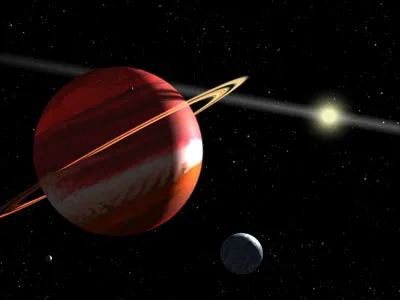
According to a new study, more than a third of the giant planetary systems recently discovered outside the solar system may contain terrestrial-type planets, some provided with extensive deep oceans with the potential for the emergence of life.
Via Space News
The study, carried out by scientists from NASA, the University of Colorado at Boulder and Pennsylvania State University, focuses on a type of planetary system different from our own. A system of that class contains gas giants known as "Hot Jupiters" orbiting very close to their parent star, even closer than Mercury is to our Sun. It is believed that these gas giants migrated toward the innermost orbital bands around their progenitor stars while the planetary systems were forming, perturbing the space environment and triggering the formation of terrestrial-type planets covered with oceans, in a "habitable zone", thus fostering the appearance of life.
The study was conducted by Sean Raymond (researcher at the University of Colorado at Boulder), Avi Mandell (NASA) and Steinn Sigurdsson (Pennsylvania State University).
The work indicates that Hot Jupiters push and drag material from protoplanetary disks during their journeys, sending rocky debris outward, where they can more likely merge in the form of terrestrial-type planets. At the same time, turbulent forces from the dense surrounding gas slow the orbital speed of small icy bodies from the outer regions of the disk, causing them to spiral into the inner zone and sending water to the newly formed planets. According to the study, such planets may end up harboring oceans several kilometers deep.
Scientists had previously assumed that as Hot Jupiters sweep up protoplanetary material in their migrations toward their parent stars, all that surrounds them could be absorbed or thrown out of the system. The new models indicate that these early ideas may be wrong.
The research team ran exhaustive simulations, each lasting more than eight months, on over a dozen computers, starting with protoplanetary disks containing more than a thousand Moon-sized bodies of rock and ice. The initial conditions for each model were based on current theories of how planets form in our solar system, and 200 million years of planetary evolution were simulated.
The team has concluded that about one in three known planetary systems could have evolved with terrestrial-type planets (still undetected) in the so-called "habitable zones", like the orbital band where Earth is. No less than 40 percent of the approximately 200 known planets around other stars are Hot Jupiters.
The new simulations show that terrestrial-type planets in habitable zones formed with enormous amounts of water, up to 100 times that present on Earth today.
Raymond is certain that there are habitable planets in other solar systems. He qualifies, however, that if life existed on those planets, it would be very different from ours. There are many evolutionary steps between the formation of such planets and the presence of life forms, especially complex life.
Additional information at:
UCB - University of Colorado at Boulder