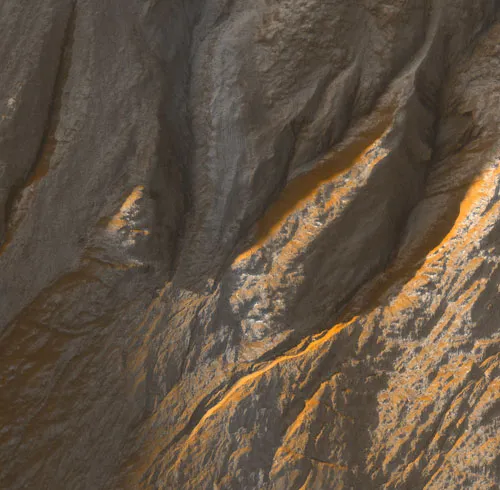
There are some areas around the south pole of Mars that have intrigued scientists for 30 years, since dark spots were discovered in that region which should be covered with bright ice.
Via El País
A. R. - Madrid
It is known that temperatures there are around 135 degrees Celsius below zero, so this ice could be carbon dioxide. Scientists thought that the darkened areas could be the dark ground seen under the transparent frozen CO2, but now there is new data and the mystery has become more complicated: the ESA's Mars Express scientific satellite has analyzed the composition of the surface in the area and the result does not fit that idea.
The Omega instrument on Mars Express measures the amount of visible and infrared radiation bounced back by the surface of Mars, which allows deducing what minerals and materials are there, since the absorption of radiation is different in each case. In the area of the dark spots, the data -low absorption in the infrared- indicate that there is hardly any CO2 ice there, clarifies Yves Langevin, from the Institut d'Astrophysique Spatiale, Orsay (France),
in an ESA note.
The explanation, some scientists suggest, could be that the frozen carbon dioxide in those dark areas of Mars is covered by dust. But this opens another question because the spots, seen with good resolution, have strange shapes, like spiders or fans. A possible answer would be that in that area, the rays of sunlight that penetrate the icy layer would heat the ground, which would increase the pressure of the CO2, forming bubbles. Those bubbles would burst at the surface like a geyser spewing dust from the ground, which would create those spider and fan patterns.
"From a physical point of view, it is a straightforward process and would lead us towards an explanation," says Langevin. But more things remain to be clarified: Why are those strange spots only observed in some areas? And why are there parts without spiders or fans but still relatively dark?
Langevin says that to try to clarify the mystery, we will have to wait until the next spring equinox at the south pole of Mars, in 2007. Since during the winter the Sun's rays do not reach that area, the formation of a pristine layer of ice in that mysterious region is expected. The idea is to observe the area just before the solar rays can begin to heat any area of ground and the bubble formation process begins.