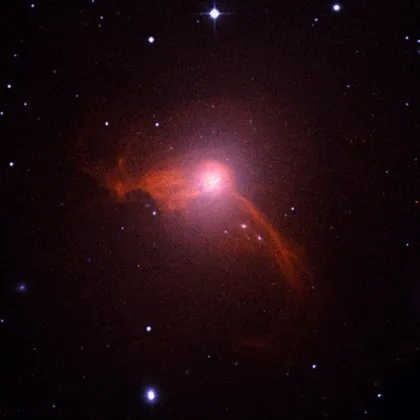
A surprising example of the power and effervescence of supermassive black holes is shown in this composite image of the elliptical galaxy M87 in the Virgo cluster.
The features in the image imply that background sounds have been generated by the black hole for eons.
Via Chandra X-Ray Observatory
This black hole located at the center of M87 is one of the most massive in the universe. The enormous reservoir of hot gas in this cluster is shown in this low-energy X-ray image from the Chandra X-Ray Observatory (in red). An optical image from the Digitized Sky Survey shows stars in the galaxy (in blue).
An uneven series of bubbles is visible in the hot gas, below and to the left of the center of M87. These are produced by small outbursts near the black hole about once every 6 million years. These sound waves generated by the outbursts are more like noise coming from the black hole than a harmonious musical performance.
A shock wave is detected in a separate image showing high-energy X-rays. This wave was produced by an explosion in the black hole 20 million years ago. Its properties, including the change in temperature and the density of the gas, are consistent with classical physics. A large bubble in the gas shows another explosion that occurred about 50 million years earlier. The long interval between these two provides evidence of even deeper sounds, 58 or 59 octaves below middle C.
Other remarkable features are seen in M87 for the first time, including filaments of X-ray emission, which may be due to gas trapped in magnetic fields. One of these filaments is over 100,000 light-years long and extends below and to the right of the center of M87 in an almost straight line.