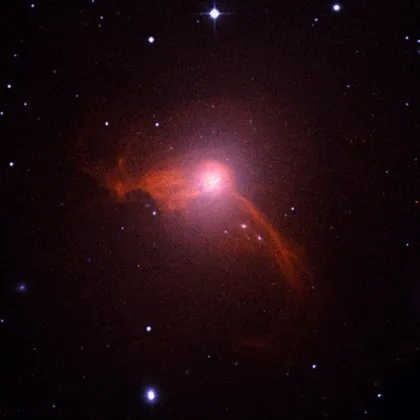
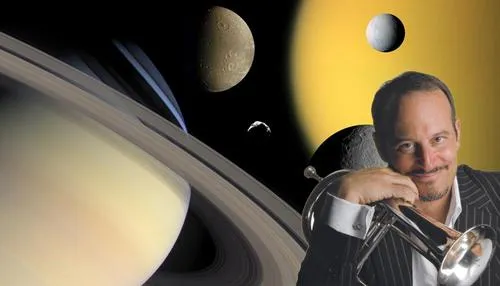
Scientific discoveries have inspired artistic works, a topic that will be explored at the upcoming World Science Festival. Another example of this occurred last week during the premiere of composer Darryl Kubian's concerto 3-2-1, inspired by The Big Bang, Zeno's paradox, and distant suns.
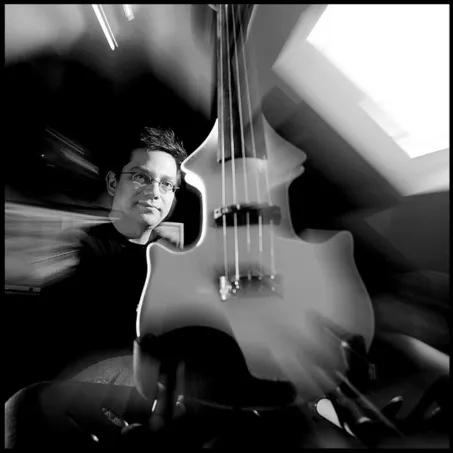
Kubian says he was inspired by a November 1999 article in Scientific American (Sci Am)1, written by cosmologists Lawrence Krauss and Glenn Starkman. The performance is not online yet but Kubian made a MIDI version available on XtremeMedium. The mp3 is 23' 17" long and weighs about 53Mb.
Darryl Kubian is a member of the New Jersey Symphony Orchestra, first violin, under the direction of Maestro Neme Jarvi and former second violin in the Brooklyn Philharmonic Orchestra under the direction of Maestro Robert Spano. Xtreme Medium is his music production company, immersed in several projects for Discovery Channels, National Geographic, etc.
Darryl released his first solo album titled "String Theory" or, in Spanish, "Teoría de cuerdas".
In a recent article on the Sci Am blog, it is explained that the concerto 3-2-1 has three movements, namely:
1. The Big Bang
2. Zeno's Paradox
3. Distant Suns
As the musician describes in the Sci Am article, "the Big Bang is obvious and if you listen very closely you can hear the violin's pizzicato which is the Singularity, the three bass drum hits (dark energy, dark matter, and gravity which are equal at that point)".
"The nuance of the series was created based on another article I read in Sci Am about how the sound of the Big Bang might have been responsible for the clumping of matter in just the right way to form the galaxies we see today. The violin's entrance is in a rubicund movement that is supposed to represent Inflation.
Then in the movement there is a pizzicato/delay section that is the creation of the atomic nucleus and the movement ends with the creation of the first stars."
"Another interesting point is the transition from the 2nd to the 3rd movement in a distorted electric violin cadenza that is supposed to represent the realm of man(...)".
I must confess that I agree with the author of the note on the Sci Am blog, George Musser. I have never been a great fan of classical music. My mp4 player contains music by Vangelis, Phil Collins, Betelgeuse (a group that includes a former coworker, Furly), music from the '80s, but mainly Genesis, whose discography I listen to over and over, particularly the album Duke.
However, Kubian's piece is truly moving. Perhaps Genesis also made symphonic rock, which has its points of contact with this work, at least in an "epic" or triumphalist tone, so to speak.
Musser says to conclude his note, that often in science an issue is explored from many angles, which should include artistic ones. The natural world is something to be experienced through all the senses. I will talk about that in the next note about the World Science Festival.
Sources and related links
- Sci Am blog: The big bang in musical form, by George Musser
- The Star Ledger: Concerto's debut is simply electric
- 1: The note in Scientific American is
The Fate of Life in the Universe;
November 1999; Scientific American Magazine;
by Krauss, Starkman; 8 Page(s)
About the images
The image is the property of JOHN MUNSON. Extracted from the note on NJ.com