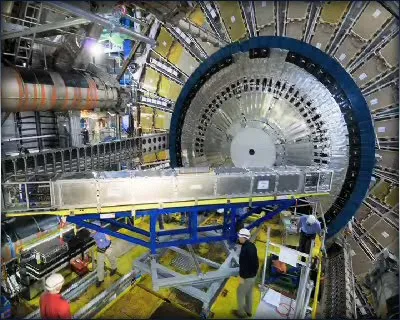
The European Council for Nuclear Research (CERN) has reported that it has started up the world's largest superconducting magnet, in Geneva, with eight rectangular superconducting coils each 25 meters long and 5 meters wide and weighing one hundred tons.
Via La Flecha
According to the largest research center, the magnet is part of the Large Hadron Collider (LHC) on which its physicists are working and which, when it becomes operational within a year, will be the world's largest particle accelerator (with a diameter of 27 kilometers) and will help scientists better understand the moment immediately after the Big Bang.
It will help scientists better understand the moment immediately after the Big Bang
The function of the large electromagnet is to create a powerful magnetic field in a specific area of the large accelerator, where a detector of spectacular dimensions is being built 45 meters underground, responsible for collecting data from the particles that are accelerated and collided in that large circumference.
With the created magnetic field, scientists will be able to alter the route of the particles, make them collide and study them, which will give more clues to the scientific community about what kind of elements existed in the universe just after the Big Bang occurred.
What is the universe made of?
It will also allow progress in knowing what the 96% of the unknown universe is made of, why particles have mass or why nature prefers matter over antimatter, as CERN explains.
To test the magnet, it first had to be cooled to a temperature of 269 degrees Celsius below zero and then it was put into operation slowly until it reached 21,000 amperes, 500 more than the current needed to produce the magnetic field required by the scientists.
To test the magnet, it had to be cooled to a temperature of 269 degrees Celsius below zero
In the construction of the ATLAS detector, where the large electromagnet has been installed, about 1,800 scientists from 165 universities and laboratories in 35 countries are working.
It is also the largest physical particle detector ever built, 46 meters long, 25 meters wide and another 25 meters high, to obtain data from hadrons that will be accelerated to the speed of light by a circle excavated one hundred meters underground, which would take more than four hours to walk around.
When released, the hadrons will collide about 800 million times per second, thus reproducing the situation close to that immediately after the Big Bang.
Scientists will try to find there some evidence of the existence of the Higgs boson, a hypothetical elementary particle that would give mass to the other particles in the universe and that would confirm the Standard Model of particle physics.
A Tour of CERN