Fifty blind people from institutions in Santa Fe attended the shows in the Ateneo hall of UNL.
Via DERF
This is an initiative of the Galileo Galilei Planetarium that has already visited several towns in the interior of the country and has 2,300 spectators at the box office. The activity served to present the program “UNL Accesible”.
Who said stars can't be touched? Yes, they can be touched, and even heard, a magic that 50 blind people from different institutions in Santa Fe were able to verify when they attended the different shows that the Planetarium for the Blind offered at the Universidad Nacional del Litoral (UNL) last Monday.
This is an initiative of the Galileo Galilei Planetarium in Buenos Aires, which has already been presented 120 times in different Argentine provinces and Uruguay, and has already reached 2,300 spectators in just five and a half years of existence. “We started in June of 2001 and since then we haven't stopped,” said Mariano Rivas, a graduate in Social Communication and amateur astronomer, who besides being a journalist is head of the Astronomy area of the Planetarium.
The presentation served as a framework for the launch of the UNL Accesible program, whose objective is to contribute to generating conditions of equity for university students with disabilities. The goal of the proposal – whose implementation will be in charge of the Dirección de Bienestar Estudiantil of UNL – is to reduce inequalities through different activities, such as the incorporation of sign language interpreters, the equipping of libraries, or the accessibility of the university's website.
The show
The show that took place in Santa Fe – the same one that can be seen and heard in Buenos Aires – was prepared by a team of sound engineers, visual artists (in charge of the sky maps) and communicators who developed the text that takes the spectators on a journey through the galaxy, in the midst of a charming atmosphere.
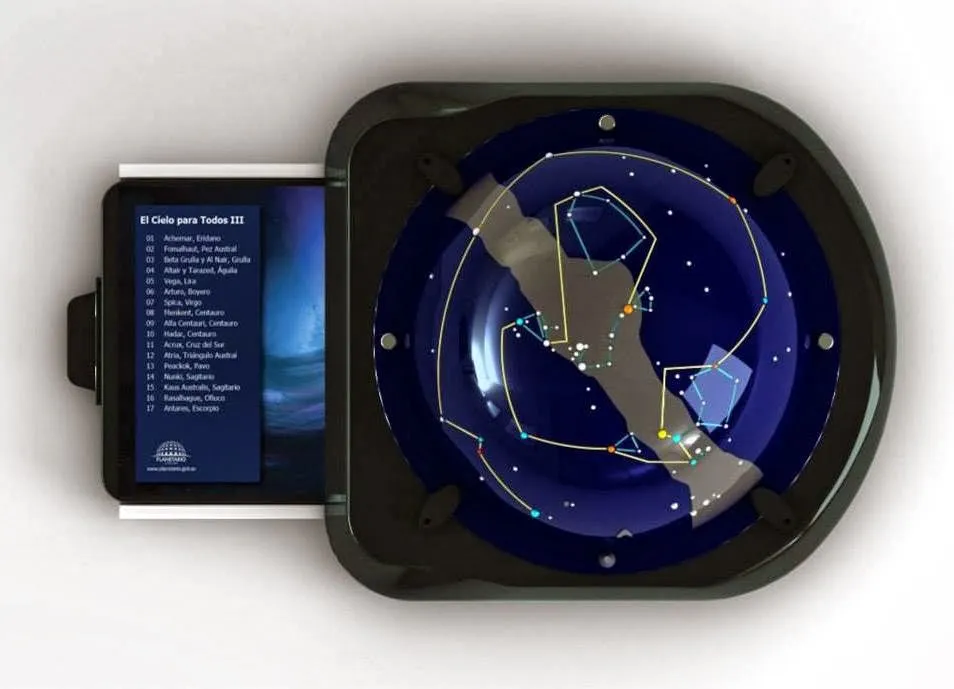
We thought of a transportable planetarium for the blind,” assured Rivas, and that is why the resources used are very few: headphones to improve hearing and two models that represent the most famous constellations and the Milky Way.
“The Sun sets and then we witness one of the most beautiful spectacles of nature: the rising of the stars,” says a voice-over accompanied by very good music. Then “the voice” guides the spectators on the journey, with the help of the two map-models: the first, a black wooden board with spiral reliefs in silver color (the Milky Way) and a small rubber ball at its bottom (the Sun). The second is assembled on half of a transparent plastic sphere; on top, an irregular figure made with glitter creates the appropriate texture to simulate the Milky Way, and small acrylic balls are the stars, connected by threads that help follow the path.
The show has been modified several times since its debut until now, always based on the recommendations made by the spectators themselves. “At first we hadn't incorporated colors because we thought it was a very visual resource. Until they told us they could distinguish between red and blue,” said Rivas. The duration of the show was also balanced (it currently lasts 35 minutes; it used to last 50) and some details were added to the models, such as the threads that connect one star to another.
The planetarium experience has been very good – he said –; the criticisms we received allowed us to improve the final product,” said Rivas.
Science for all
According to Rivas, the planetarium experience for the blind has no equal in America, “and probably not in Europe either, because we were called from Spain to learn more about the initiative,” assured the specialist.
The project is part of the program for non-habitual audiences, which includes other activities carried out by the planetarium. “Everything is under the large umbrella of conceiving science as a right, and thinking that it must reach everyone without any kind of restriction,” indicated Rivas, who every Sunday has a column on astronomy on the program “Científicos Industria Argentina,” hosted by Professor Adrián Paenza on Telefé.
Prensa Institucional UNL