The sky for everyone
The “Galileo Galilei” Planetarium, under the Ministry of Culture of the City of Buenos Aires, presented on Friday a new version of this innovative and inclusive project.
On Friday, October 11, the Planetarium presented the new version of the project that began twelve years ago: “The Planetarium for the Blind: the Sky for Everyone”.
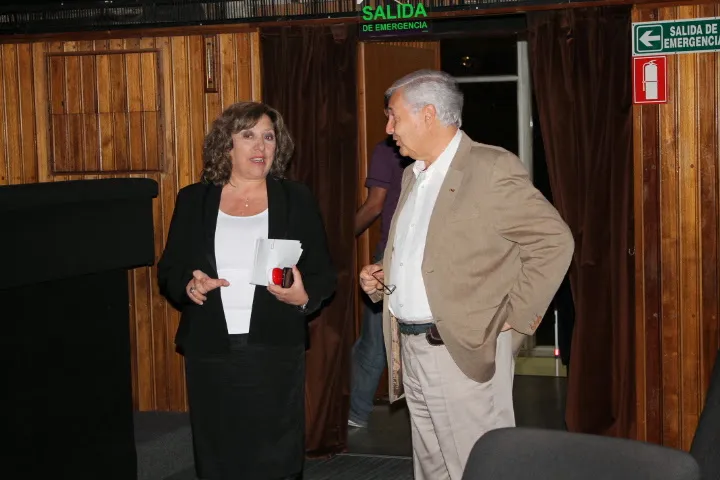
The premiere took place before an audience with and without visual ability. Shortly after 19:30 h, the presentation began, led by the Director of the Planetarium, Lic. Lucía Sendón de Valery, who recalled that the project was started in a previous administration, that of Leonardo Moledo -who was invited but could not attend- and that over the years it has been modified based on feedback from participants and the interest of the Planetarium staff in achieving greater inclusion.
The director thanked a number of people and institutions involved in this new version of the Planetarium for the blind, such as COPIDIS and the Biblioteca Argentina para Ciegos (BAC).
The evening then continued with a musical performance by a blind singer accompanied by a guitarist. Subsequently, Lic. Mariano Ribas and Walter Germaná spoke to briefly explain the development of the project.
The Project was led by Walter Germaná, who coordinated the interaction of all the actors who contributed their grain of sand and was the one who worked to make the new version an improvement that integrates the knowledge acquired.
What is it?
“The Planetarium for the Blind: the Sky for Everyone III” is a scientific outreach show, aimed primarily at blind or visually impaired people. Essentially, it is a tactile and auditory planetarium, with a recorded narration (Cristina Ruffa Circelli and another colleague did the voice-over), with music and soundscapes. And its goal is to bring the knowledge of the sky, the stars, and astronomy in general closer to the blind public. A goal centered on the premise that knowledge is a right, and as such, must be accessible to everyone.
During each presentation, which lasts a little over half an hour, the audience “travels” through the sky, identifying stars, constellations, and the outline of the Milky Way, and at the same time, accesses different astronomical notions (especially those related to stars).
It is an unprecedented project at the national level, and one of the few of its kind worldwide. Now, based on the experience gained in almost 200 performances (in which more than 2,000 blind and visually impaired people participated), we present a new version, completely superior, both in terms of content and teaching strategies, as well as the materials and technology used.
Project in evolution
Since its birth in 2001, the “Planetarium for the Blind: the Sky for Everyone” of the Buenos Aires City Planetarium has been evolving. And to a large extent, it was due to the enriching experiences gathered at the end of each presentation, where attendees have shared and commented on their impressions with us. Experiences that were materialized in constant improvements that were incorporated over the years.
In this third version of the show, profound modifications and improvements have been incorporated compared to the two previous versions (launched in 2001 and 2004 respectively). On the one hand, the new script is more agile and compact, has two levels of narration, and features carefully treated complementary sounds. On the other hand, the tactile celestial map is far superior to previous versions: the relief stars now have different sizes, are accompanied by Braille indications, and the tracing of the “guide-thread” and the constellations is more easily identifiable by touch. Furthermore, careful work has been done with the colors of the represented stars, considering that the show is also aimed at people with partial vision.
After 12 years of presentations and enriching experiences, our “Planetarium for the Blind: the Sky for Everyone” begins a new and promising stage. And we want to share it and celebrate it together.
Performances are free of charge.
They are held, by prior telephone arrangement, on days and times to be agreed upon.
Information: Monday to Friday, calling from 10 to 16 h.
at telephones 4771-9393 and 4771-6629.
What is it like?
The Planetarium for the blind is composed of different parts that integrate into the presentation. It consists of an object in the shape of a hemisphere (to give a tactile sensation), as well as special sounds (to account for the brightness-color of the stars) and narration and music specially designed for the occasion.
The object was designed by Maximiliano Torres Sagardoy, an industrial designer (UTN) who, based on the data indicated by Germaná, set out to create an object that met the proposed objectives, adding the value of his design knowledge so that the hemispheres would be functional and aesthetic.
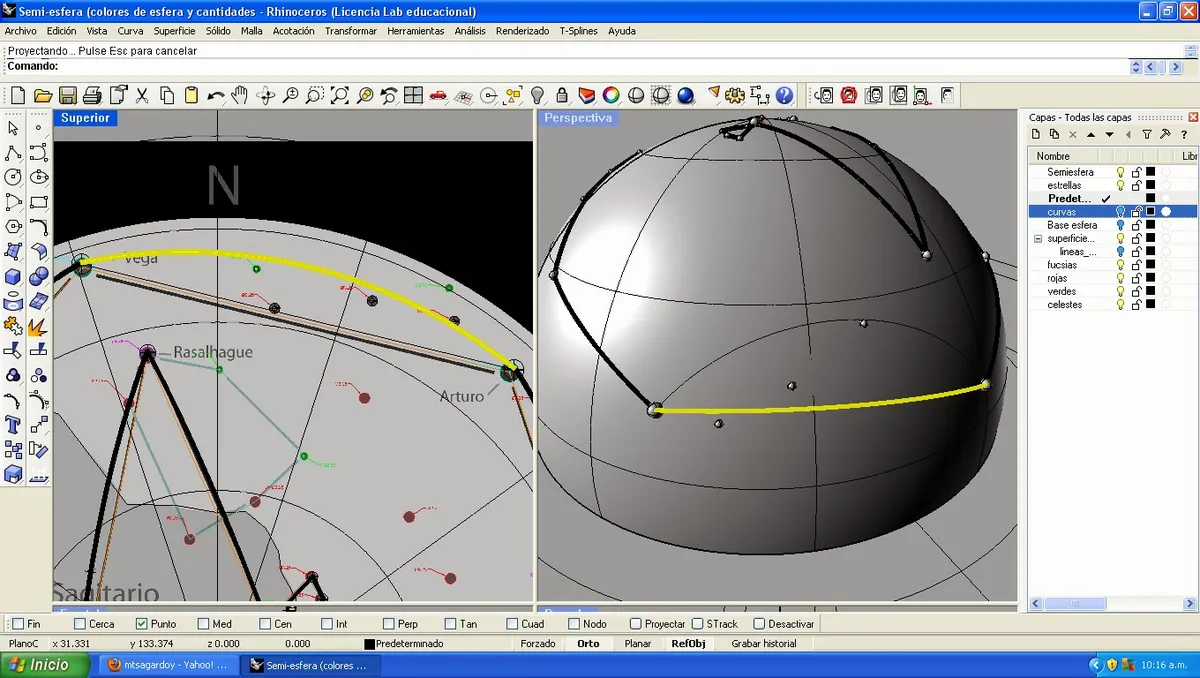
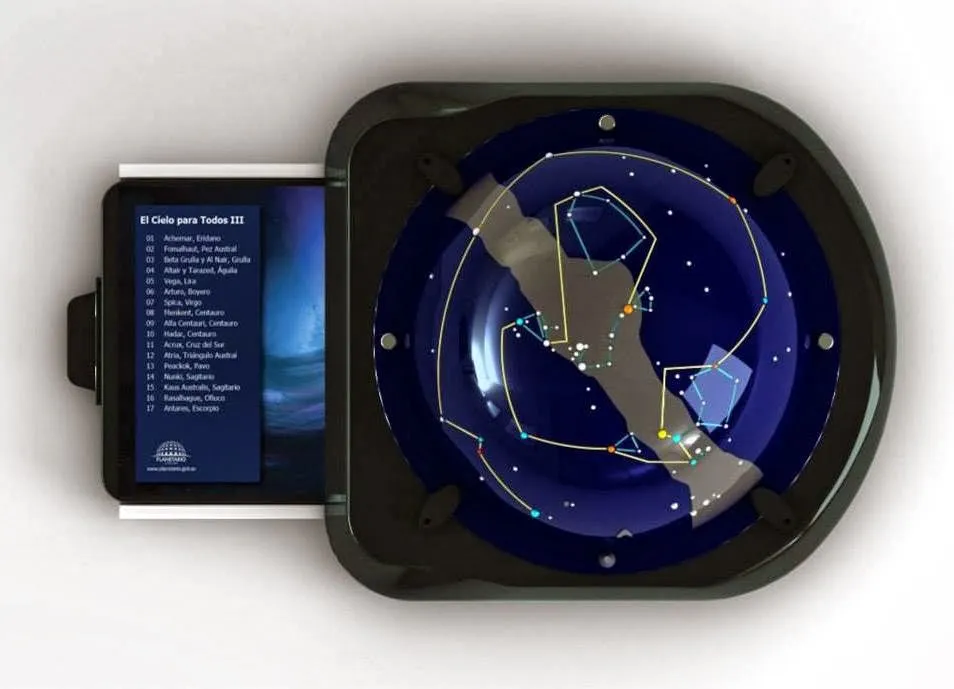
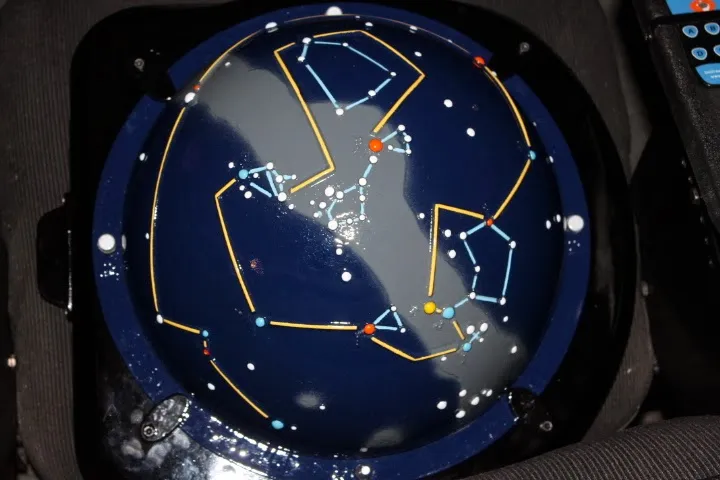
The hemispheres -which total 40 to date- were designed with special software (Rhinoceros, see Fig. 3) with the idea of placing only some stars (winter sky in Buenos Aires) on the surface and that each one would have a different size according to its apparent brightness.
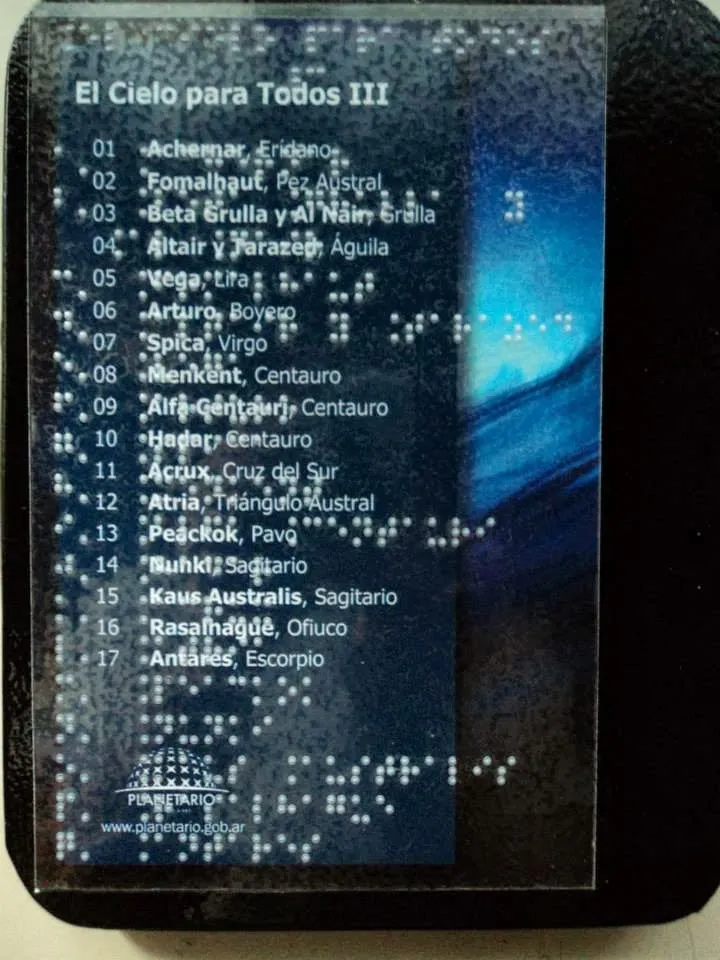
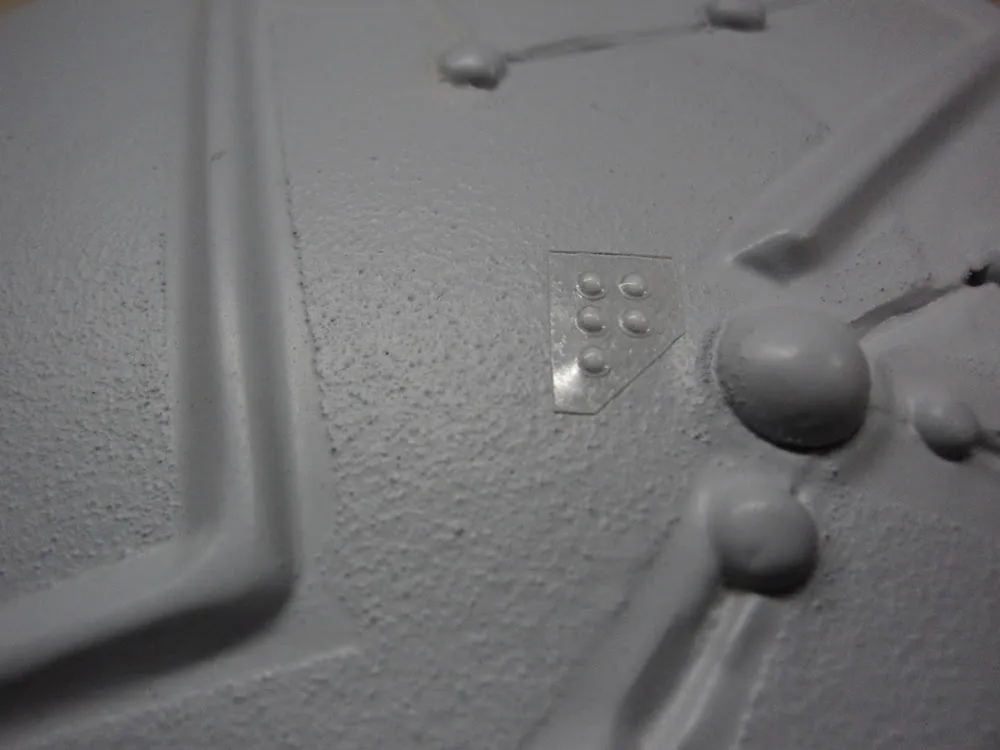
Furthermore, each star is connected to the others by a path or guide thread. The idea is that the audience follows that path according to the audio narration. At the same time, each star has, to one side, a number written in braille (Fig.7) that serves to identify each celestial body thanks to the fact that the hemisphere is then mounted on a base that features a sliding tray with a runner system (Figs.1-2). When sliding the tray, a list appears with the name of each star in braille with its corresponding identification number.
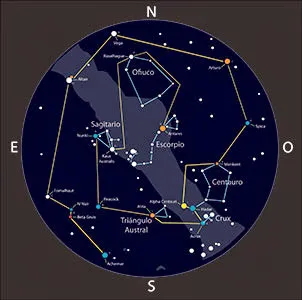
Some constellations are also marked on the spheres. Every star in the sky belongs to some constellation, but only some form their "silhouette." The marked constellations are Ophiuchus, Sagittarius, Centaurus, Triangulum Australe, Southern Cross, Scorpius.
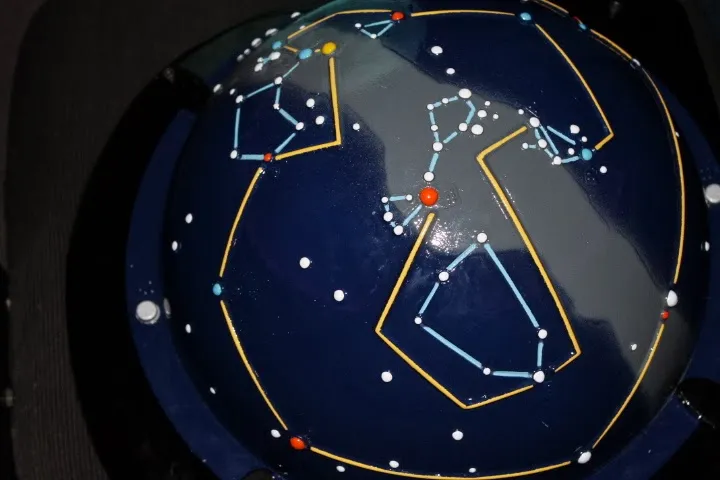
The guide-thread is a tactile path in over-relief, while the lines connecting the stars in the constellations are in under-relief (Fig. 4).
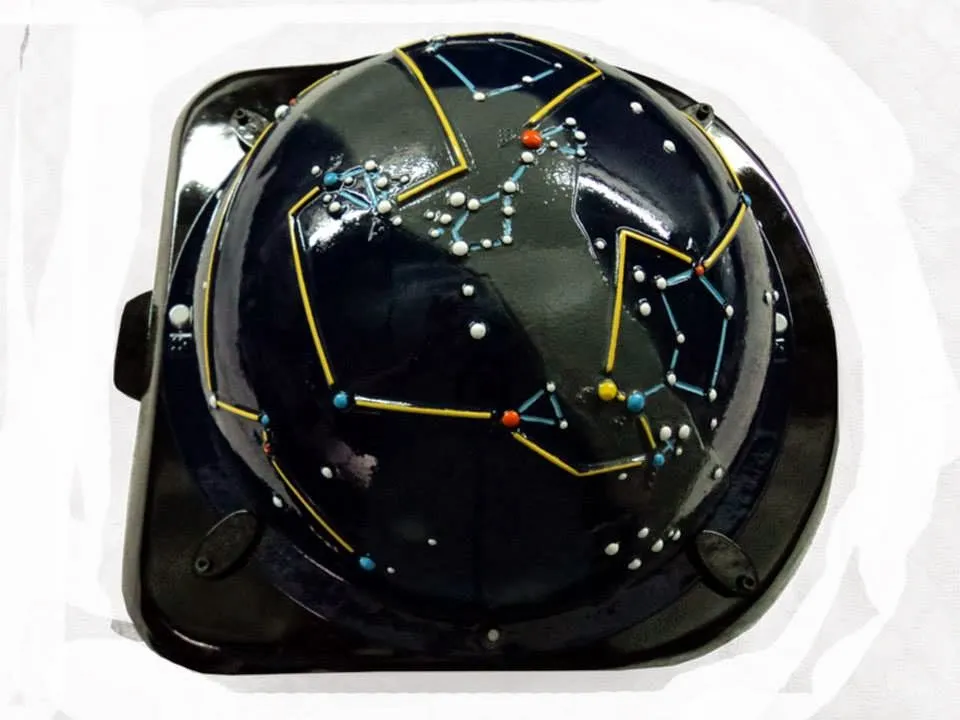
Fig. 4.
Since the project is aimed both at those with total visual impairment and those with reduced visual capacity (amblyopes) who can perceive colors, colors were chosen according to the indications of the consulted organizations to be appropriate for that audience.
The guide wire is painted yellow and the connections between the stars of the constellations in light blue.
Each star, besides being differentiated from others by its size (in relation to brightness) was also painted according to its color. For example, the path begins at Achernar (in Eridanus) and it is white-bluish (light blue, +0.45) and then goes to Fomalhaut (white, +1.16) in Piscis Austrinus. Along the way, it passes by Beta Gruis and Al Nair.
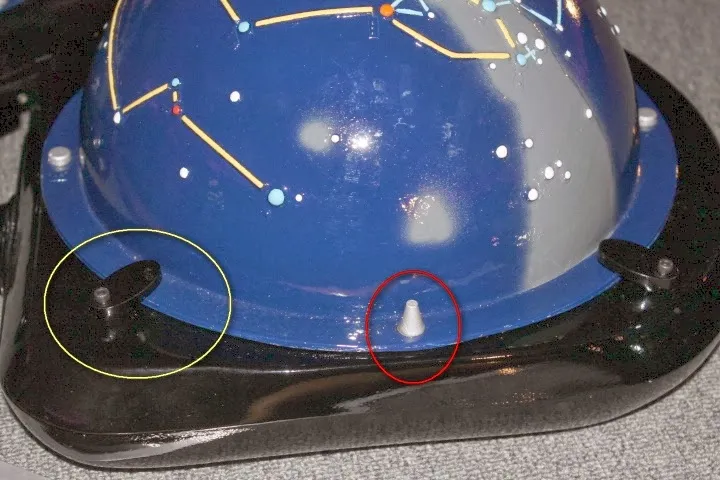
The start of the guide path is indicated by a small cone on the base that serves to indicate the South cardinal point (Fig. 6). The other three cardinal points are also shown, each with a letter written in braille. The West and East points are inverted relative to the display on the planetarium dome (see separate section).
According to some participants, after the presentation, on some spheres it is possible that this braille indication is incorrectly placed, that is, in the common order (east to the right). The narration will also have to be reviewed, since if it says "now we go towards the East" it should match the hemisphere, i.e., in relation to the left.
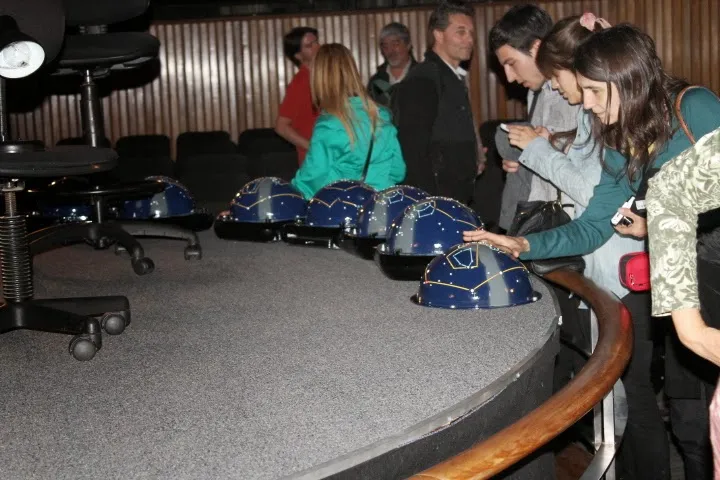
Torres took great care in the design to make it aesthetic, but also functional. The hemispheres can be easily removed from the base, which allows them to be stacked so their storage does not take up too much space (Fig.5-Fig.6). It would also allow, in the future, to change the spheres that currently show the winter sky in the southern hemisphere. That is, it is a scalable or expandable system for the future.
New senses, new relationships
Germaná and his team thought about designing this new version so that not only touch by difference in size accounts for difference in apparent brightness, but that this could also be understood thanks to the sound metaphor. For this, they had the work of Ulises Labaronnie who worked according to the scheme: low frequency-long wavelength. As he told me, "open frequency filters mean high brightness, when I remove high frequencies and let only the low ones pass it means low brightness. Low notes, low temperature; high notes, high temperature." When I asked if it is possible to do this precisely in relation to the real brightness-temperature data, he said no, that it is "adapted" for these purposes: "I put all the stars on the E major scale, so that there would be a harmonic relationship between them. If I had followed a real scale, certain sounds would have been extremely high-pitched and the illustrative sense would probably have been lost. It is still an adapted metaphor, although I followed parameters like brightness and temperature to give it meaning."
Although to know if the objective was met or not, one must ask the audience it is aimed at (which happened after the event, according to tradition). At least to me it seemed that the objective is indeed met.
It should be clarified that since this presentation included people without visual impairment, when naming each star, besides the sounds designed by Ulises playing, a colored star image appeared on the dome, which strengthens the formation of meaning in the brightness-color relationship.
For the blind audience, the relationship is tactile-auditory. While touching the star, the sound is heard. The sound appears twice for each star.
Furthermore, the narration is well musicalized, with a detail that was pleasant. When talking about a multiple system, a sound was shown and heard that refers to two stars orbiting the common center of mass, which, according to a member of the specific audience, was appropriate.
In short: it is a project initiated by the management of Leonardo Moledo and continued under this management, thanks to the Planetarium staff. It remains to be said that the script was written by Lic. Mariano Ribas who included basic astronomy concepts not only about apparent brightness, color, temperature, but also about how stars form and how they "end" their lives, expelling material into the interstellar medium.
The project, as stated, will continue to grow through the contributions of the participants and the interest of the Planetarium staff in improving it.
The Director of the institution, when asked by me, highlighted that the City Government gave her the freedom to work and funds, without which it would not have been possible. At the same time, she acknowledged that the Palermo building is not as accessible as it could be, despite having an access ramp, a wheelchair section, and a section with a magnetic loop, there is much work to be done in terms of accessibility.
Everything is design
Not only the hemispheres have "design." The entire project as a whole, as well as each part, also has it: the sound, the musicalization, the script, the narration, and the images are specially designed parts, as well as the whole. Design is often thought of on several levels: technical, functional, aesthetic, and symbolic. The first two are subject to revision, as some easily correctable error may have slipped in. The third is undeniably achieved. The last is crucial: that the audience the project is aimed at forms the desired meaning is always a communication challenge. However, meanings are infinite. And the project itself is a symbol of the expansion of rights, which deserves an astronomical applause.
An inverted projection
A curve is concave or convex depending on how we look at it. We see the planetarium dome as concave.
What had to be done here is a transposition or adaptation of one curve to another. From the planetarium dome (concave) to the hemispheres (convex). But besides the change of curve, it is a change of size and situation. It goes from a dome several meters across to a hemisphere of 30 cm that instead of being over our heads is on our lap.
Under a dome like the Planetarium's, I can say (if I am correctly positioned) that if I am in the center of the room, I will have North forward, South behind me, and East to my right. Everyone happy.
If I turn around 180º, I will have South forward, North behind, and East to my left.
But with the sphere on my lap and considering that we start from the South, I will also have the East on the left and not on the right. And I will have the North ahead. If I raised the hemisphere over my head, the North would be behind.
For this reason, the cardinal points East and West are inverted on the hemispheres.
Gallery
Sources and related links
- Planetarium for the blind at the Galileo Galilei Planetarium.
- MTS Design, Maximiliano Torres Sagardoy.
- Ulises Labaronnie.
About the images
- Fig. 2: Braille List on Tray. Fig. 3: Screenshot of the Design program. Fig. 4: Render of a hemisphere. The yellow guide thread in relief and the low-relief blue lines of the constellations are noticeable. The stars have different sizes and colors. Figs: 1-4. Credit: Maximiliano Torres.
- Fig. 5: Hemispheres mounted on base and one outside the base at the Planetarium. Fig. 6: Detail of Lock to remove sphere from base and detail of the South-Start indicator. It is also noticeable that the Milky Way is in gray over-relief. Figs. 5-6. Own photos. Fig. 7: Sector of the sky for the tour (Credit: Planetarium).