The encyclopedic astronomical dictionary for sign language, based on French, now for other languages, including Spanish.
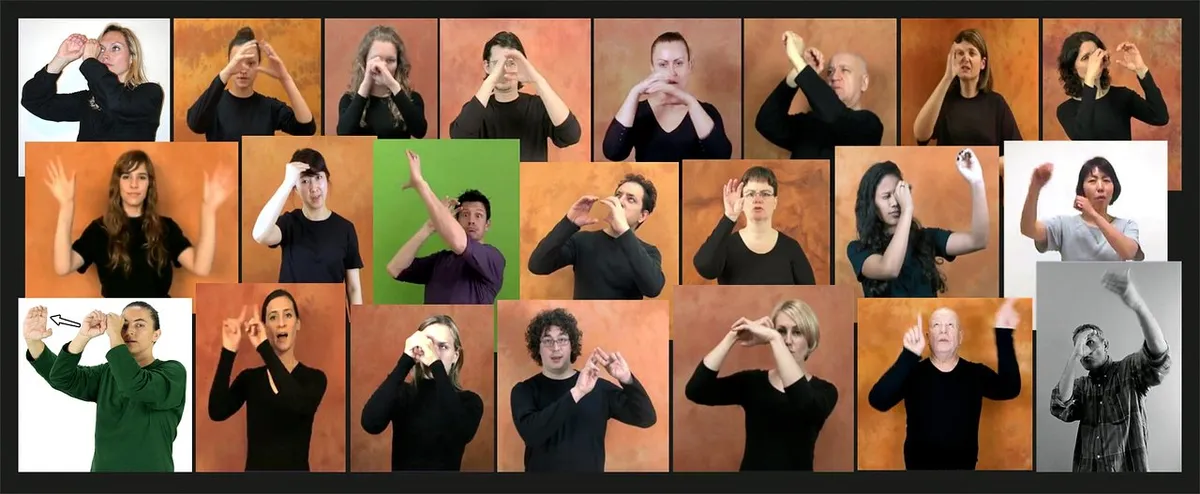
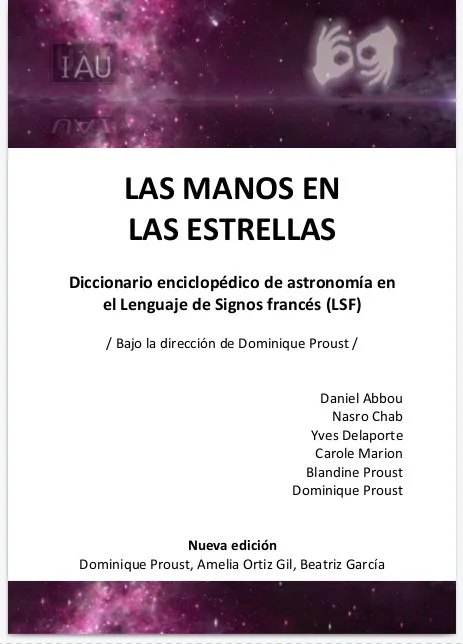
During IYA 2009 (the International Year of Astronomy) a dictionary of astronomy for French sign language titled Hands in the Stars was published, under the direction of Dominique Proust. The dictionary contained about 300 signs describing various celestial bodies such as planets, asteroids, galaxies, as well as technical terms like telescope and photometry. In 2016-2017, a major project of the Commission for Inclusion of the International Astronomical Union (IAU), Division C, Commission C1 WG3, translated that dictionary into English and Spanish.
Based on previous experiences, the commission embarked on a longer-term project to collect signs from different languages, starting with 47 words that experts agreed were the most used in astronomy education and outreach.
Sign language is practiced in almost all countries, but due to cultural differences, different signs developed to designate common objects, as with other languages and tongues. "A universal sign language is gradually developing, mainly to designate objects and situations related to contemporary technology or events. However, there will always be differences between signs in each country that must be taken into account, since in each country their own signs developed over time", explained Dominique Proust.
Some terms in astronomy already had a counterpart in sign languages, but many others did not. It was important to have the collaboration of the deaf community so that together with educators and astronomers they could develop appropriate signs.
In physics and astronomy, the speed of light is used, which is usually written with the letter c, equivalent to almost 300,000 km/s. In sign language, the sign for speed + the sign for light is used, as well as the sign for the letter c to indicate the constant.
Astronomy is one of the subjects in which signing in LSF (French Sign Language) is both rigorous and poetic. The signs attributed to the different planets of the Solar System refer to their particular characteristics. For example, Mercury is very close to the Sun, Mars is red, Jupiter is represented by its famous red spot which has been observed with telescopes for centuries,
Saturn is known for its rings. The representation of the sky is aided by the fact that most constellations evoke animals or objects that already have a sign: bear (big or small), swan, fishes, whale, etc. Mythological names follow legendary traditions; thus, Orion is a hunter and the Centaur is a being with the torso of a man mounted on the body of a horse.
Scientific technology is signed in the same way, for example, computers are identified by their model (PC, laptops, etc.). Medicine and biology have their own technical and complete vocabularies.
This overview can, obviously, provide only an approximate idea of scientific communication in LSF. Facial expression is extremely important, whether to express that a mathematical sequence tends to minus infinity and is therefore "very small," or that the star Vega in the constellation Lyra has a surface temperature of 35,000 degrees and is therefore "very hot." In addition to the rigor of scientific discourse, the signer accompanies (in the musical sense of the term) his words with gestures in which the combination of signs is supported for their interpretation. This duality of interpretation transcends the precision of words so that there is not only understanding but also feeling. In this way, the association of body expression with the frequent academicism of scientific discourse adds its touch of humanity and sharing to a somewhat harsh world.
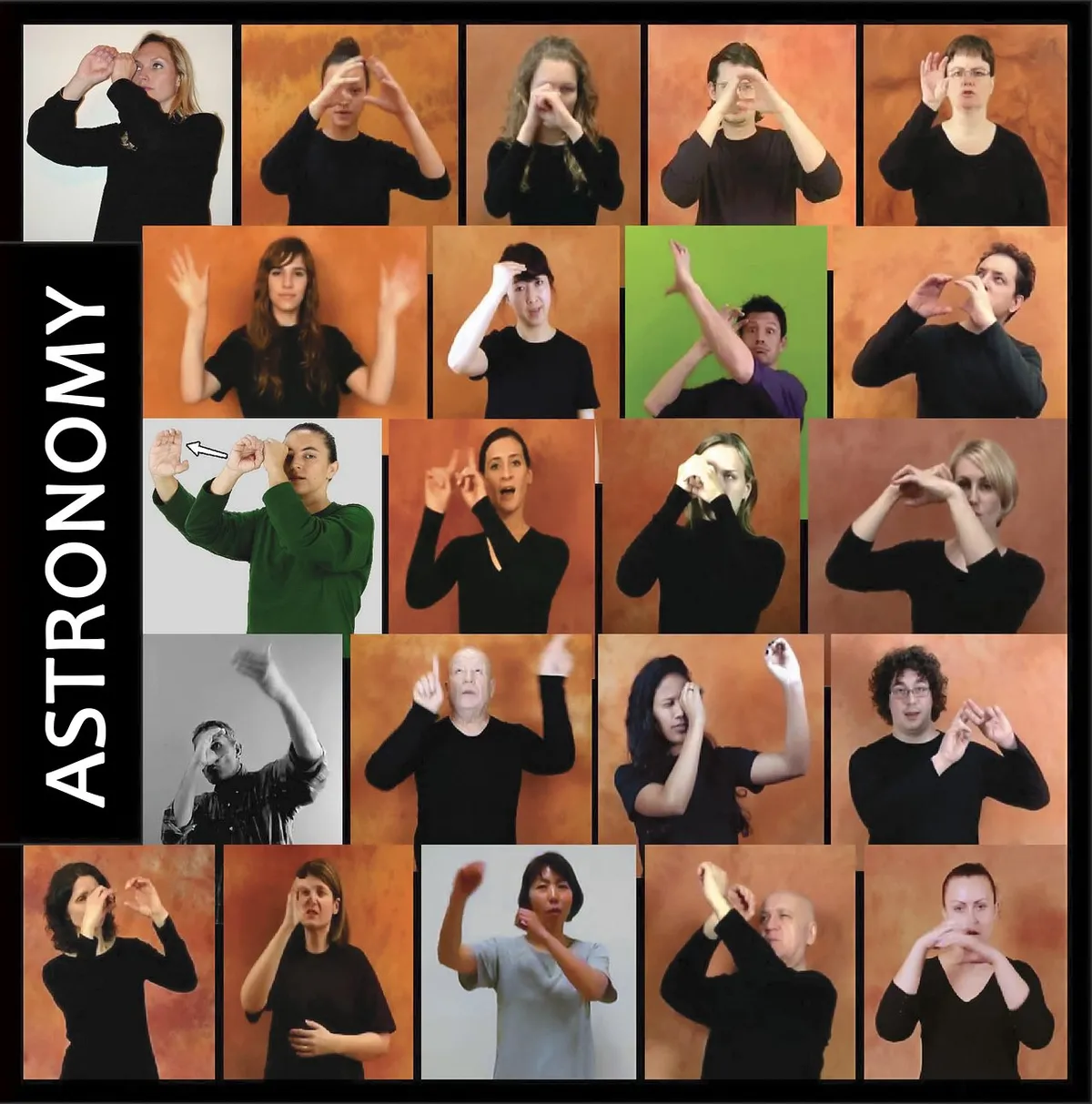
Among the collaborators of this project are Argentinians:
Argentine Sign Language (LSA)
Miguel Angel Medrano, National Federation of Argentine Sign Language Interpreters
Luis Enrique Pinto Yohann, deaf, instructor of LSA, Member of the Asociación de Sordos de Mendoza
Silvina Pérez Alvarez, ITeDA (CNEA, CONICET, UNSAM), Mendoza
Beatriz García, ITeDA (CNEA, CONICET, UNSAM) Mendoza, UTN Regional Mendoza
and Spaniards:
CNSE Foundation For the Elimination of Communication Barriers
Amelia Ortiz-Gil, Astronomical Observatory of the University of Valencia.
I recommend readers download the file to read its introduction about the history of sign languages and their relationship with the powers that be and science.
KOSMOSLOGOS
It is possible to use the Spread the Sign site to search for words and see in short videos the associated sign for each language. If I do that for Universe (Cosmos, Kosmos) and Word (Logos, Word) the result would be this:
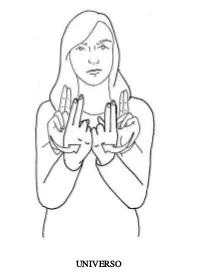
According to the new dictionary, Universe is said in signs with the sign for U in the shape of a sphere, slightly different from what is seen in the video. The graphic is this:
Sources and related links
- Hands in the Stars: The First International Comparative List of Astronomical Words in Sign Languages
https://www.iau.org/news/pressreleases/detail/iau1706/ - Download link for dictionary in Spanish
http://sion.frm.utn.edu.ar/iau-inclusion/wp-content/uploads/2017/11/Diccionario-castellano.pdf - Youtube: Astronomy in sign language
https://www.youtube.com/watch?v=ksFhan9IKKU - Spread the sign
https://www.spreadthesign.com/
About the images
Credit: IAU