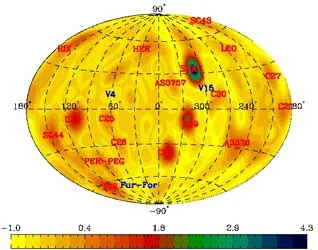
Its detailed maps show our cosmic neighborhood out to a distance of 600 million light-years, identifying the main superclusters of galaxies and empty spaces. They also provide important data regarding the distribution of the mysterious "dark matter" and "dark energy," which are estimated to constitute 96 percent of the apparent mass of the Universe.
Via La Flecha
Source: SOLOCIENCIA.COM
Within this immense volume, the most massive supercluster of galaxies is 400 million light-years away. Its name derives from its discoverer, the American astronomer Harlow Shapley. The Shapley supercluster is so large that it takes light at least 20 million light-years to travel from one end to the other. However, this is not the only massive supercluster in our neighborhood.
The supercluster known as The Great Attractor, which is three times closer than Shapley's, plays a fundamental role in the motion of our galaxy. According to the team, the Milky Way, its sister galaxy Andromeda and other galaxies in the neighborhood are moving towards the Great Attractor at an astonishing speed, around one and a half million kilometers per hour. The researchers also established that the Great Attractor is an isolated supercluster and is not part of Shapley's.
The new maps are based on the observation of an effect produced by the gradual expansion of the universe. This effect is the change undergone by the colors of galaxies when the wavelength of the light they emit is "stretched" or "shifted towards red." By measuring the magnitude of this redshift, astronomers can roughly calculate the distances that separate us from the galaxies.
The new large-scale survey, known as "2MRS", has combined colors and two-dimensional positions gathered by the "2MASS" survey with the redshift of 25,000 galaxies from most of the visible sky. These redshifts were measured specifically for 2MRS or were obtained from an even deeper survey of the southern celestial vault, the "6dFGS" survey.
The great advantage of 2MASS is that it records light in the near-infrared (the portion of the infrared spectrum closest to visible light). This near-infrared band is one of the few types of radiation that can pass through gases and dust, and that can be detected on the Earth's surface. Although the 2MRS survey is shallower than other recent surveys, it covers the entire sky.
"To understand the large-scale motions in our universe, we need to map the distribution of dark matter, rather than that of luminous matter," explains Dr. Pirin Erdogdu (from the University of Nottingham and lead author of the study). "Fortunately, on a large scale, dark matter is distributed almost the same way as luminous matter, so we can use one to help unravel the other."
See also :http://www.ucl.ac.uk/news/news-articles/0610/06102305