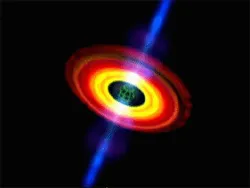
Research by British astronomers, published on 12/7/06 in Nature, reveals that the processes in black holes of all sizes are the same.
Via Eurekalert.com
Professor Ian McHardy, from the University of Southampton, led the research team whose results were published on the 7th of this month (together with his colleagues Drs Elmar Koerding and Christian Knigge and Professor Rob Fender, and Dr Phil Uttley, from the University of Amsterdam). Their observations were made using data from NASA’s Rossi X-ray Timing Explorer and the X-ray observatory, XMM Newton.
McHardy commented that by studying the way the X-ray emission from black hole systems varies, they found that the accretion or "gobbling" process -when black holes are pulling matter towards themselves from their surroundings- is the same in black holes of all sizes and that AGN (Active Galactic Nuclei) are like black holes on a galactic scale. They also found that the variation in X-ray emissions is correlated with the width of the emission lines of the black hole systems.
These observations are important for our understanding of the different types of AGN, by classifying them according to the width of their emission lines.
The research shows that the characteristic timescale changes linearly with the mass of the black hole, but inversely with the accretion rate. The team argues that if both variables (timescale and accretion rate) were measured, one could -with this simple relationship- determine the masses of these stellar creatures where other methods are very difficult, for example in obscured AGN.
According to McHardy, the accretion of matter onto a black hole produces strong X-ray emissions from very close to the black hole itself. Therefore, studying the way these rays vary their emission (the X-ray light curve) provides a good way to understand their behavior.