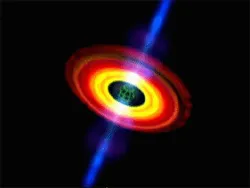
The finding supports the idea that only rapidly spinning stars can collapse to create powerful explosions called long gamma-ray bursts
Via El Universal and Space.com
A black hole has been seen spinning faster than any other known, according to a new analysis released by the journal New Scientist.
The finding supports the idea that only rapidly spinning stars can collapse to create powerful explosions called long gamma-ray bursts.
To measure the spin of black holes, astronomers measure the size of the disks of matter orbiting around them.
A spinning black hole drags spacetime around it, increasing the speed of matter orbiting around it, which allows matter to move in a closer orbit without being sucked into the black hole, so the faster a black hole spins, the more stable the orbit matter can move in.
But the closest edge of this disk is too small to be seen directly.
In previous measurements of black hole spin, scientists have had to make assumptions about characteristics such as the tilt of the disk relative to the line of sight to Earth.
Now, astronomers have managed to measure the spin of a black hole with a new method that requires few assumptions.
Jeffrey McClintock, from the Harvard-Smithsonian Center for Astrophysics in Cambridge, Massachusetts, led the research.
Hot gas
McClintock's team examined a black hole in our galaxy called GRS 1915+105, located 36 thousand light-years away. Matter is hotter the closer it is to the black hole, so the team used X-ray observations from NASA's Rossi X-ray Timing Explorer (RXTE) orbital observatory to measure the temperature of the gas in the disk.
They found that the most stable orbit around GRS 1915 is so close that the black hole must be spinning at nearly 1000 times per second, the fastest rotation ever recorded.
"The application of this discovery to understanding black holes and their physics is absolutely important," said McClintock.
"It's the most exciting thing I've worked on."
But a second study of GRS 1915 suggests the rotation could be lower, according to an analysis of the same RXTE data by Matthew Middleton of Durham University in the UK and his colleagues.
Stellar collapse Chris Done, a member of Middleton's team, says their analysis suggests the spin is "substantial but not extreme."
They argue that X-rays scatter electrons from the disk making temperatures appear higher than they really are. This gives the illusion of a closer disk and therefore a faster spin for the black hole.
But if McClintock's team is right, the black hole is spinning 98 percent faster than the maximum theoretical rate, which is calculated from how fast stars can spin before they collapse to form black holes.
The observation provides support for the idea that gamma-ray bursts, fleeting but powerful explosions, are produced by rapidly spinning stars.
In this scenario, a black hole forms at the center of each rapidly spinning star and some of the remaining stellar matter forms a disk that spirals into the black hole.
Fast spin
The interaction of the black hole and the disk produces jets that emit copious amounts of gamma rays.
But the star has to be spinning very rapidly when it collapses for this disk to form, and some astronomers have expressed doubts that stars could be spinning so rapidly at this stage of their lives.
The present research could clear up some of those doubts.
More info at NASA