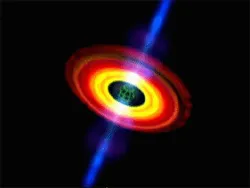
It was discovered by a NASA space telescope; it is located 4,000 million light-years from Earth
Via La Nación, Reuters, Space.com
WASHINGTON (EFE).- A space telescope from the National Aeronautics and Space Administration (NASA) discovered a black hole in the process of swallowing a star in a galaxy 4,000 million light-years from Earth.
The episode of cosmic cannibalism was observed over the last two years in the constellation of Boötes by NASA's orbital telescope "Galaxy Evolution Explorer", according to a report published in the journal Astrophysical Journal Letters.
That telescope is sensitive to two different wavelength bands and with that it managed to detect the flash coming from the center of the galaxy.
Black holes are massive bodies with a gravitational force so powerful that not even light can escape them.
It is believed that most black holes lurk at the center of all galaxies and in the Milky Way, which hosts the solar system.
Scientists believe that black hole is like a dormant volcano.
According to astronomers, the star came too close to the black hole and was mutilated by its gravitational force.
Some parts of the star were swallowed by the hole, which caused an ultraviolet flash captured by the satellite.
The telescope was built by NASA's Jet Propulsion Laboratory, which leads the mission.
Scientists at the California Institute of Technology are analyzing the data collected by the observatory.
See also:
Press release on Galaxy Evolution Explorer
Video about black holes on Space.com