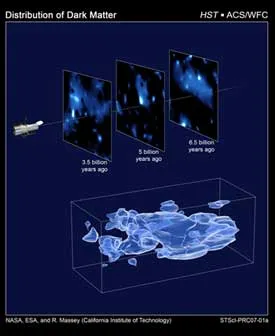
Dark matter is invisible to all our instruments, but that doesn't mean it doesn't exist. A new technique is being developed at the Max Planck Institute for Astrophysics that could reveal dark matter.
Via UniverseToday
A sufficiently large radio telescope would be capable of mapping the radiation from pregalactic hydrogen - formed just after the Big Bang and visible in all directions. Any intervention by dark matter will distort this radiation, revealing its presence and quantity.
Since Einstein (and the famous 1919 eclipse experiment) we know that light is deflected by the gravity of bodies. The strength of the distortion can be used to measure the strength of the gravity of background objects and calculate their mass. If distortion measurements were obtained from a large number of distant galaxies they could be combined to make a mass map of the background.
This technique has already produced precise measurements of the typical mass associated with galaxy backgrounds, as well as mass maps of galaxy clusters. However it has some limitations. Even a large telescope in space can see only a limited number of galaxy backgrounds, a maximum of 10,000 in each part of the sky the size of the full Moon. Measurements from about 200 galaxies must be averaged together to obtain the distortion signal, so the smallest area from which mass can be obtained is about 0.2% the size of the full Moon. The resulting images are unacceptably blurry and too grainy for many purposes.
400,000 years after the Big Bang, the Universe cooled enough for ordinary matter to become a diffuse gas of hydrogen and helium. A few hundred million years later galaxies and the first stars formed. Their ultraviolet light heated the gas again. During this reheating and for an extensive period of time, the diffuse hydrogen was hotter or colder than the radiation left by the Big Bang. As a result it must have absorbed or emitted 21cm radio waves. The expansion of the Universe caused the radiation to become visible today at wavelengths of 2 to 20 meters, and a number of low-frequency radio telescopes are currently being built to conduct this search. One of the greatest advances is the Low Frequency Array (LOFAR) in the Netherlands, a project in which the Max Planck Institute is planning to have a significant role, together with several German institutions.
Pregalactic hydrogen has structures of all sizes that are the precursors of galaxies and there are up to 1000 of these structures at different distances along each line of sight. A radio telescope can separate them because structures at different distances give signals at different observed wavelengths. The gravitational distortion of these structures could allow radio telescopes to produce high-resolution images of the cosmic mass distribution. An object similar in mass to our Milky Way could be detected even when the Universe was only 5% of its current age. Such high-resolution images require an extremely large telescope. However, with this technique it is not necessary to wait for the construction of such a giant. Mass maps of a large fraction of the sky made with an instrument like the SKA could measure the properties of dark energy with greater precision than the methods suggested so far.