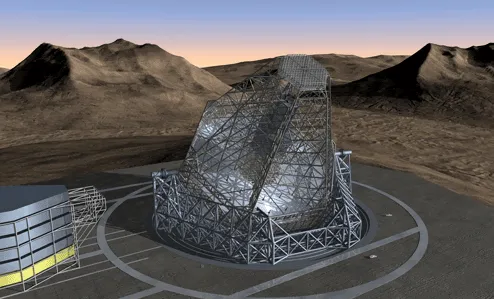
The European Southern Observatory (ESO) has agreed to proceed with detailed studies for a new Extremely Large Telescope.
Via ESO
The ESO Council gives the green light to the detailed study of the European Extremely Large Telescope (E-ELT).
Astronomy has just received a considerable boost with the decision of the ESO steering committee to proceed with the detailed study of the European Extremely Large Telescope. With a budget of 75 million euros, this study will make possible, within three years, the start of construction of an optical/infrared telescope of about 40 meters in diameter that will revolutionize ground-based astronomy. The chosen design is based on a revolutionary concept specially developed for a telescope of this size.
"Today is a great day because the Council has just authorized us to continue with the design of ESO's next flagship telescope," says Catherine Cesarsky, Director General of ESO.
Since the end of last year, ESO has been working together with its user community, composed of astronomers and astrophysicists, to define the new giant telescope that will be needed for the next decade [1]. More than a hundred astronomers from all European countries have been involved in this project during 2006, helping the ESO Project Offices to produce a new design, which was meticulously evaluated for performance, cost, schedule and risks.
This accelerated step has been possible thanks to preliminary studies carried out in Europe (for example for OWL and Euro-50), as well as research and development promoted in collaboration with a large number of European high-tech institutes and industries.
Provisionaly named with the acronym E-ELT, for the English initials of European Extremely Large Telescope, ESO's innovative project was presented two weeks ago to more than 250 astronomers at a conference in Marseille. The enthusiastic reception paved the way for the ESO Council's decision to move to the next phase: the detailed design of all facilities.
Cesarsky explains that upon completing the three years of the Final Design Study, it will be known exactly how each element will be built, with the corresponding cost detail: "We then expect to start construction and finish it by 2017, when we will be able to install instruments and begin operations."
The current concept, whose cost is estimated at about 800 million euros, consists of a telescope with a primary mirror 42 meters in diameter and is absolutely revolutionary. "A telescope of this size cannot be built without a radical rethinking of the way telescopes are made," says Catherine Cesarsky.
The 42-meter diameter primary mirror will be composed of 906 hexagonal segments, each 1.45 meters, while the secondary mirror will have a diameter of 6 meters.
To compensate for the distortion introduced by atmospheric turbulence in the images of celestial objects, the telescope will need to incorporate adaptive optics elements [2].
The tertiary mirror, 4.2 meters in diameter, directs the light to the adaptive optics system, composed of two mirrors: one of 2.5 meters supported by a minimum of 5000 actuators capable of deforming it thousands of times per second and another of 2.7 meters in diameter that will allow the final image corrections.
These five mirrors will provide exceptional image quality, with no significant aberrations in the field of view.
The E-ELT site is expected to be designated by 2008.
Extremely large telescopes are globally considered one of the highest priorities in ground-based astronomy. They will allow considerable advances in astrophysical knowledge, enabling detailed studies of topics such as extrasolar planets, the first objects that formed in the universe, supermassive black holes and the nature and distribution of the dark matter and energy that dominate the universe.
With a diameter of 42 meters and its adaptive optics system, the E-ELT will be more than a hundred times more sensitive than the largest current optical telescopes.
"This is truly the beginning of a new era in optical and infrared astronomy," concludes Catherine Cesarsky.
High-resolution image: See here
More information
The ESO Council represents 11 European countries (Belgium, Denmark, France, Finland, Germany, Italy, the Netherlands, Portugal, Sweden, Switzerland and the United Kingdom, while the incorporation of Spain is expected by the end of this year).
Notes
[1] The current generation of 4 to 10 meter telescopes has already meant an incredible advance in the knowledge of the universe, with the discovery of hundreds of extrasolar planets and the study of very distant galaxies and the even more astonishing evidence that the universe would be mostly composed of dark matter and energy, whose nature is still unknown. All these discoveries have raised many questions that the new generation of Extremely Large Telescopes will be able to answer.
[2] Post-Focal Adaptive Optics, built into the instruments and not included in the telescope design itself, is a well-established technology that currently has 7 systems and a laser guide star in operation at Paranal. Incorporating adaptive optics into the telescope design is the next natural step in telescope design and construction.