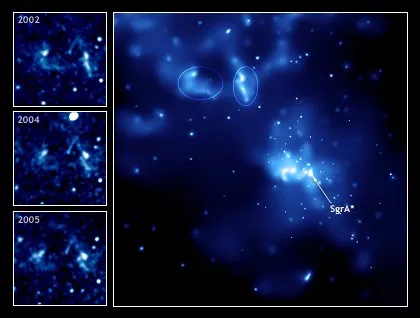
ESA's gamma-ray observatory, Integral, has observed the center of our galaxy during a moment of rare calm.
Via ESA
Interestingly, during this Integral observation some of the most energetic sources around the black hole that occupies the center of our galaxy were temporarily 'silent'.
This is an unusual event that is allowing astronomers to go in search of even fainter objects. It may even allow them to glimpse matter as it disappears into the massive black hole at the center of our galaxy.
The galactic center is one of the most dynamic regions of our galaxy. It is believed to be 'inhabited' by a giant black hole, called Sagittarius A*. Since the beginning of the Integral mission, this ESA gamma-ray observatory has enabled astronomers to keep an eye on the galactic center and its constant changes.
Integral has discovered many new sources of high-energy radiation in the vicinity of the galactic center. Since February 2005 Integral began to constantly monitor the center of the galaxy and its immediate surroundings, the so-called galactic 'bulge'.
Erik Kuulkers, from the Integral Science Operations Centre at the European Space Astronomy Centre (ESAC) of ESA, in Madrid, leads the galactic centre monitoring program. Now Integral has turned its state-of-the-art 'eyes' on about 80 high-energy sources in the galactic bulge. 'Most of these sources are X-ray binary stars [which emit intensely in X-rays],' says Kuulkers.
X-ray binary systems are made up of two stars orbiting each other. One of the two is relatively normal; the other is a collapsed star, like a white dwarf, a neutron star or even a black hole. If the stars are close enough to each other, the gravitational pull of the collapsed star can extract gaseous material from the normal star. As this gas approaches the collapsed star, orbiting it, it also heats up to over a million degrees Celsius, and that causes it to emit in X-rays and gamma rays. The amount of gas falling from one star to the other determines the brightness of the X-ray and gamma-ray emission.
According to Integral's observations in April 2006, the high-energy emission from about a dozen of the sources closest to the galactic center temporarily weakened. Kuulkers rules out the possibility that a mysterious external force is acting on these objects, making them remain quiet. 'All the sources are variable and it was just pure luck, or chance, that they 'turned off' during that observation,' he says with a smile.
This fortunate weakening allows astronomers to set new limits on how much these X-ray binary systems can weaken. It also allows new research to be carried out with the data.
'When these usually bright sources weaken, we can search for even fainter sources,' says Kuulkers. These other sources could be other X-ray binaries, or also high-energy radiation from the interaction of giant molecular clouds with supernovae. There is also the possibility of detecting the faint high-energy radiation from the supermassive black hole at the center of our galaxy.
The galactic center observation program with Integral will continue throughout this year. The data are made available to the international scientific community just one or two days after being obtained. Astronomers access them through a specific page on the Internet, managed by the Integral Science Data Centre (IDSC) in Geneva, Switzerland. Thus, anyone interested in specific sources can keep track of interesting changes and make follow-up observations with other telescopes.
Note to editors
The article explaining this finding has been accepted for publication in Astronomy & Astrophysics, under the title: "The INTEGRAL Galactic bulge monitoring program: the first 1.5 years", by E.Kuulkers et al.
For more information:
Erik Kuulkers, ESA Integral Science Operations Centre
Email: erik.kuulkers @ sciops.esa.int
Christoph Winkler, Integral Project Scientist, ESA
Email: christoph.winkler @ esa.int