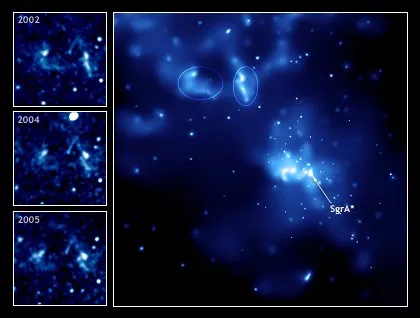
This set of images from the Chandra X-ray Observatory shows evidence of a light echo generated by the Milky Way's supermassive black hole, known as Sagittarius A.
Via Chandra
Astronomers believe a mass equivalent to the planet Mercury was devoured by the black hole about 50 years ago, causing an X-ray flare that reflected off gas clouds near Sagittarius A.
The image shows a Chandra view of the Milky Way's center, with the black hole marked. The small images show close-ups of the regions marked with ellipses. Clear changes in the shapes and brightness of the gas clouds are seen between the three different observations in 2002, 2004, and 2005. This behavior agrees with theoretical predictions of light echoes produced by Sagittarius A.
The first X-rays from the flare would have reached Earth 50 years ago, before X-ray observatories were in place to observe them; the reflected X-rays took a longer path and arrived in time to be recorded by Chandra.
The gas clouds in the image are glowing through a process called fluorescence. The iron in these clouds has been bombarded by X-rays from a source that flared in the past or by very energetic electrons. The electrons or photons collided with the iron atoms, knocking out electrons close to the nucleus, causing more distant electrons to fill that space, emitting X-rays in the process.
However, the detection of variability in this fluorescence from the gas clouds rules out the possibility that they were bombarded by energetic electrons. Other explanations for the X-ray emission are also ruled out, including the possibility that the gas clouds are remnants of exploded stars or that the light echo did not come from Sagittarius A but from a neutron star or a black hole stripping matter from a binary companion.