Quasars are ultraluminous objects, concentrations of swirling gas that feed supermassive black holes located in galactic centers. Although smaller than our solar system, a single quasar can shine as brightly as an entire galaxy.
Via Universe Today, Space.com and SDSS
Compared to normal galaxies, quasars are extremely rare. The new map was created using the Sloan Digital Sky Survey (SDSS-II) and includes more than 4,000 quasars, as far away as 11 billion light-years.
The new map reveals a close relationship between quasars and dark matter, just as theory predicts. The details will be published in The Astronomical Journal.
Dark matter is a mysterious hypothetical substance that does not interact with photons, making it invisible to detection instruments. Scientists estimate that only one-sixth of the matter in the universe is visible, while the rest would be dark matter.
Even though it cannot be seen, it can be detected by its gravitational influence. Theories predict that matter - both dark and visible - was regularly distributed in the early universe, and over time it became concentrated.
Quasars would have formed in these zones of dark matter concentration.
The researchers developed models of how quasars depend on the dark matter surrounding them, and this new study matches those models. These dark matter clumps would have provided the gravity that helped these supermassive black holes acquire their material.
The results are described in the paper "Clustering of High Redshift (Z > 2.9) Quasars from the Sloan Digital Sky Survey," accepted for publication in The Astronomical Journal, and posted to the astro-ph archive.
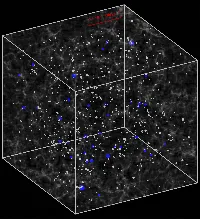
Image:
The illustration -360 million light-years- shows the distribution of dark matter, massive halos, and luminous quasars in a simulation of the early universe 1.6 billion years after the Big Bang. The filamentary structures in gray show the distribution of invisible dark matter. The small white circles mark concentrations of dark matter halos more massive than 3 trillion times the mass of the Sun. The blue marks are more massive halos, about 7 trillion suns, that host the most luminous quasars. In the SDSS sample, it is demonstrated that quasars reside in these rare and very massive halos.
(Credit: Paul Bode and Yue Shen, Princeton University)