An international team of astronomers from the Sloan Digital Sky Survey detected seven -and possibly eight- new satellite galaxies of the Milky Way.
Via SDSS and Science.
"Cold dark matter models predict that there should be many more small galaxies in the Local Group than have been observed," explained Dan Zucker, a team member from Cambridge University. "In less than a year, we have used SDSS-II to find seven new dwarf satellite galaxies of the Milky Way. We have discovered an eighth, but we are not sure if this one is a satellite of our galaxy."
"We have found almost as many satellite galaxies of the Milky Way as had been detected in the last 70 years," commented Vasily Belokurov, also from Cambridge.
The discovery of "A new population of ultra-faint Local Group galaxies" was announced on January 9 at the meeting of the American Astronomical Society in Seattle.
Dwarf galaxies contain, at most, a few million stars and usually orbit around larger galaxies, like the Milky Way. In its simplest form, the most accepted theory of galactic formation predicts that our galaxy should have hundreds of galaxies of this type, but only a few were well known before SDSS-II.
The new dwarfs have some unusual properties. "They are more like hobbits than dwarfs," commented Belokurov, since they are smaller and fainter than the previously known satellite galaxies. Many of the recently discovered ones seem to be on the verge of breaking apart -probably due to the gravitational pull of the Milky Way- and the dwarf "Ursa Major II" appears to be split into several parts.
Current theories of galactic formation suggest that many, perhaps all, of the stars in the Milky Way's halo originated in dwarf galaxies that were dissolved when they merged with the Milky Way itself.
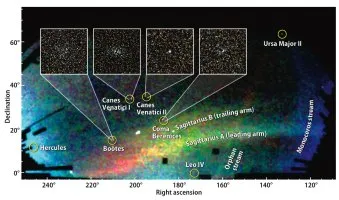
The seven new satellite galaxies lie in the area of the sky around the Galactic North Pole studied by SDSS-II. There are two new dwarfs in the constellation of Canes Venatici, one in Bootes, one in Leo, one in Coma Berenices, one in Ursa Major and one in Hercules.
The eighth and recently discovered one would be the most intriguing. Called Leo T, it is 1.4 million light-years away, at the limits of the Milky Way's gravitational influence.
"It could be a 'free-floating' Local Group galaxy, rather than a satellite of our galaxy," said a team member, Sergey Koposov, from the Max Planck Institute for Astronomy in Heidelberg. Besides the great distance, Leo T is distinguished from the other seven by having old stars (over five billion years) and comparatively young populations (less than a billion years). It also appears to have neutral hydrogen gas, so its period of star formation may not have ended.
More information:
SDSS