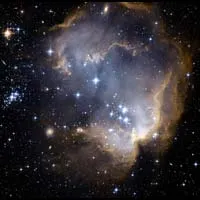
This new image taken with NASA's Hubble Space Telescope depicts bright, blue new stars formed at the center of a region in the Small Magellanic Cloud.
Via HubbleSite
At the heart of the star-forming region lies the star cluster NGC 602. The high-energy radiation emanating from the hot young stars is forming a "hole" in the cloud, eroding the material.
Ridges of dust and filaments of gas are seen toward the northwest (in the top left of the image) and toward the southeast (in the lower right corner). Pillars shaped like elephant trunks toward the hot blue stars are signs of their erosive effect. In this region, Hubble can trace how star formation began at the center of the cluster and propagated outward.
The Small Magellanic Cloud, in the constellation Tucana, is 200,000 light-years from Earth. Its proximity makes it an exceptional laboratory for conducting in-depth studies on the process of star formation and its evolution in an environment somewhat different from our Milky Way.
Small galaxies like this one, with far fewer stars compared to ours, are considered the primitive building blocks of larger galaxies. The study of star formation in these small galaxies is particularly interesting to astronomers because their primitive nature means they lack a large percentage of heavy elements that are forged in successive generations of stars through nuclear fusion.
These observations were made with the Advanced Camera for Surveys in July 2004.
Filters that isolate visible and infrared light were combined with a filter that shows the hydrogen and nitrogen emissions from the glowing clouds.