An international team of physicists has managed to generate quantum entanglement of six photons in the laboratory, thus performing the thought experiment known as Schrödinger's cat. By Yaiza Martínez from Tendencias científicas.
Via La Flecha
This result, which constitutes a record in particle physics, opens the doors to future experimentation with so-called qubits (quantum units of information), which are the basis of the intended quantum computers. Quantum mechanics applied to computational information processing has not yet been able to become a reality due to problems inherent to the very functioning of subatomic particles, but this limitation is now closer to being overcome.
An international team of physicists has managed to generate quantum entanglement of six photons in the laboratory, thus performing the thought experiment known as Schrödinger's cat.
The term quantum entanglement designates the fact that any pair or group of quantum objects can be placed in a superposition of states. Each of these states describes many objects at once, whose properties are linked: if one object is in a certain state, it partly determines the state of another object.
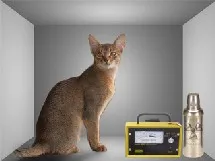
Physicist Erwin Schrödinger tried to explain quantum entanglement and the superposition of states in a way as simple as it is disturbing: in a closed, opaque box, a cat, a bottle of poisonous gas, a radioactive atom with a 50% chance of decaying, and a device that, if the particle decays, would break the bottle, causing the cat's death by poisoning, are placed.
Therefore, the cat's fate depended on a single atom that would behave according to quantum mechanics, so the entire system would be subject to its laws. The so-called "Copenhagen interpretation" indicates that these laws work as follows: as long as we do not open the box, the cat is both dead and alive at the same time, and only the act of opening the box and observing it reduces the probabilities to one of them.
The scientists followed a technique with which they « pumped » photons into a crystal with the help of an ultraviolet light laser. These photons have the property of spontaneously decaying, splitting in turn into two entangled photons.
Taking three pairs of these photons, and using light beams to separate them, various entangled states of six photons can be obtained, which remain polarized in a horizontal or vertical state (similar to the "alive" or "dead" state of Schrödinger's cat).
As Lu and his colleagues explain in an article, the researchers therefore managed to perform various types of entangled states with the six photons, such as the cluster state or the Greenberger-Horne-Zeilinger state.
They also point out that slight modifications to their method would allow the creation of many other graphical states. The importance of this possibility of variation lies in the fact that various six-photon entanglements can be generated, as well as multiqubit graphical states, which would serve as an experimental device for the development of quantum computing.