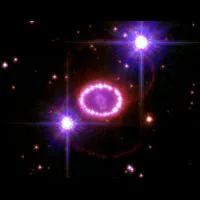
As seems to be concluded from a study by SRON, the Netherlands Institute for Space Research, after observations with ESA's X-ray observatory, XMM-Newton, the universe would contain one and a half times more calcium than previously assumed.
Via ESA
The iron in our blood, the oxygen we breathe, the calcium in our bones, all the atoms we are made of are created in stars during their final explosion. So-called supernovae expel this material into space which will become the building blocks of new stars enriched with these elements. However, many questions remain to be clarified about the formation of elements and the way they are distributed.
According to Jelle de Plaa, a researcher at SRON, many answers can be found in distant galaxy clusters. "These consist of hundreds of galaxies, each containing billions of stars. Due to their quantity and enormous sizes, the clusters contain a large percentage of all matter in the universe. During the past billions of years, supernova explosions have enriched the hot gas with heavy elements, such as oxygen, silicon and iron"
Using XMM-Newton, De Plaa determined the abundance of oxygen, neon, silicon, sulfur, argon, calcium, iron and nickel in 22 galaxy clusters. In total, he has seen the "pollution" produced by about 100 billion supernovae. When he compared the measured amount of elements in the clusters with theoretical supernova models, the measured calcium abundance appears to be one and a half times more than theoretically assumed before.
De Plaa and his colleagues also found that many supernovae in the clusters are the result of the deadly dance between two stars orbiting each other. A very compact white dwarf steals matter from its unfortunate companion. The matter forms a layer on the surface of the dwarf, which, upon reaching a certain limit, its core can no longer support the weight of the matter and explodes as a supernova.
"About half of the supernovae in the clusters appear to have exploded in this way. This is much more than expected for this type of supernova, which in our galaxy is 15%"
The results will be appreciated by scientists who model supernovae. "Until now, experts in this field had to make conjectures about how supernovae explode. Having measured the remnants of 100 billion supernovae, we found more accurate averages than before. This will help understand how white dwarfs die"
The results will be published in Astronomy & Astrophysics, in the article titled: "Constraining supernova models using the hot gas in clusters of galaxies", by J. de Plaa, N. Werner, J. A.M. Bleeker, J. S. Kaastra, M. Mendez, and J.Vink (http://www.aanda.org/index.php?option=forthcoming&Itemid=18, DOI: 10.1051/0004-6361:20066382).
They will also appear online on Astro-ph in the article: "Constraining supernova models using the hot gas in clusters of Galaxies", by J. de Plaa, N. Werner, J.A.M. Bleeker, J. Vink, J.S. Kaastra, M. Mendez (astro-ph/0701553).